

SUMMER NEWSLETTER – 31- JULY 2025
Welcome to your 35th VertueYachts quarterly NEWSLETTER! Bettina, above, racing in the Trieste Barcolana is a fitting image to introduce this summer’s stories.
Believe it or not, this is the 31st. Newsletter since the first one was published in July 2016. We have tried to keep the ethos of a kind of Vertue Owners Association Newsletter/update of all things Vertual and I am extremely grateful to you growing band of owners and others who now contribute regularly to this little bit of fun. Owning a boat can be quite a serious matter for some and it is as well to remind ourselves that it’s meant to be FUN……..isn’t it?
Certainly Enea Riboldi considered it all to be fun whenever he set sail aboard his beloved Bettina, one of the jewels of the northern Adriatic ‘fleet’. I am immensely grateful to Tiho Trnovski for providing some insights into the life of this remarkable man, who will be missed by all who knew him.
Another talented Italian called Matteo Richiardi has appeared in these Newsletters before, usually having fun, with his continuing exploits aboard Mea. His version of ‘Me and my Vertue’ is one of the more lyrical we have seen so far, and I am sure some more of you will now be inspired to send your own tales of fun aboard your Vertue.
It would be difficult to own a Vertue for long without coming across the name of Peter Woolass and his beloved boat Stelda. He not only sailed her single-handed across the Atlantic in 1969, but wrote a best-selling book about the experience and then produced the definitive book about the history of the class. Stelda is now available to the right owner for £1 thanks to the generosity of the family who have carefully looked after her since Peter stopped sailing, many years ago. Contact me, Roger Robinson for more information: speedwelltwo@gmail.com
Writing about Stelda and Peter prompted me to review the seven published works about the fun, trials, and tribulations of the various owners who have written books about their Vertues. I was mightily surprised to be reminded that of all these boats she is the only one still in commission, based in the UK; all the others are finding their own fun in other parts of the globe. What an international family we are!
I hope you all enjoy this light-hearted round-up of the latest News from our Vertual world, and don’t forget to send us some more of your own stories and anecdotes in time for inclusion in the Autumn Newsletter.
__________________________
Enea Riboldi
It is with great sadness that I must report the death of Enea who was a genius in the art of illustration and the proud owner of the early Cheoy Lee built Vertue Bettina.
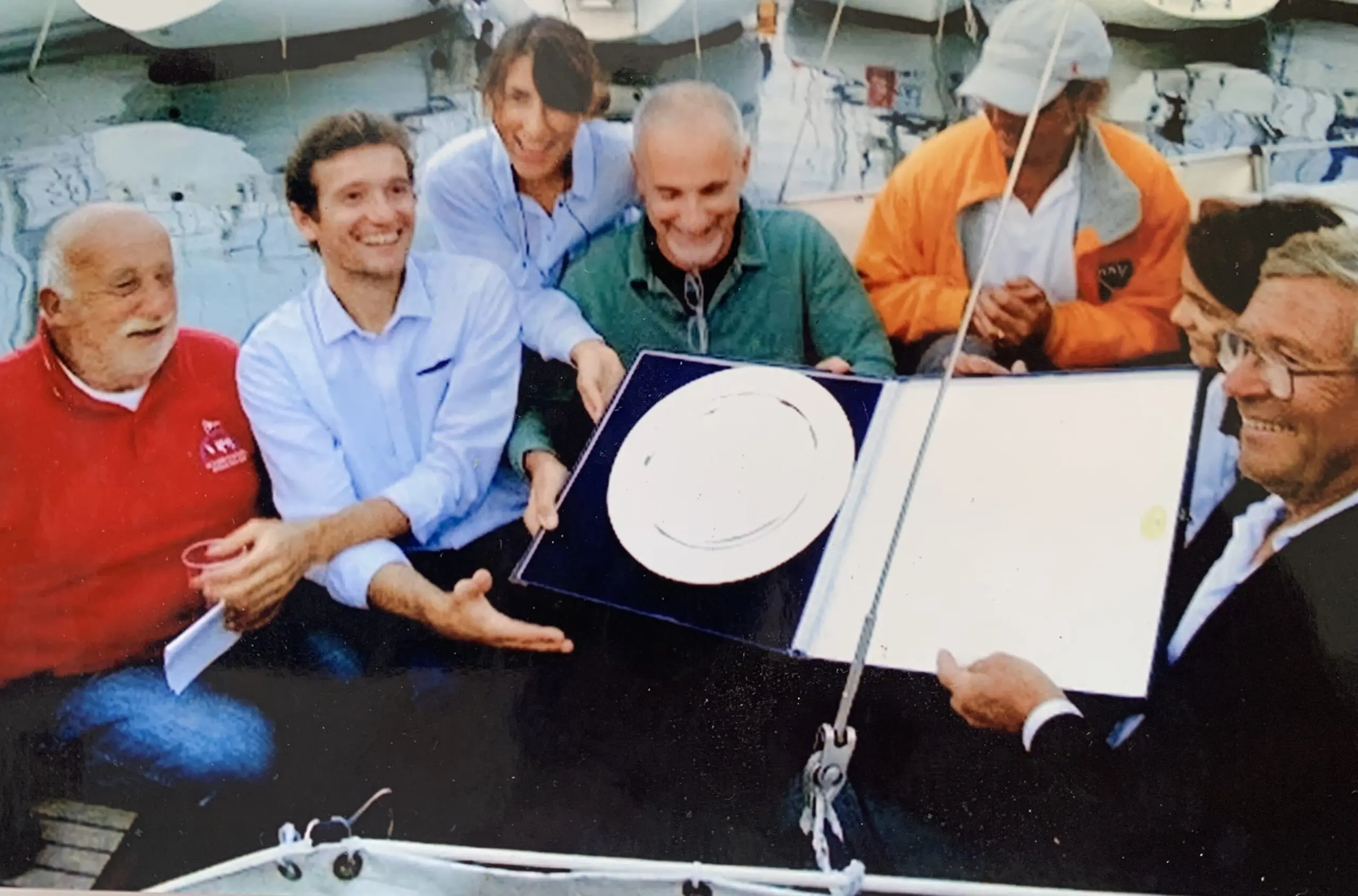
Here is Enea, in green, being presented with the Trieste Challenge plate aboard Bettina.
I am proud to be able to share with everyone this short tribute by his old friend, the Commodore of the Adriatic Vertue Fleet:
Enea Riboldi, 1954 - 2025

Great friend, known artist and sailor par excellence.
This is the way I will remember Enea since our first meeting in Trieste and Barcolana classic regattas in 2007.
Tragically injured in 1998 and confined to wheelchair did not stop him from sailing, cruising and competing.
His Virtue and trust in Vertue made him achieve much more than able body sailors  have done.
That bond of the man and his boat with harmony was presented in his artwork and everyday life.
To sail his V58 Bettina, original as she was, with novice crew of friends requires good instructions specially when racing.
Enea has achieved all that and won quite a number of tough regattas.
He was one of first six original founders of
Adriatic Vertue Fleet and promoter of the Class.
Last time I saw him was on his return from Greek islands cruise in 2023.
In August 2024 on his last cruise he was taken ill from the boat and died this May.

Sea ceremony will be held this September when man and his beloved boat will be reunited bonded by the sea they both loved.

Captain T Trnovski
Jan Gilda
V123
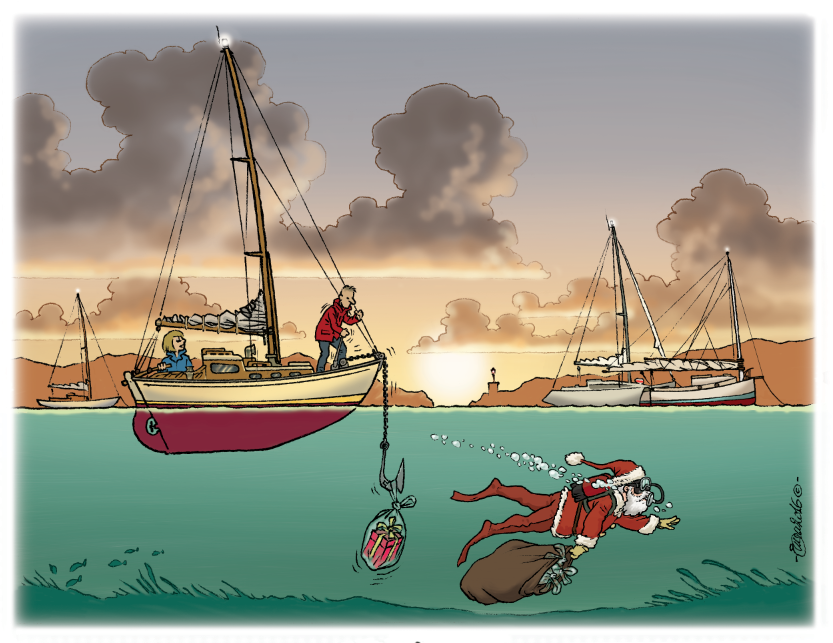
One of my own favourite Christmas Card illustrations by Enea, drawn a few years ago.
Enea was a proud member of that enthusiastic group of owners of Vertues who based themselves around the northern shores of the Adriatic, and celebrated their fellowship with an annual regatta in the temperamental waters around Trieste.

The famous Trieste Barcolana Classics Vertue challenge Silver Plate with the Adriatic Vertue Fleet named in 2008: Vertue xxxv-Bettina-Return-Jan Gilda-Fab-Tanera

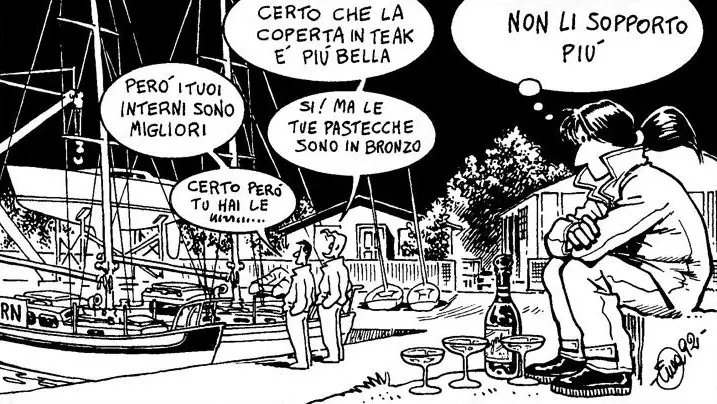
Here are two excerpts from Enea’s huge collection of illustrated stories involving Vertues.
_________________________
MEA & me
By Matteo Richiardi
Roger asked me to write a piece about my Vertue and me, about MEA and me. After Alasdair Flint and Adrian Morgan, this is a great honour, and also a challenging task. I am no arctic adventurer, no shipwright, no navigator. My experience with wooden boats is short, and amateurial. And while I have some stories of solo passages, I didn’t travel far and wide… So, what can I say of interest to others? I wait for inspiration until the day I set off for a second tour of the British Isles. I am lucky: despite the usual wind on the nose, this time I am not forbidden by race rules or incapacitated by mechanical failures to use the engine… which gives me a bit of time to think, and write.
Why a Vertue? I’ll get there, but before I respond I need to address another, more fundamental question: Why sailing? Echoing what one of my favourite musicians, Asaf Avidan, says about being an artist (hereby replaced by ‘sailor ‘),
“You are [a sailor] because you can’t be anything else – it’s so obviously true to me, I am not [a sailor] because I chose to be [a sailor], there’s many things I can do in my life which would pay the bills easier. […] I need to [go sailing] in order to stabilise myself, in order to explain this chaos to myself, and everything else is just a ripple effect.” And now with my words: “I am longing. For what, I don’t know, and possibly I won’t ever know. It might not matter. It’s the longing that makes the sailor…”

A personal exploration of meaning by means of a little old boat
I have just left the Orwell and I am now sailing past the river Deben, the engine quietly helping the sails on a close-hauled port tack. I am back at sea. After the usual frenzy of the days ahead the departure, I am totally at peace. My thoughts wander, the stream of conscience widens…
…It is interesting how I seem to find a sense of purpose – to maintain, equip, and care for my boat, to leave port, to arrive at a distant destination – for something that ultimately does not have a purpose – sailing; like life perhaps, except they say life is motivated by life itself; maybe sailing is also motivated by sailing itself; navigare necesse est, vivere non necesse; a space-time for thinking, a space-time for not thinking; the sea, the sky, the stillness and the flow; beauty; my dad’s wooden dinghy; the feeling I am wasting my time; the feeling I am not wasting my time; beauty; a state of grace; distancing myself from those I love so that I can get closer again…
I am abruptly brought back to reality by the sound of an alarm: the engine is overheating. No water is coming from the exhaust. From philosophising to practical problem solving in one second: “It’s the switching that makes the sailor…”
The impeller looks fine and turns fine, water comes through the sea intake; no other checks come to mind. Day one, a few miles from my home port and already the end of the voyage; I can’t go engineless like Brest last year, the Fastnet two years ago, the RB&I three years ago… Reluctantly, I turn back: with the wind now in my favour, I undo in minutes the gains that I hardly won in half an hour. But… wait a minute… Let me heel the boat on the starboard tack. I switch on the engine again, and the alarm remains silent! What an idiot. With all my recent engine troubles – I’ve got a sculling oar on board for a reason! – I forgot this simple lesson in geometry…
Little boat of mine, so many troubles so much joy. A ray of sunshine comes through the grey and cold…
…Men have sailed for thousands of years; a literary journey; still intellectualising after all; no, David Lewis is no mental masturbation; nor Humphrey Barton, Peter Woolass, Peter Hamilton and all the community of small boat voyagers that choose a Vertue for lack of anything better, and did not regret it; what a wooden boat culture in this country; how I’d love to learn woodworking; storm-proofing MEA; so many things I would not have thought of; she-is-ready-I-am-ready, sort of; butterfly in the stomach; will learn on the way…
End of streaming. In two words: Beauty, and Grace. Seems like destiny that this is what MEA means, in Chinese. Built to the Ocean Vertue design by the Cheoy Lee shipyard in Hong Kong, teak planking on ipol frames (whatever ipol is…). I have engraved the Chinese ideograms on the stern.
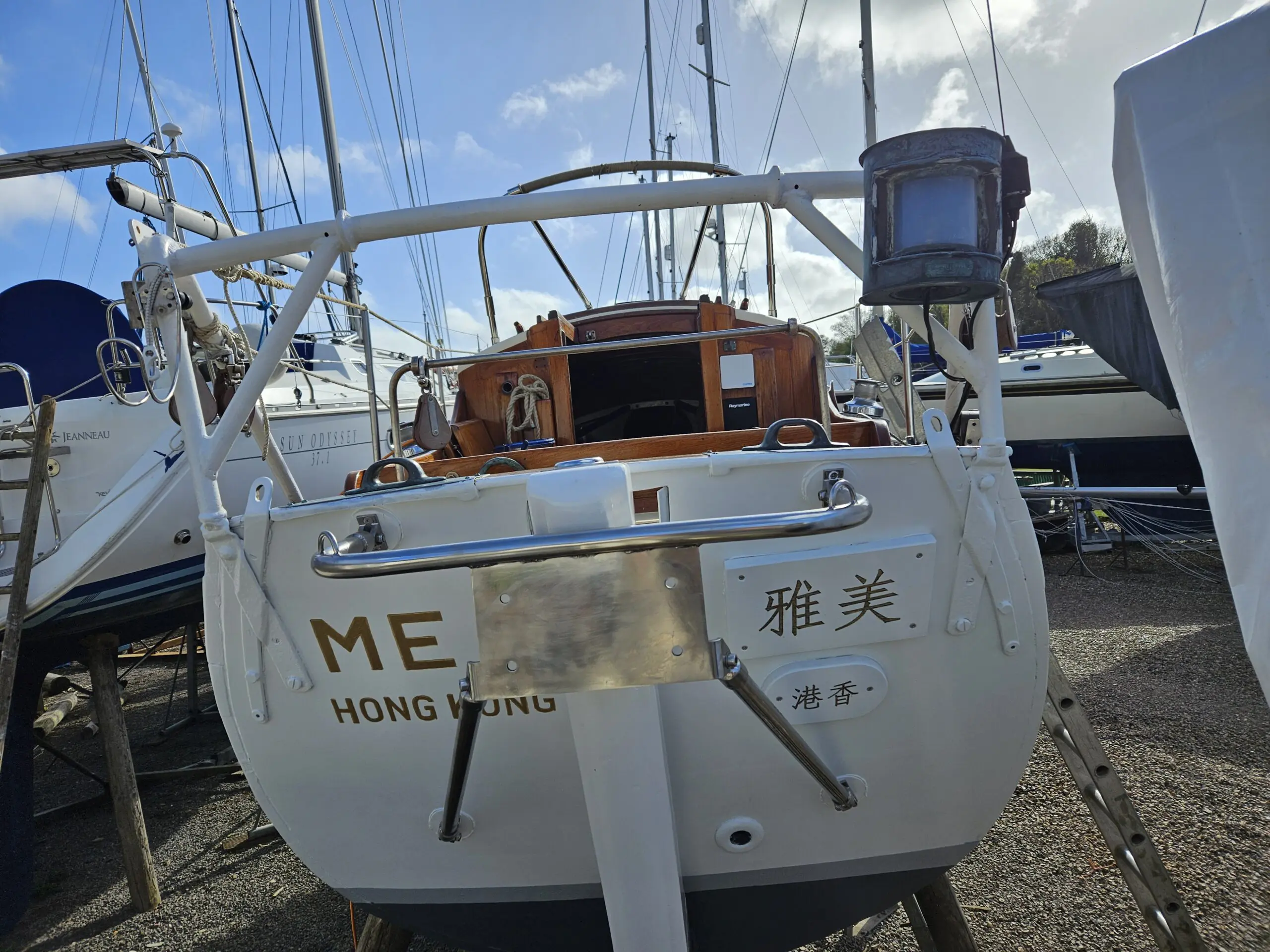
But I messed up the mandarin and ended up engraving “Kong Hong” on the bottom plate, for god’s sake… My Taiwanese friend comes to rescue and she explains to me that Chinese is a magic language, it can be written in all directions, top-down, bottom-up, left-right, right-left, and the plaques on the stern are a beautiful example of circular writing. So beautiful that, one sunny day of March, they attract the attention of a border patrol. When did you arrive. This morning. From where? Cambridge. Not Hong Kong? Kong Hong sir, near Bangor, Northern Ireland, I am tempted to say. Instead I go Oh, that wasn’t me… The boat was sailed to England by her first owner, on a three-year cruise that brought him to Borneo, Ceylon and South Africa, before eventually reaching Falmouth. And since? …MEA’s fourth owner was a young Swede, who in 1987-1988 took her on an Atlantic cruise. When his mum manifested her preoccupation for the planned voyage to the third owner, a Norwegian playing the French horn in a Stockholm symphony orchestra, he replied “Don’t worry, MEA will take care of him”. His single-handed journey back from St. Barthelemy to Stockholm took 59 days… OK, OK, that’s fine, you go…
But I can’t stop thinking. Are MEA’s brightest days in the past, like those of many old boats? What if not?
The question is not without personal significance, as I am also, so to speak, not as young as I used to be.

Maybe this is what pushed me to enrol, in 2022, in the Round Britain and Ireland race. It took MEA 36 days at sea to sail clockwise around the British Isles, the smallest and oldest boat to ever complete the race (also the slowest, if you wondered). The following year was the 50th edition of the Fastnet, and I threw my challenge to Alasdair and his SUMARA OF WEYMOUTH. Unfortunately, he had better plans (sailing the Northwest passage on the gaff-rigged cutter INTEGRITY, ubi maior…), so solo I went, for what I called my Slownet challenge. On the more-or less original Fastnet course it took me 2 hours less than JOLIE BRISE in 1925 to complete the race, thanks to a couple of near gales. 2024 saw me attending the Fêtes Maritimes de Brest. After an engine failure on day 1, it took me 13 days to sail to Brittany, though fortunately only 5 days to sail back. This year will hopefully be the Anti-clockwise tour, with my family joining me for the Caledonian canal (What’s the point of turning back, when Fort William is diametrically opposed to home?). I want to make justice to this old habit of mine of sailing past beautiful places without stopping.

And in the future? I don’t know, we will see. We will sea. What makes the sailor… the will… and the sea…”
Oh… The original question:
…I THINK THERE IS VALUE IN SAILING A PROPERLY PREPARED, OLD LITTLE BOAT FAR FROM LAND. THERE IS VERTUE. THERE IS BEAUTY AND GRACE.
______________________________
STELDA IS FOR SALE £1 to the right home.
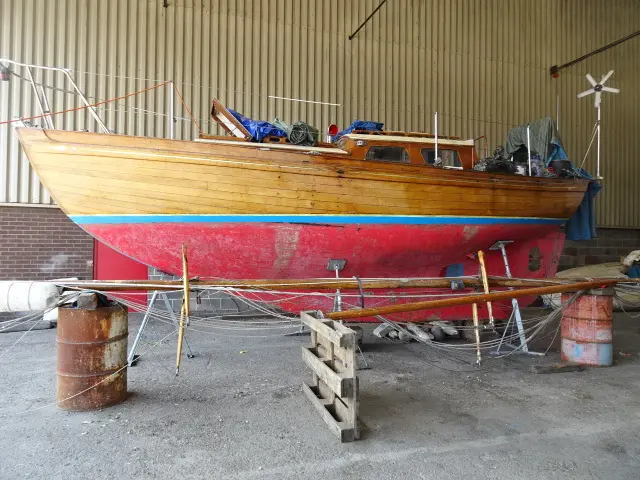
Stelda is currently in covered storage ashore.
She is an exceptionally original example of mid-1960’s British wooden cruising yacht with a particularly celebrated history. Built in 1963 by Cheoy Lee, Hong Kong: one of 25 Vertues built there out of top quality teak on ipol. Dimensions 25’3” 7.7m x 21’6” 6.5m x 7’2” 2.2m x 4’6” 1.4m.

Here is a copy of the English brochure for the series of Cheoy Lee built Vertues, including Stelda, that were shipped to the UK in the early 1960’s.
These boats had classic British construction detailing as specified by Jack Laurent Giles & Ptnrs. Ltd., Lymington. Stelda is best known for having completed an early single-handed Transatlantic passage in 1969 skippered by Peter Woolass who wrote the book called ‘Stelda, George and I’. Peter then wrote the ‘class book’ called ‘Vertue’, known and prized as ‘The Blue Book’.
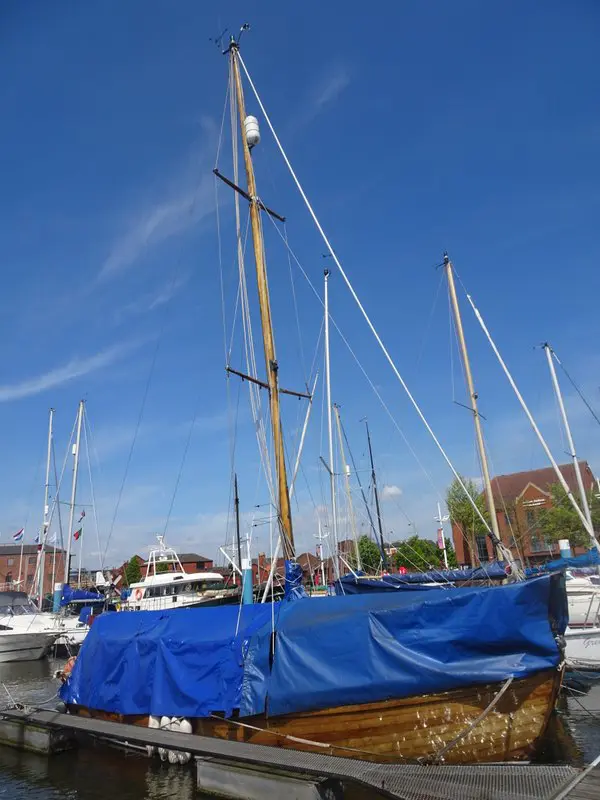
Since then the boat has had a quiet life afloat, lightly used and carefully maintained until very recently. She is hardly modified or changed since when she was built. She is now lying ashore under cover on River Humber.
Stelda is offered for sale for £1 to the right owner by the family of her late owner. I will advise and help with any aspect of the project and further information about the class can be found on www.VertueYachts.com
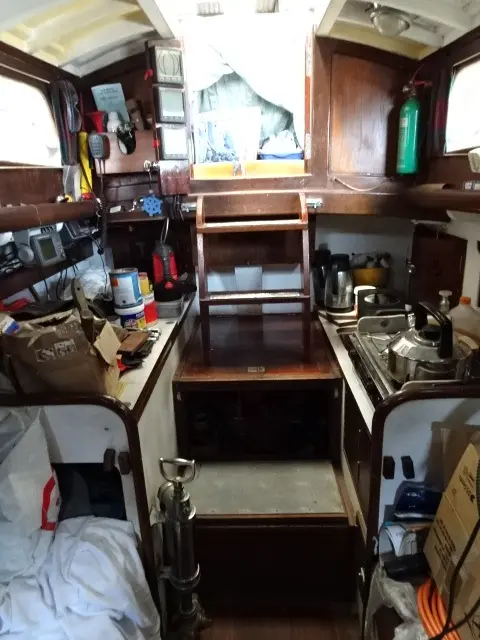
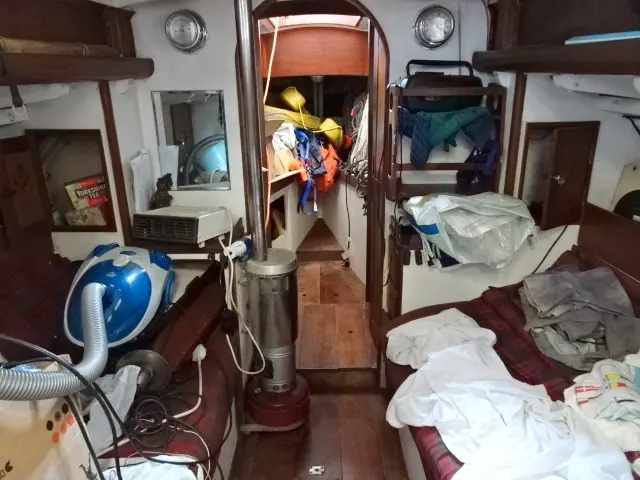
Stelda‘s interor is almost ‘as original’, with the varnished teak finish in testament to the very high quality of her superb construction. She has a huge amount of gear and equipment including spruce spars, numerous sails, covers and standing and running rigging.
Please contact me via this website if you are seriously interested in looking after Stelda.
The importance of Stelda as a boat lies in the fact that she was owned for many years by Peter Woolass and was one of the three protagonists in his delightful book ‘Stelda, George & I’. Peter wrote a very modest account of the preparations and faultless execution of his single-handed Transatlantic passage with Stelda in 1969, and subsequently followed this up with the book for which he is equally well remembered, simply called ‘Vertue’. This self-published handbook of all things ‘Vertue’ is a mine of technical and entertaining information about the class, and was the fountainhead of all information about the boats for many years after its publication in 1973. Indeed it has served as an inspiration for this modest website.
Peter eventually sold the boat to fellow Yorkshireman Bernard Gaffrey who has since spent many years looking after her as if she was the national treasure that many people consider her to be. After he recently passed away his family started searching for a suitable new custodian for the boat who will continue to look after her for many more years. The asking price reflects the importance they attach to finding the right home for this very special boat rather than seeing her deteriorate through neglect. Please get in touch with me Roger Robinson speedwelltwo@gmail.com for more information.
___________________________
BOOKS ABOUT VERTUES
Whilst writing about Stelda‘s Sale, above, I realised that she is the only Vertue still based in the UK to have had a book written about her!
Vertue xxxv has to be one of the most famous Vertues still afloat…..but she continues to keep a low profile in the Venice lagoon area, as far as I am aware. Her transatlantic passage in 1950, skippered by Humphrey Barton and ably assisted by Kevin O’Riordan, was proudly used by Barton and the Jack Giles partnership to publicise the class and boost sales. Hopefully they would be delighted to see Stelda‘s teak topsides still varnished, 62 years after her launch! The book is simply called ‘Vertue xxxv’.

____________________
Salmo became the heroin of Peter Hamilton’s delightful book about her single-handed trans-Atlantic passage in 1956 and subsequent voyage all the way to California….where she continues to reside. See ‘The Restless Wind’.

Salmo
____________________
Cardinal Vertue was used by David Lewis to launch his incredible offshore voyaging career by taking part in the first OSTAR in 1960. She subsequently made what I consider to be the two most dangerous passages ever completed by a Vertue, in the Southern Ocean under Bill Nance’s ownership. She ended up rotting to bits ashore under the burning Florida skies. Lewis’ book has the snappy title of ‘The ship would not travel due West’.
Cardinal Vertue
____________________
Stelda became Peter Woolass’ heroine in the story of his single-handed transatlantic passage of 1969 and then went into a kind of gentle retirement. She remains in Yorkshire, perhaps awaiting another new chapter in her life. ‘Stelda, George & I’.

Stelda
____________________
From the start Vertue Carina had a hard early life by being sailed single-handed from Hong Kong to Durban by the legendary South African sailor, Bruce Dalling. She was then bought by a starry-eyed young couple, John and Karen Cross with a dream to sail from South Africa to Denmark and back. They completed their voyage in 1973 and Karen’s delightful book called ‘The Baby Boat‘ is about to be republished. Carina is still sailing out of Simons Town in South Africa.
Vertue Carina
_____________________
Twenty years after Bill Nance doubled the Horn, father and son team David and Daniel Hayes made the same passage, in January 1985, during their circumnavigation of South America. Their beguiling book was written by them both, and describes many unusual facets of such an amazing undertaking aboard their grp Vertue II Sparrow: it’s called ‘My Old Man and the Sea.’ David sold her recently and she is now based on the east coast of Canada.

Sparrow
_____________________
Sam McKinney’s book called ‘Sailing with Vancouver‘ is a fascinating insight into both the wild and beautiful Pacific northwest as a cruising ground, but also into the incredible seamanship of the British Navy in the 1790’s. Sam follows in Vancouver’s wake aboard his Vertue Kea, which had been exquisitly built some year before by John Weir. Kea is still sailing in the area and will be appearing at the Port Townsend Wooden Boat Festival this September.
Kea
__________________________
The Stern Locker
In the Spring Newsletter I quoted Douglas Phillips-Birt expressing his distaste and horror at the use of a word that has fortunately dropped out of use these days. I have no hesitation in repeating it again here. He quoted Humphrey Barton, who had written:
“Jack (Laurent Giles) and I beg you not to use the dreadful word slutter. Masthead sloop describes the rig exactly. Slutter should not be allowed to survive. Do help us to kill it”
Today the nasty habit is almost dead, and I urge anyone reading this to respect the views of those who created the rig and to finally help us kill it off once and for all.
_____________________
A propos the above, Juan Pablo Olaberria, who is restoring Grace near Lymington, wrote recently to discuss the perrenial problem of stowing the lazy inner forestay when sailing under the masthead genoa. Clearly the length of this inner forestay, or more correctly, forestay, is too long to stow down the mast or indeed straight to the base of the shrouds. (The genoa, if hanked, would be set on the topmast forestay. In these days of roller-furled heads’ls this is now usually a bare stay with the furled genoa set abaft it.) My own solution aboard Hoitak was to have a short lashing from the bottom of the port shrouds which made fast to the bight of the stay with a rolling hitch. The eye of the bottom end of the forestay could then simply be taken forward with another short lashing to the next stanchion base forward. Both Juan Pablo and I would very much like to hear about other, perhaps more elegant and efficient, solutions to the problem.
When I bought Kandy, shown here above, in the 1990’s she came with roller furling on both the genoa jib and stays’l. There were pros and cons, as can be imagined, but I kept the arrangement for several years of gentle, mostly single-handed cruising and day sailing. Hugh Davies, meanwhile, who completed the Azores and Back single-handed ‘race-rally’ last year has rigged his very special VII, Eden Marindin with double masthead genoa jibs. It looks very impressive to me but I wonder about tacking the forward sail and hope to persuade him to enlighten us all about this in due course.

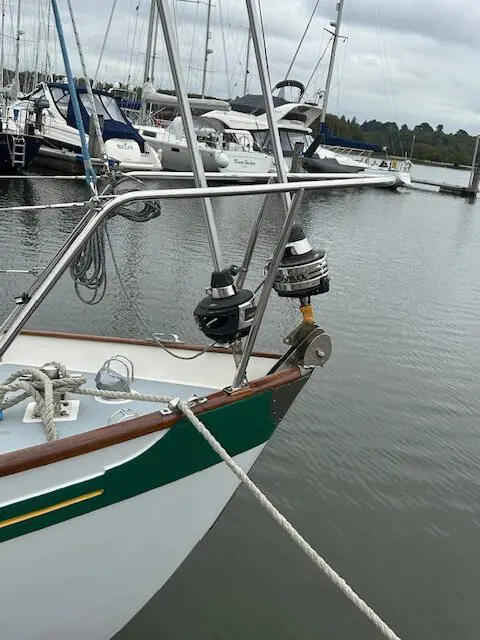
Eden Marindin with her twin furling headsail arrangement. She is the last of the Bossoms built, grp, Vertue II’s.
I am very keen to hear from you with any further thoughts and ideas on this, so please help us keep the Newsletter going.
With best wishes, fair winds and following seas!
Roger
_______________________________