

AUTUMN NEWSLETTER-36-OCTOBER 2026
Welcome to another quarterly Newsletter: our modest celebration of the history and ongoing adventures of the Vertue Class. This month’s treats include the trials and tribulations of refits and restorations as well as the rewards of all the works completed. We also have another tale of impeccable preparation and seamanship, so modestly recounted by our ‘Arctic Correspondent’, aboard the very good ship Sumara. As an extra bit of help to those owners struggling to find good homes for their precious craft, we have briefly listed those boats currently for sale. I would like to thank Massimo for his latest instalment describing Stelda‘s refit in Trieste: Alasdair Flint’s first instalment of his outrageously brave ‘Greenland Expedition’: Tony Holt’s incredibly skilled master-class in thoughtful wooden boat restoration; and Juan-Pablo’s delightful description of the transparent relief to be felt at the culmination of a similar five-year project with Grace. I have had pleasure in tying together a few loose ends about the background to the four gaff-rigged Vertues that we have found so far……..I feel sure there may be more to be discovered, tucked away in remote backwaters of the world, such as those frequented by the quaintly-named Canvasback!
_________________________
STELDA
Stelda‘s refit continues apace with great authenticity and respect. She is, after all, one of the most famous Vertues ever, having been written about extensively by her owner Peter Woolass in the 1970’s. Now being restored in Trieste, here is the latest illustrated progress report from her dedicated new owner Massimo Zanco:
“Stelda’s refurbishment is progressing. Not exactly at high speed, but it’s moving forward!
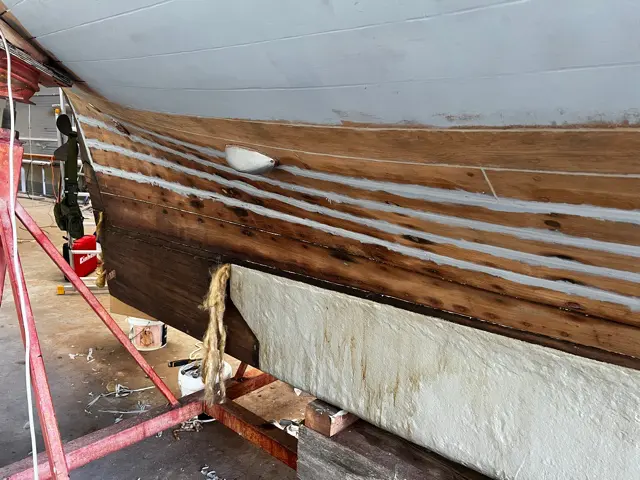
The hull paint has been completely removed, and the hull has been thoroughly checked before applying several coats of epoxy primer and paint. Everybody was surprised to see the quality of the teak planking — it is basically like new.
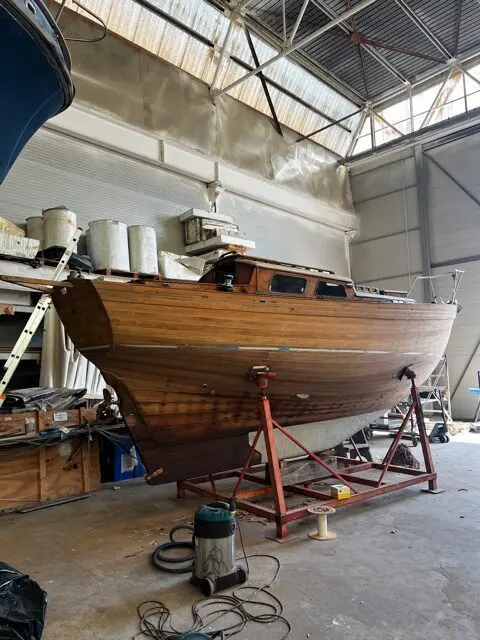
The rudder needed major work, including its attachment points, probably due to the hard work it went through during Peter’s voyage, or simply because of its age. Anyway, it has now been professionally repaired.
George is also in the process of being restored. Even if I never cross an ocean, I feel it is right to keep him on board, as he was an important character in Peter’s book, don’t you think???
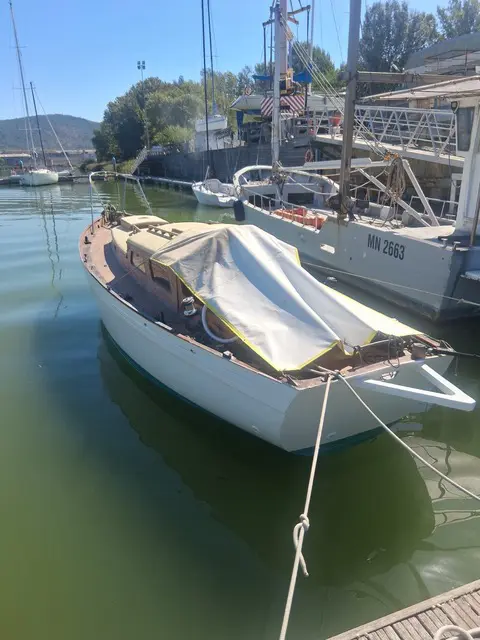
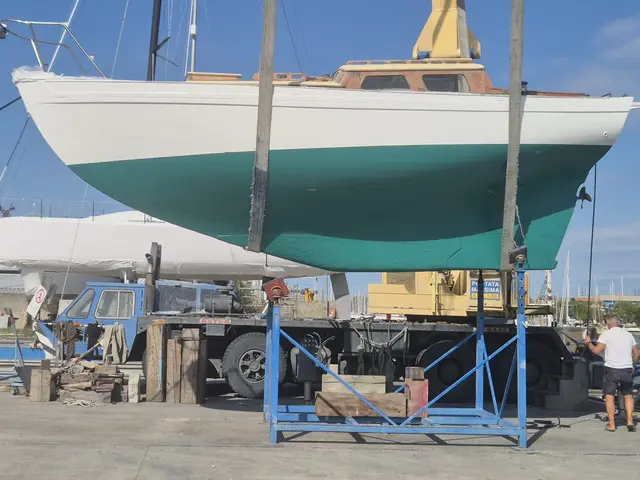
Because Stelda had been out of the water for such a long time, we decided to launch her for a few weeks to let the timber get used to its natural element again — and to see if she still remembered how to swim! At the beginning, as expected, we had some water coming in, but after a while she sealed herself properly.
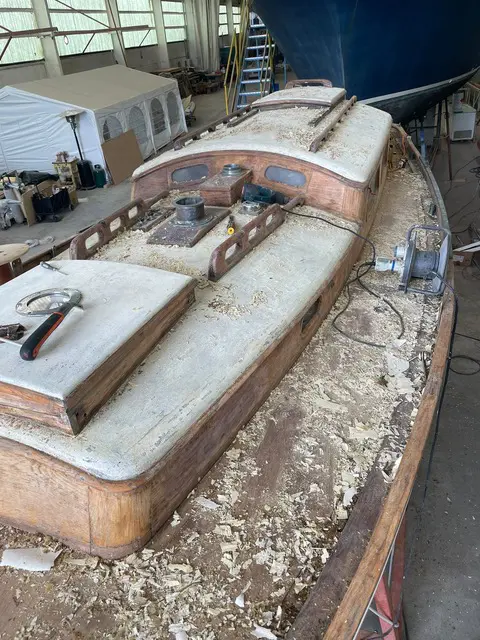
Now she is back in the shed, and the work has moved on to the deck. I removed all the old fibreglass layer this summer — this is apparently how a true Vertue lover likes to spend his holidays!
The plywood layer is in good condition, but we need to replace the wooden joint between the plywood deck and the hull (I don’t know the correct English term for it) to ensure a perfect seal before applying the new fibreglass layer.
This should be completed within the next few weeks, and then she will be ready for repainting.
I’ll be going to Italy next week to attend the Barcolana and will stay there for three weeks. I’ll combine my work in Thailand — working remotely early in the morning — with working on Stelda in the afternoons.
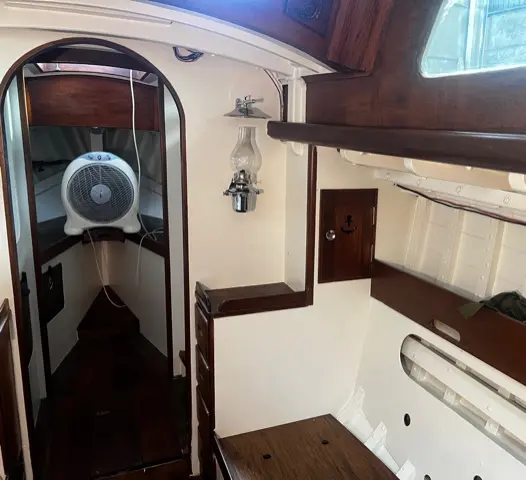
The interior is already done. New piping has been installed, both manual bilge pumps have been refurbished, and a new electric bilge pump has been fitted. The entire electrical system has been replaced with a new one, while keeping the same style and appearance as the original.
The engine overhaul is complete. With a bit of luck, I should be able to install it in October while I’m there. The mast has been totally disassembled, conditions are ok. Under painting now and new rigging will be made in October.
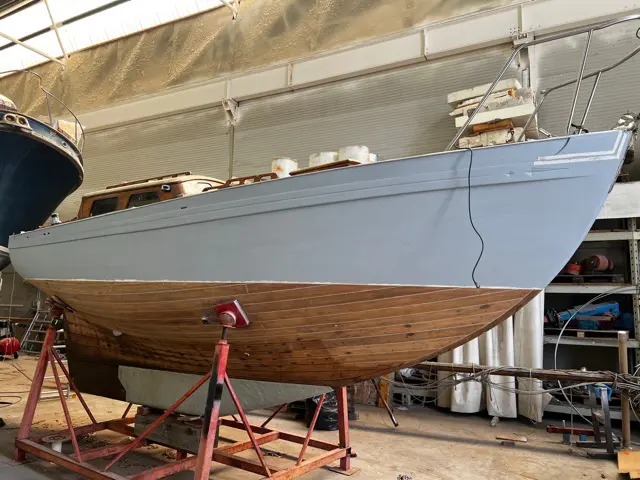
As you can see, I’m trying to restore Stelda to the best of my ability, giving her another long life while keeping her as close as possible to her original condition. I don’t like changing too much of her DNA — I’m a classic and romantic guy, as you know!
Regarding the rigging, I decided to remove the Genoa furling system and go back to the traditional hank-on system for the headsails, just as Peter used during his time with her.
She won’t be ready this autumn. It’s really not easy to manage all this with the limited amount of time I spend in Italy and while coordinating everything from Thailand. But that’s OK — there’s no hurry.
She will definitely be ready by Christmas and sailing again in spring 2027. I would love you to be there with me that day.
I’ve attached some pictures of the work and progress. I’d be very happy if you could include an update about Stelda in the next newsletter.”
__________________________
Sailing my Vertue Sumara to Greenland – Part One
Alasdair Flint
The Plan
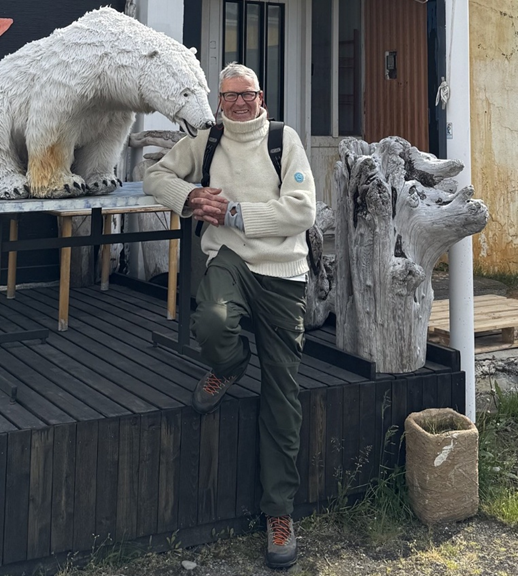
I suppose many of us harbour quiet sailing ambitions—our personal ‘Cape Horns’. For some, it is an Atlantic crossing; for the truly adventurous, perhaps it’s squeezing a Vertue through Havengore Creek – has anyone done that? For me, I had become slightly obsessed by the idea of sailing my Vertue to Scoresby Sund, the world’s largest fjord situated on the northeast coast of Greenland
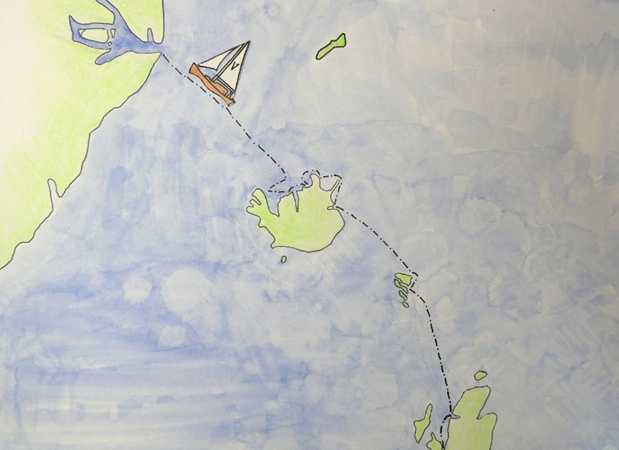
The slightly edgy idea first came to me 15 years ago. I was planning a trip to the remote Arctic island of Jan Mayen and spotted that Scoresby Sund was only 230 nm to the west of the island. I thought it would be fun to visit so I bought all the necessary charts and added it to the sailing schedule. However, the chief objective was to reach Jan Mayen and climb Beerenberg. Had I studied my ice charts more thoroughly, I would have realised that we were way too early to visit Scoresby Sund and it was still blocked with ice. In 2019 Will Stirling rang me to ask if I would like to join him on a voyage to Scoresby Sund in his gaff cutter Integrity, of course I jumped at the idea. I joined him in Husavik, on the north coast of Iceland. We were all ready to sail early in July but the ice still hadn’t cleared. All was not lost, we had an exciting voyage further south along the Greenland coast. The trip helped to add to my experience navigating in the ice.

In 2022, I decided to have another crack at it with my Vertue, Sumara. By now I had learnt that the ice doesn’t clear until the 23rd of July. I had been told this very specific date and based my schedule around it. I sailed to Husavik. The ice did indeed clear but the weather was diabolical. The Denmark Strait is notorious for its severe storms, unpredictable weather, and generally hostile maritime environment. It is known as one of the windiest and most dangerous stretches of open water on Earth. I couldn’t see a window long enough to safely cross to Scoresby Sund, so I decided to retreat back to Scotland.
Not to be defeated this year I decided to have one more shot at it in Sumara. This was to be my fourth, and it was definitely going to be my last attempt. I gave some thought to why my last trip didn’t achieve its goal. We retreated due to the weather conditions, but I could possibly have pushed on. My issue was that my crew was not a very proficient sailor, and I would be making the critical “go or no-go” decision on his behalf. I am sure he would have said “Whatever you think Captain” but I really didn’t want to make that decision on his behalf. This year I wanted to have a crew member who could share that responsibility, someone who could assess the weather and sea conditions and have their own opinion. They would know what they might be heading into.
I was also keen to find someone who could stick with the boat all the way back to Scotland. I needed to avoid having to plan sailing around impending flights from Reykjavik, and I wanted to avoid over wintering in Iceland. Paul was up for it. We are off!
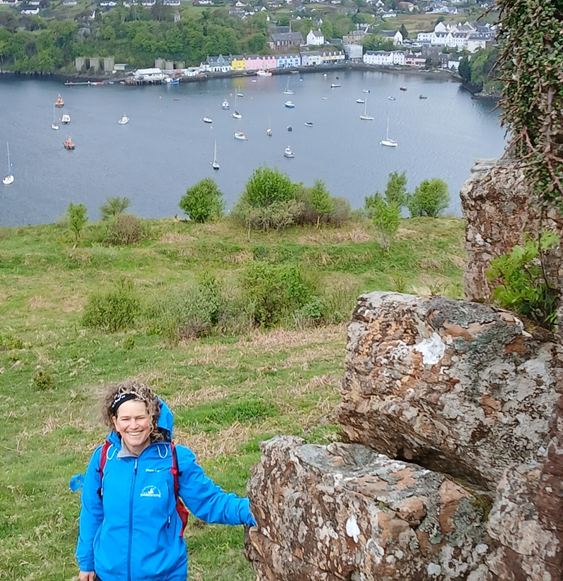
My first crew was Jannicke. We set off from Oban early in May. I like to call in to Ullapool when I venture northwards. I had discovered that there was going to be a repeat of their very successful “Luggerfest” in May and decided it would be fun to join in. Adrian Morgan’s Vertue No2 – Sally was going to be there, so it wasn’t just luggers.
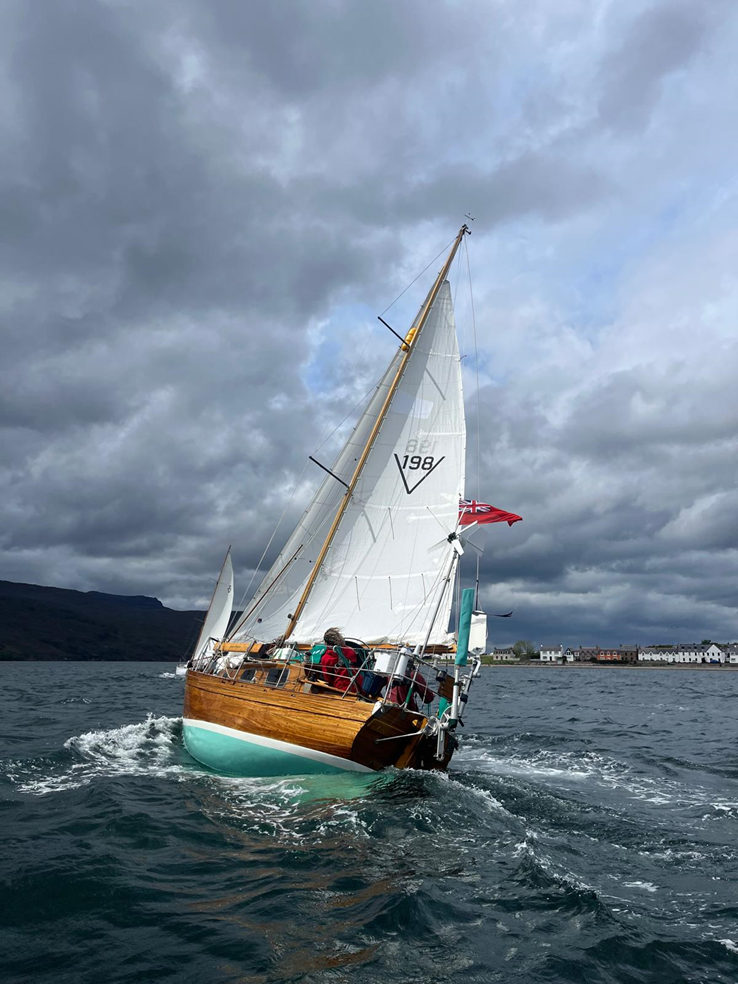
Joining the Luggerfest meant a very tight schedule to prepare the boat and sail her up the West Coast of Scotland. It also meant I would need to leave the boat in Ullapool for a few weeks because it was too early to head north. This proved to be a very fortuitous move. The run up to Ullapool and the racing around the buoys was a perfect shakedown. The pause gave me time to sort a few things out whilst the boat was still in the UK. I needed to buy a new tiller pilot and replace my aging AGM battery. There were also a couple of canvas items I wanted to make.
Late June – We Set off towards the Faroes
Torsten, my second crew member, joined me in Ullapool for the next leg to the Faroes. Torsten is a racing sailor, used to sailing fast in lightweight boats. He really appreciated the solid reassuring feel of Sumara. After a cracking early morning start the wind began to die off and we changed up to the genoa.
On Sumara changing sails is a bit of a faff as all my headsails are hanked on. I can’t just roll out a bit more, but I need to physically change over the sails. I actually enjoy working on the foredeck so I haven’t followed the trend of leading all the lines aft.
With the genoa hoisted we were making 3.4 knots but by 21:00 GMT the wind had dropped off, and it was time to start the motor. We motored through the night until I noticed the engine temperature rising. We stopped the engine and needed to add an extra 1 L of coolant. I had already replaced the TMC gearbox earlier in the year. This was all rather boring as the engine was new in 2019 and I needed to be confident that I had total reliability to manoeuvre in the ice in the remote fjords. The overheating meant that instead of relaxing to a reassuring chug chug, I had a nagging feeling the temperature alarm would sound and the engine would sieze up.
The wind returned and we rehoisted the genoa to make 5.6 knots, eventually changing down to the Yankee. The tides around the Faroe Islands are famously violent so we were glad that Sumara was galloping along at hull speed.
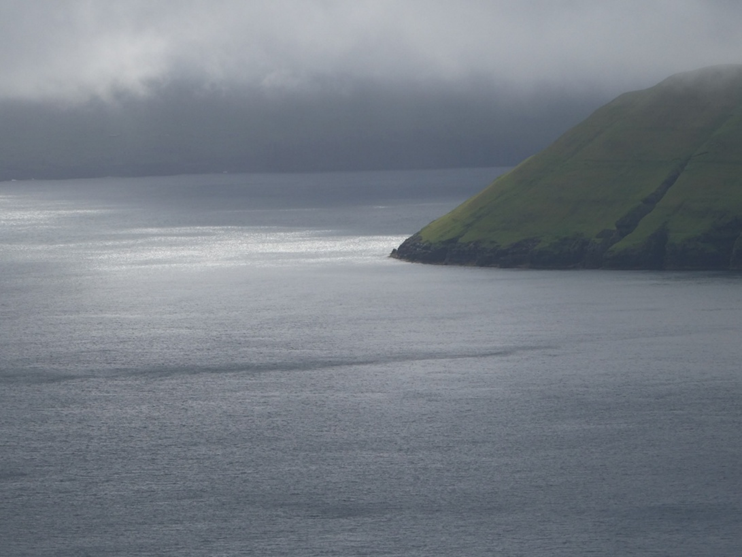
Lille Dimon on the approach to the Faroe Islands
We moored in Torshavn having logged 279 nm at an average speed of 4.36 knots. Our speedy journey gave us the opportunity to do some exploring of the nearby area. This was done mainly in the rain; Torshavn is the wettest capital city on Earth. We topped up the fuel tank to confirm that at 2,000 rpm the Beta 16 hp engine was using just .85 litre per hour. This was good news for the forthcoming circumnavigation of Milneland – a large island within Scoresby Sund.
My partner Grit and a friend of ours, Jo, arrived to take over from Torsten. Our task was to get Sumara to the north coast of Iceland ready for Paul. Up here you need to grab any possible weather opportunity, it is no good waiting for ideal weather as it may never come. I normally search for a decent wind direction and worry little about strength, Vertues can cope with a blow.
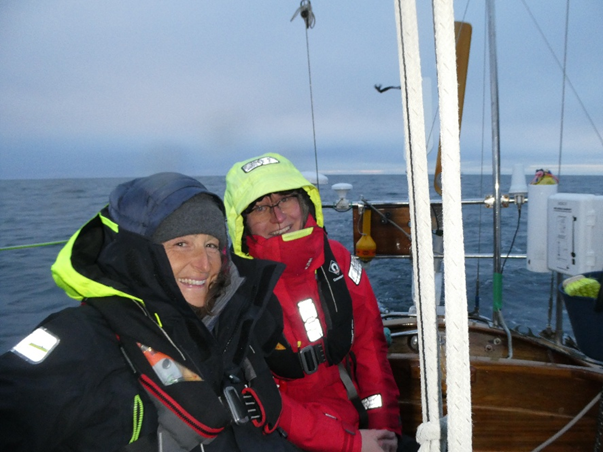
Jo and Grit all togged up and looking forward to the sail to Iceland
We departed at 03:50 GMT on Tuesday 30th June with a poled-out Yankee and a reefed main secured with a preventor. We only made 2.6 knots over the ground as we bucked the remaining foul tide.
End of June – A Nasty Incident
We rounded Fugloy, the northern island of the Faroes, and we gybed the main across. Jo looked up and saw that the top of the sail had twisted and was hooked onto the end of the upper spreader. The sail battens are held in place with a flap of Velcro. To remove the battens, you need to pull out the flap of Velcro and to do this there is a small loop of cord sewn into the end. Stupidly I thought it best to leave these small loops hanging out of the end of the sail to make things easier when I take the sail off the boat. It was this small loop which lined up perfectly with the upper spreader when there was one reef in the main. It had become solidly jammed in the slot on the end of the spreader. I tried flicking the leech to no avail. It was too high for a boat hook to be of any use. We couldn’t lower the sail. It seemed I would need to climb the mast, but the boat was rolling like a pig, and it would be no easy task. I was about to go below to get my climbing gear when, to my relief, the cord snapped and the sail became free. I was very grateful that the sailmakers had used Nylon and not Dyneema. It was a lesson to avoid overstrength fibres unless you actually need them. I then noticed Jo was wearing a Dyneema bracelet so I suggested she might prefer to remove it while we were sailing.
This wasn’t going to be a good trip for Jo. I have a policy of not discussing seasickness on Sumara. It can be a self-fulfilling prophecy. I had noticed that Jo had a packet of seasickness tablets in the pocket of her bag, so I assumed she had her own way of dealing with the malady. Sadly, with the nasty sloppy sea off the north coast of the Faroes, Jo succumbed. She simply couldn’t face going below despite our assurance that it would be the best place. It was cold on deck with waves around 2 metres high and building. Jo is one of the most energetic and enthusiastic persons that I know, it was heartbreaking to see her totally incapacitated. Having one person lying across the cockpit was hampering access to the winches. After 15 hours we did persuade Jo to go below where she remained until we saw a pod of about 30 pilot whales. At this point she jumped up with joy to watch the spectacle before succumbing once again. It transpired that she had not taken the pills!
By now the wind had got up and we were sailing at 4.7 knots with a triple reefed main and reefed Yankee. At 21:00 GMT on Thursday 2nd July we spotted the ice capped peaks of Iceland.

Approaching Iceland
By 06:00 GMT on Friday 3rd July we moored safely in Seyðisfjörður. It was 7°C but the sun was out. We all enjoyed a cold beer while we waited to clear customs.
6th July 2026 – Seyðisfjörður to Husavik
I have sailed to Seyðisfjörður before. It is the nearest port to the Faroes and provides a safe entry under any conditions. With all these deep sided fjords katabatic winds can be an issue as the cold dense air rushing down from the mountain tops can easily pin a boat down. Once we cleared customs we enjoyed a few days in this arty town. I ate the best lamb I have ever had!

Sumara moored alongside in Seyðisfjörður
Our next hurdle was to round the Langanes headland just 3 nm south of the Arctic Circle. This is the Portland Bill of Iceland and the violent tide race or “rost” needs to be treated with some respect. It was 74 nm away, so timing is tricky. There is conflicting data on when slack water occurs with the CA suggesting 10:23 whereas the Icelandic website “Sjolag.is” says 08:30. We decided to aim for 08:30 Tuesday 7th July and take the west going tide along to the next port of Raufarhöfn.
It was a windy passage and soon we were sailing at 5 knots which would put us ahead of schedule. I tucked in a reef, but we were still making 5 knots. Even with a reefed Yankee and triple reefed main we were still making 5 knots! I decided we should hove to for a while but when I hauled in the main the speed reduced to 3.8 knots, just right for the headland. So, the next time you see a boat sailing with the wind on the beam and the sails sheeted tight, cut them some slack, they may be doing it deliberately! We rounded the headland a “biscuit toss” from the shore where you can find calmer water. The good news was that Jo had no signs of seasickness and was back to her cheerful super enthusiastic self!
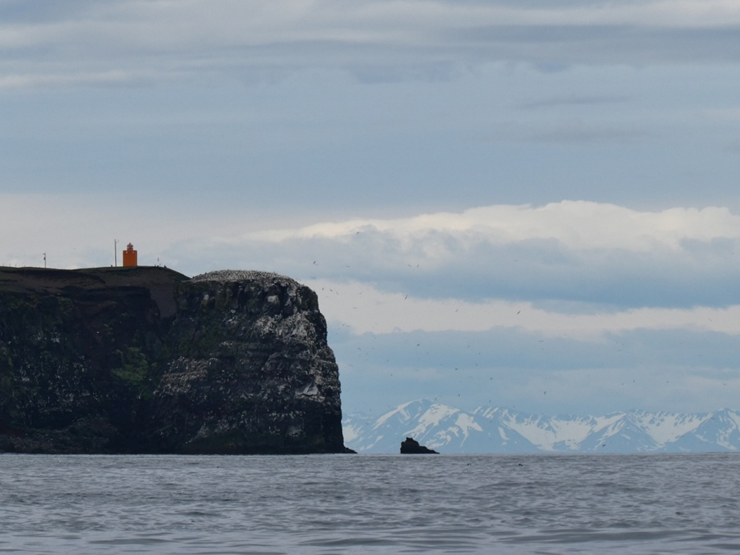
As we approached Raufarhöfn it was blowing a good force 5 from the southeast with a very lumpy sea. The entry was quite “exciting”. With the wind howling through the port, we couldn’t see any space to moor. There was a slim chance there would be a spare pontoon amongst the small fishing boats. We would be fairly committed in the approach with little room to do a “U” turn but luckily a free pontoon appeared just in time and we moored smoothly.

Sumara can easily tuck in with the small fishing boats
This is one massive advantage that the Vertue has, it can nearly always find a little space in the harbour. I feel sorry for those sailing around in 50 foot boats needing to book rare hammerhead berths in advance, or having to anchor off. A fisherman came along to admire the boat and confirm that we would be fine where we were. Time to explore this whacky port
As I had been to Raufarhöfn before, I was beginning to feel like a proper Cruise Ship Guide, knowing all the good spots. Raufarhöfn is Iceland’s most northerly port. It was once Iceland’s second largest herring exporting town with a population of tens of thousands. Now just 180 people remain. The school has just closed for good, but luckily the swimming pool, sauna and hot tubs were open. After a good soak, we went to an art exhibition inside a fish oil tank!
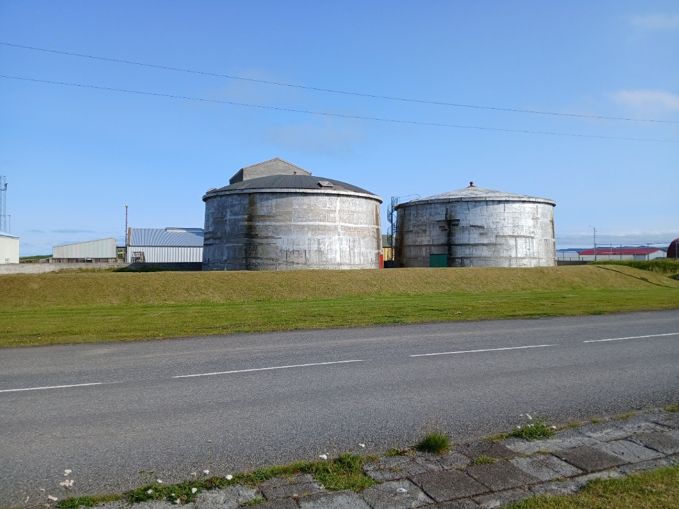
I am not too sure of the economics of holding an art exhibition inside a fish tank in a remote village with just 180 residents, but I am not an economist!
On the 9th July we set off for Husavik 72 nm away.
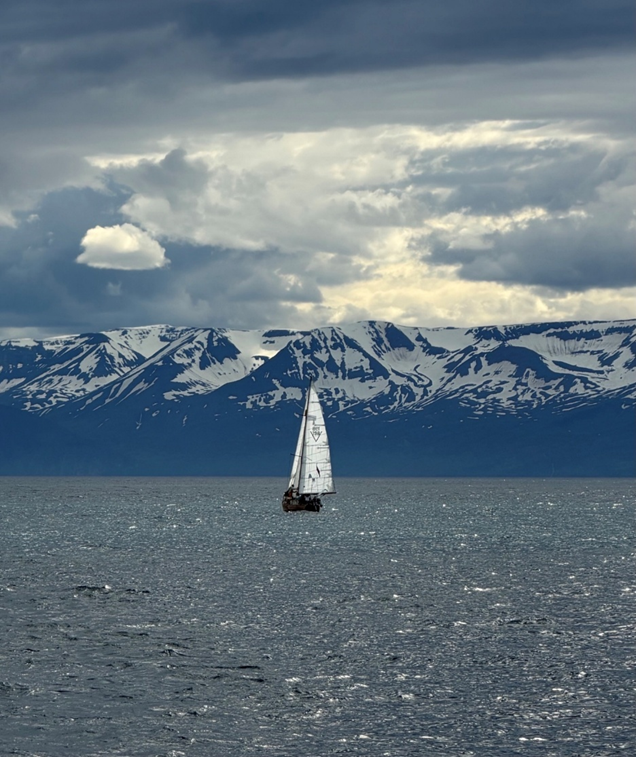
Sumara approaching Husavik. Photo kindly sent from Yacht Louise
I was planning a few “me” days on the boat in Husavik. I like to get the boat to myself from time to time. Grit and Jo were flying out on the Friday and I thought Paul was due to arrive on the Sunday, but Paul had actually found an earlier flight and he arrived just a few hours after Jo and Grit had gone. Bang went the me-time! I put on my trusty Tourist Guide hat and showed Paul around this town, famous for its whale watching.
All the time we were tracking the ice charts from the Danish Meteorological Institute. There was no point in setting off only to be thwarted by dense ice.
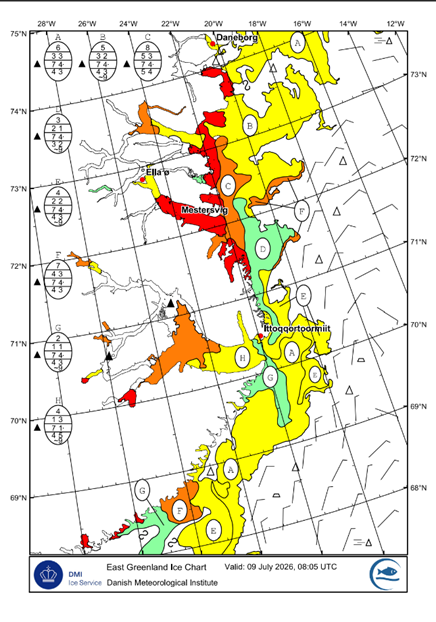
Early July and the sound was blocked with 6/10 ice
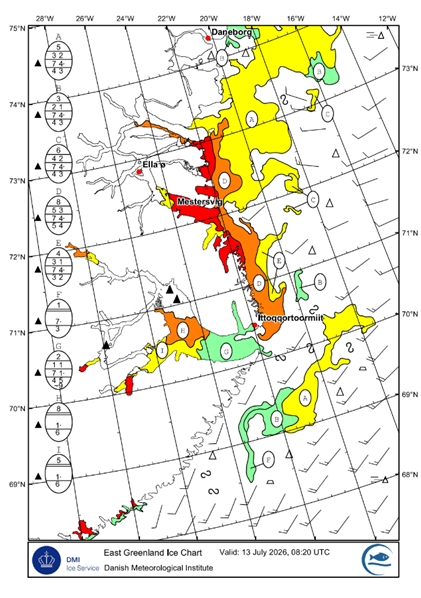
By mid July the entrance to the sound becoming accessible
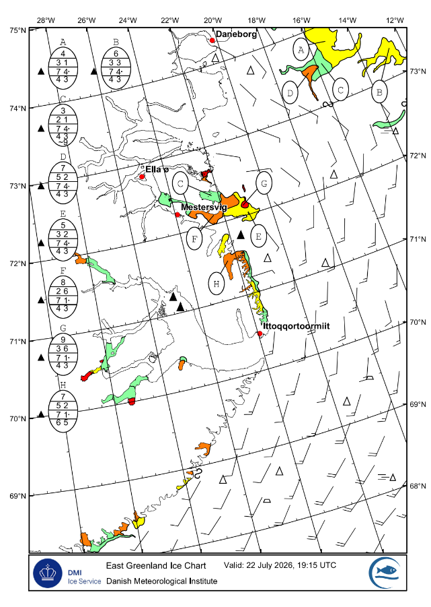
By 22nd July the area was completely clear
The good news was that the ice had cleared, that was one worry to tick off the list. We kept an eye on the weather by using the apps “Windy” or my preferance “Ventusky” which also shows the isobars and fronts. The wind was going to be unfavourable to head north. I was keen to escape Husavik. It is a lovely place, but I had been there too long. We decided to sail 41 nm along the Iceland coast to Siglufjordur, an old herring fishing port with an award-winning Herring Museum, what’s not to like? This was to be our port of departure for the 270 nm leg to the entrance of Scoresby Sund.
In Siglufjordur we were able to top up with diesel and water. Sumara’s fuel tank holds 61 litres but we carried two 20 L Scepter military specification containers on deck plus 20 L in various cans in the starboard locker. We reckoned we could motor in flat water for over 500 miles. Sumara has two small stainless steel water tanks under the berths. The cool top surface acts as our fridge. They only hold 17L each.

The stainless steel water tanks under each berth serve as Sumara’s fridge. Heavier items are stored in the bilge.
I carry five flexible Ortlieb 10 L water bags and one 10 L Jerry can. The flexible ones can be stashed into small and awkward spaces. It is necessary to carry enough provisions to last the whole trip. There is a small shop in Ittoqqortoormitt, the settlement at the mouth of Scoresby Sund, but it is only restocked twice a year. It is regarded as poor form to reprovision boats there because it takes supplies from the locals. We stocked up and were keen to set off.
The wind was a moderate north-westerly. We hoped we could sail close-hauled along the north Iceland coast as far as the Horn then, as the wind came around, head off towards Scoresby.
25th July 2026 We set off at 07:00 Saturday morning into a low wet mist. Sadly, we couldn’t hold the intended course. The sea was very lumpy, and we needed to bear off to power up. We had to tack to clear the coast, but we were tacking through about 120°. After 24 hours of bashing into a big cold sea, we had only made 35 nm from Siglufjordur! Although our confidence levels very high when we set off, this first day out was very wearing. It is days like this when you wonder why you are punishing yourself, it was no fun at all. Luckily by 10:00 on Sunday the wind had backed slightly, and we were able to make slow progress north.
I expected to sail for a couple of days before needing to worry about clunking into any ice but to our amazement at lunchtime just 40 nm off the coast a massive berg appeared. It was followed by a few growlers. It’s the growlers that are a worry. It meant we needed to up the quality of our watches, from now on we needed to keep a constant eye on the sea ahead. I shunned getting Starlink on Sumara so I can’t receive emails at sea but later noticed that the Icelandic Coast Guard had been following our track and sent me a warning about this large stray berg.
Sumara only has one 125 amp general service battery and it was already down to 12.2 volts. I turned off the AIS and Navionics to save power. By 21:00 that evening the wind had died down and we started the engine. By 03:00 Monday morning the wind had died completely leaving a smooth swell. We dropped the headsail and continued under power.
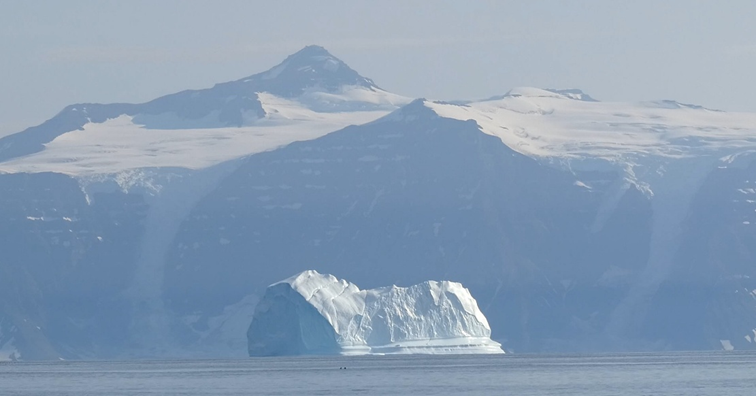
Iceberg in Scoresby Sund
By lunchtime we were spotting bergs. We registered with the Greenpos system via satellite phone. It is a requirement that you call in with your position and the ice conditions every 6 hours. If you fail to get through, then they may try to rescue you at your cost!
At 19:00 the engine heat alarm sounded. We had lost 2 L of coolant. We checked the raw water filter and found that it was covered with a green slime. It was hard to judge whether this would be enough to restrict the raw water flow to the engine. We cleaned the filter, refilled the coolant and restarted the engine. It was fine. From then on, I added a column in the logbook to record the engine temperature. We kept a nervous eye on it. Engines are crucial in the fjord where the Greenland High can result in many windless days.
Land was now in sight. By mid-day on Tuesday we were off Kap Brewster, the entrance to Scoresby Sund, and were negotiating bergs and growlers in drifting mist and fog.

At 17:00 we anchored off Ittoqqortoormiit in 9.7 m. I use a 15 kg Rocna anchor with 60 m of 8 mm grade 70 chain. I have no windlass. We use blue fishermen’s gloves and haul the chain by hand. We were surprised that there were no other boats there. We opened some beers to celebrate. While we sat in the cockpit, we saw a fast local fishing boat arrive and were slightly taken aback to see it immediately hauled out of the water! It reminded me of the Fair Isle ferry. It has to be said that the settlement was not a very protected harbour. There are other areas where shelter can be found but we needed to hire a rifle from Ittoqqortoormiit so anchoring a few miles away from the village and walking into town unarmed is not really ideal. We are in serious polar bear territory.

Ittoqqortoormiit
The following morning, we pumped up the Avon dinghy and rowed ashore. Ittoqqortoormiit has a population of 329 and is one of the most remote settlements on earth. It is also one of the hardest to pronounce!
It was originally intended that the settlement would be made in the safe harbour of Hekla Havn 100 nm up the fjord but the ship delivering the settlers broke its rudder in the ice, so they formed the settlement here.
Although we were celebrating our success, our voyage wasn’t over yet. Our ambition was to sail up the sound to Hekla Havn on Denmark Island and then perhaps attempt a circumnavigation of Milneland, a circular trip of over 340 nm. Would we be able to make it through the thousands of icebergs calving off the numerous glaciers? Would the engine hold up? Will the weather be favourable? Would we be able to get Sumara safely back to Scotland? Will we ever learn how to pronounce Ittoqqortoormiit?
See Part Two in the Christmas Newsletter
____________________________
Ice Bird by Tony Holt
It has been a somewhat challenging year for boatbuilding outside, as we seemed to go from winter floods straight into summer heatwaves!
Anyway, having renewed the outer stem I turned my attention to the inside. I laminated a new floor and three further pieces to reinforce the new outer stem joints and also the original scarph joint which had opened a little through shrinkage. All through bolted with silicon bronze bolts.
I then made good the access hole that I had cut in the foredeck.
I removed the two wrought iron breasthooks and after repairing the rotten ends of the stringers, they were cleaned up and epoxy coated before being refitted using new fasteners.
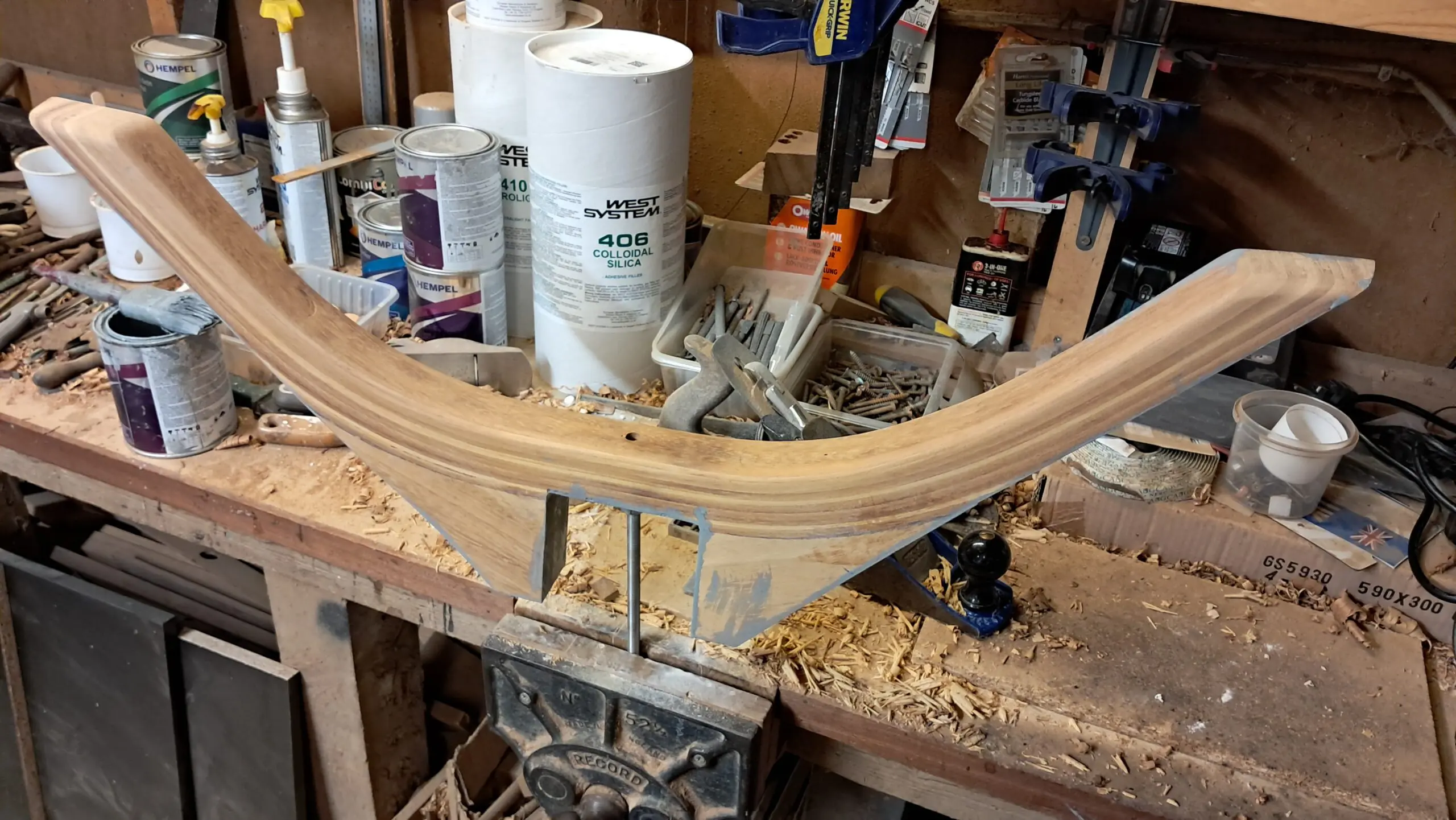

After repairing some frame ends it was time for paint and the next step…..
Which was working back along the keel and inspecting the remaining iron floors and removing sample copper fasteners from the oak floors, all of which proved to be as new.

The galvanised floors were ok so I epoxy coated them ready for refitting.
Unfortunately the planking had not fared so well over the years. There had obviously been a long history of problems here – even the patches had patches!

Had to replace some sections of planking and fit graving pieces elsewhere.
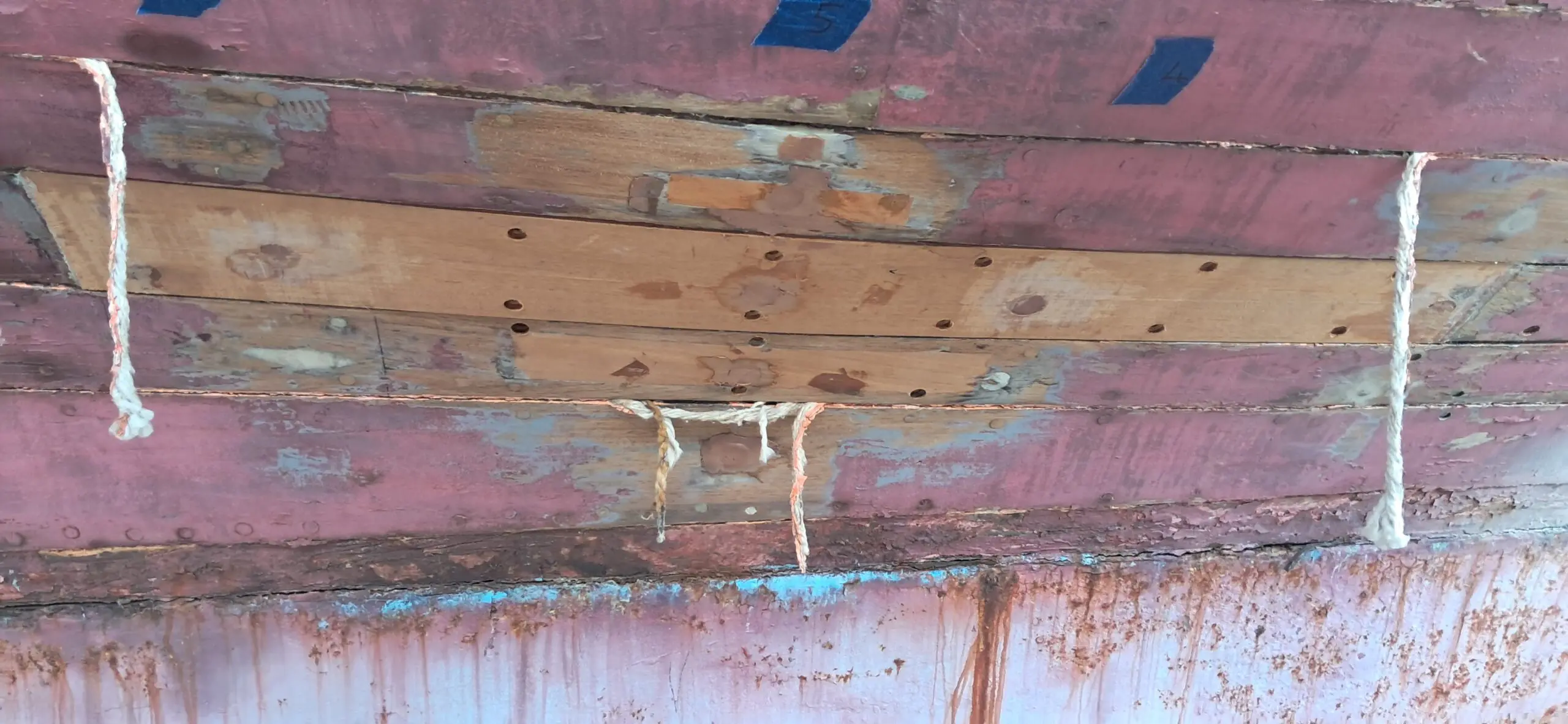
Eventually it all went back together and I wrapped up this area by repairing and refastening the mast step, not forgetting to add the customary silver coin…..
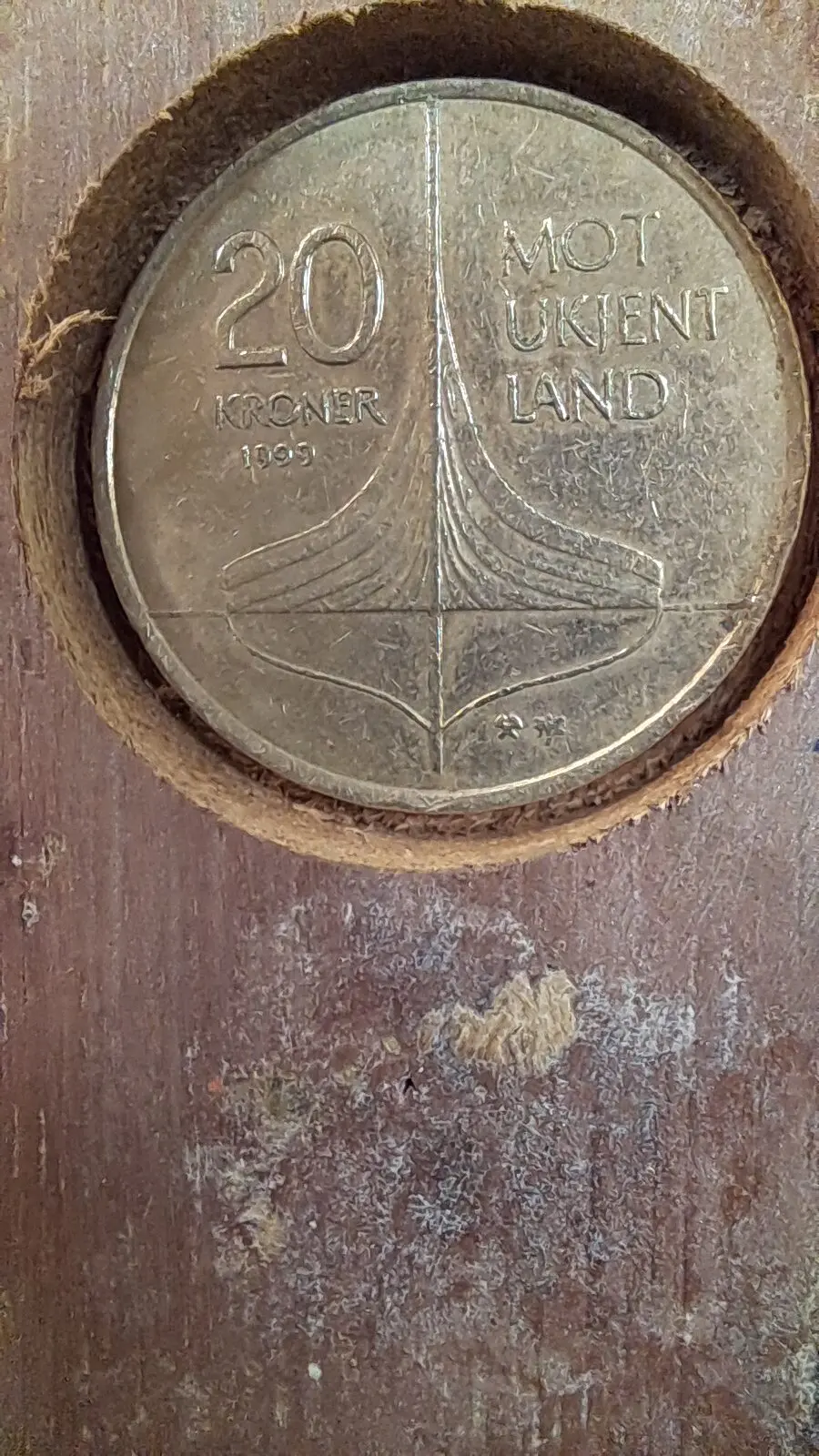
Traditional coin in the mast step!
Having decided that it would be nice to get up off my knees for a while, and get some sunshine, I set up some staging to access the toerails for repair. When Ice Bird was transported down from Scotland to Dorset both toerails were found to be pushed inwards by the heavy ratchet straps securing her to the cradle. I had hoped it would just be a refastening job but by now I really should have known better!
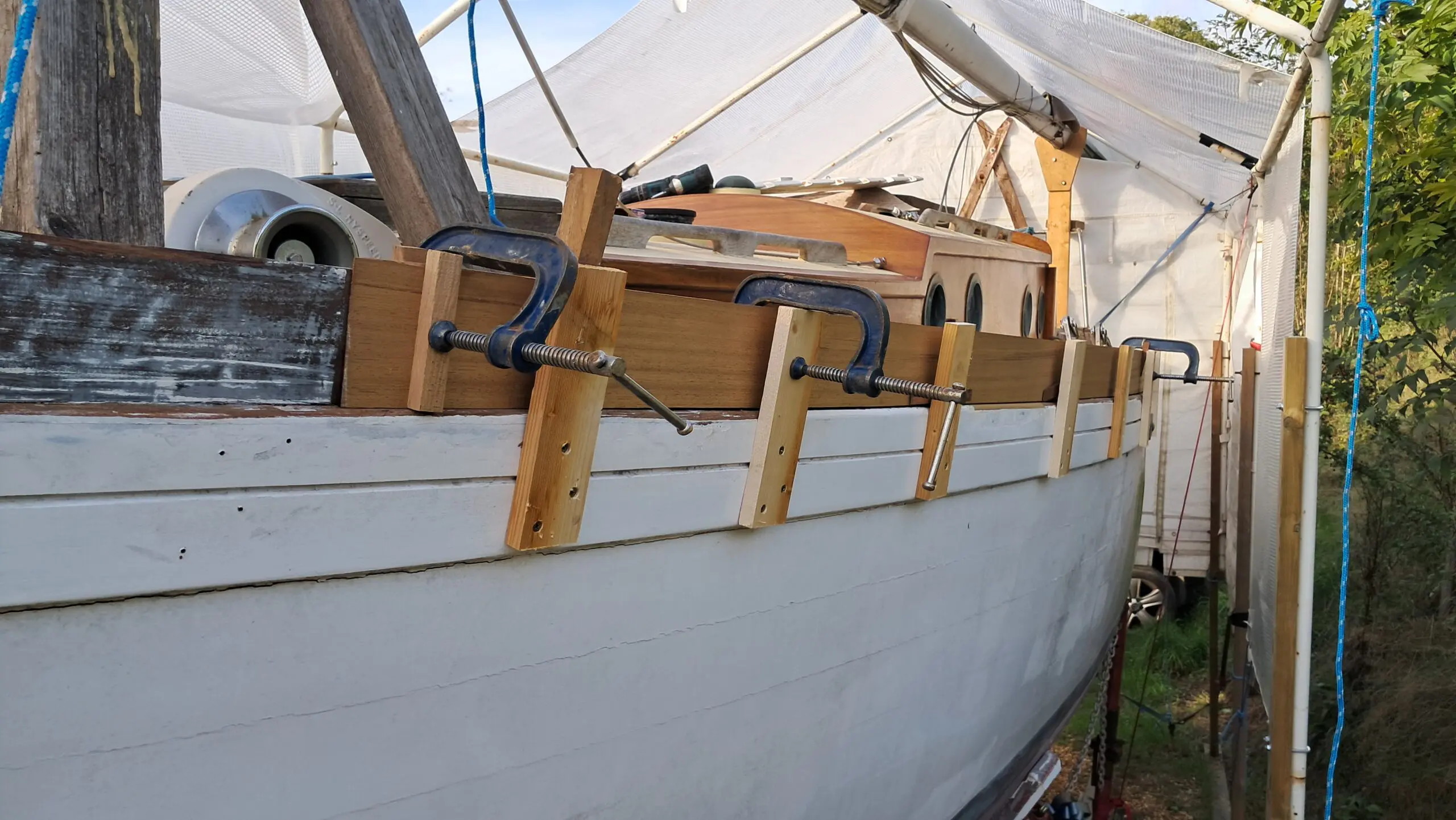
I renewed both sides using some very nice Iroko, fixed with long coach screws and additional gallery bolts in way of the sail tracks. I screwed some temporary cleats to the sheerstrake to enable clamping the new pieces in place and also allowing me to mark off the changing bevel on the toerail’s bottom edge. Before final fitting, I routed out half depth recesses behind the chainplates to allow access for re caulking or removal if required.
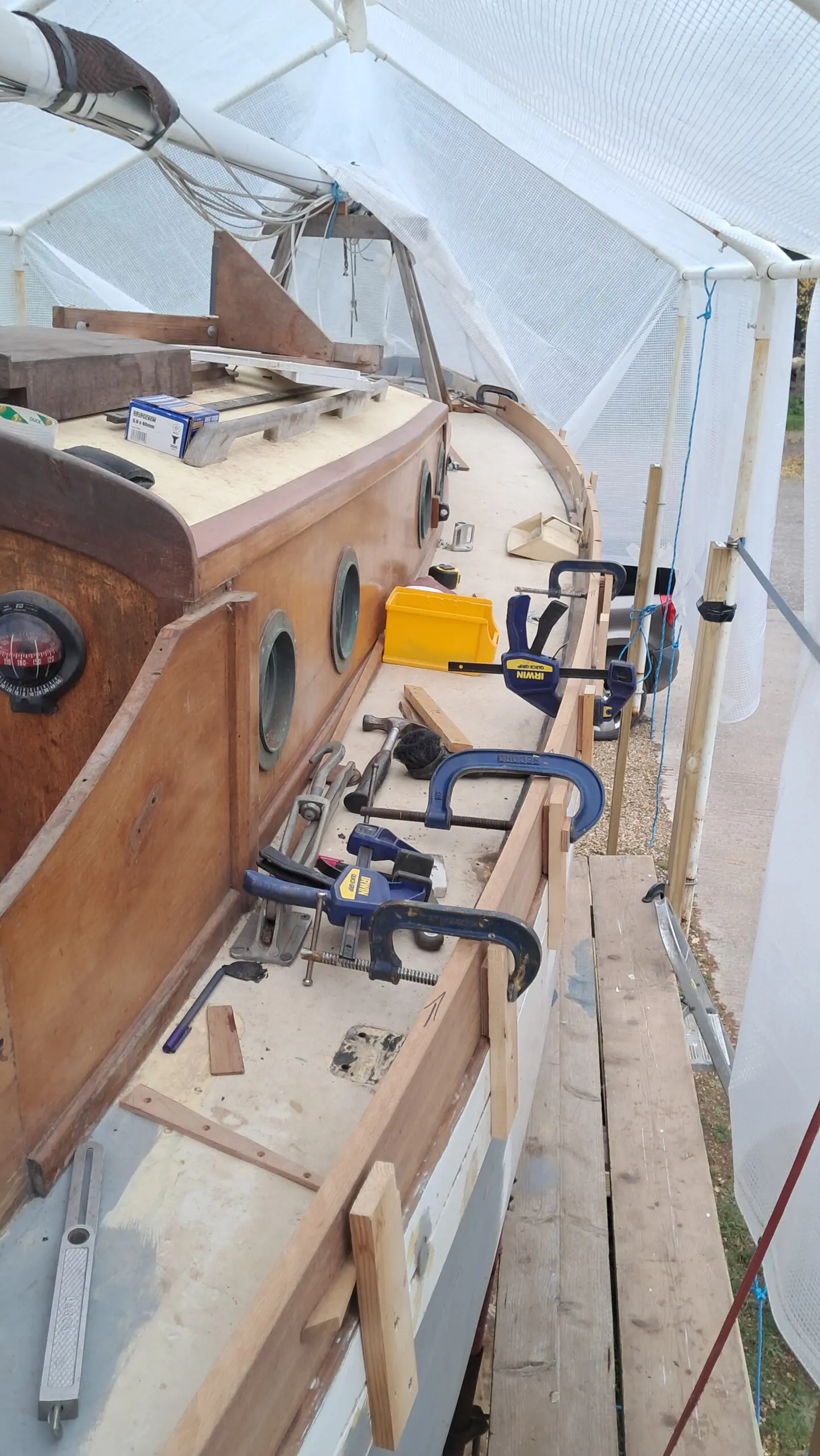
Next I made the capping from the same timber and rebated over the toerails. It was suitably challenging, working alone, to steam bend them to shape and fix them down.


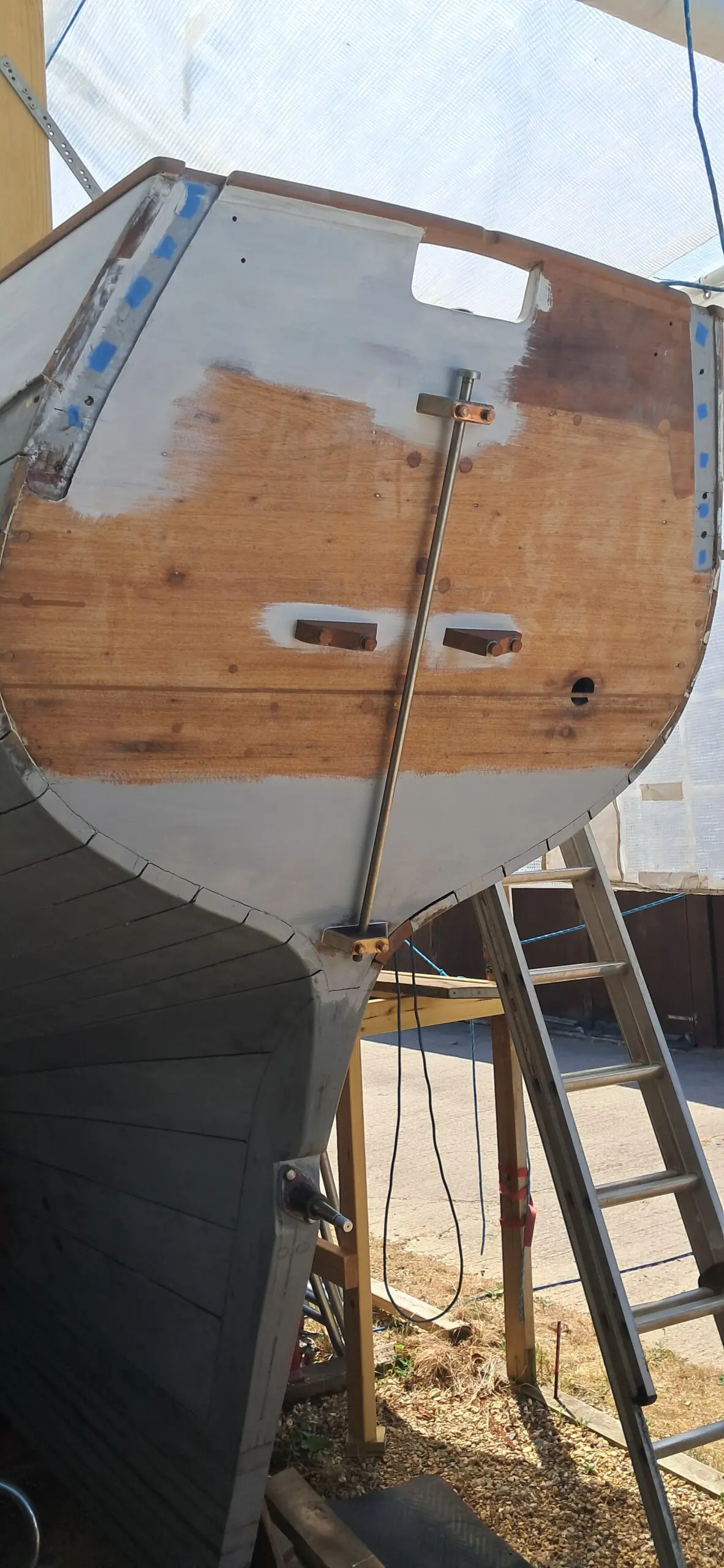
Next on the agenda were some new rudder fittings. The heel fitting is a relatively recent addition in stainless steel and is in good condition. The centre one just below the water line is probably original and very rusty, the upper one is brass and quite worn. There is a long stainless pin running between them which is also in good nick.
Not having the funds for custom bronze replacements I decided to make a pair from Tufnol secured with bronze bolts. There are Acetal thrust washers. While I was there I added a couple of rudder stops for good measure.
I had previously stripped the transom with a view to varnishing it but I discovered from Matteo’s entertaining blog that that’s known as a Baboon Butt, so I went off the idea and have reverted to painting it!


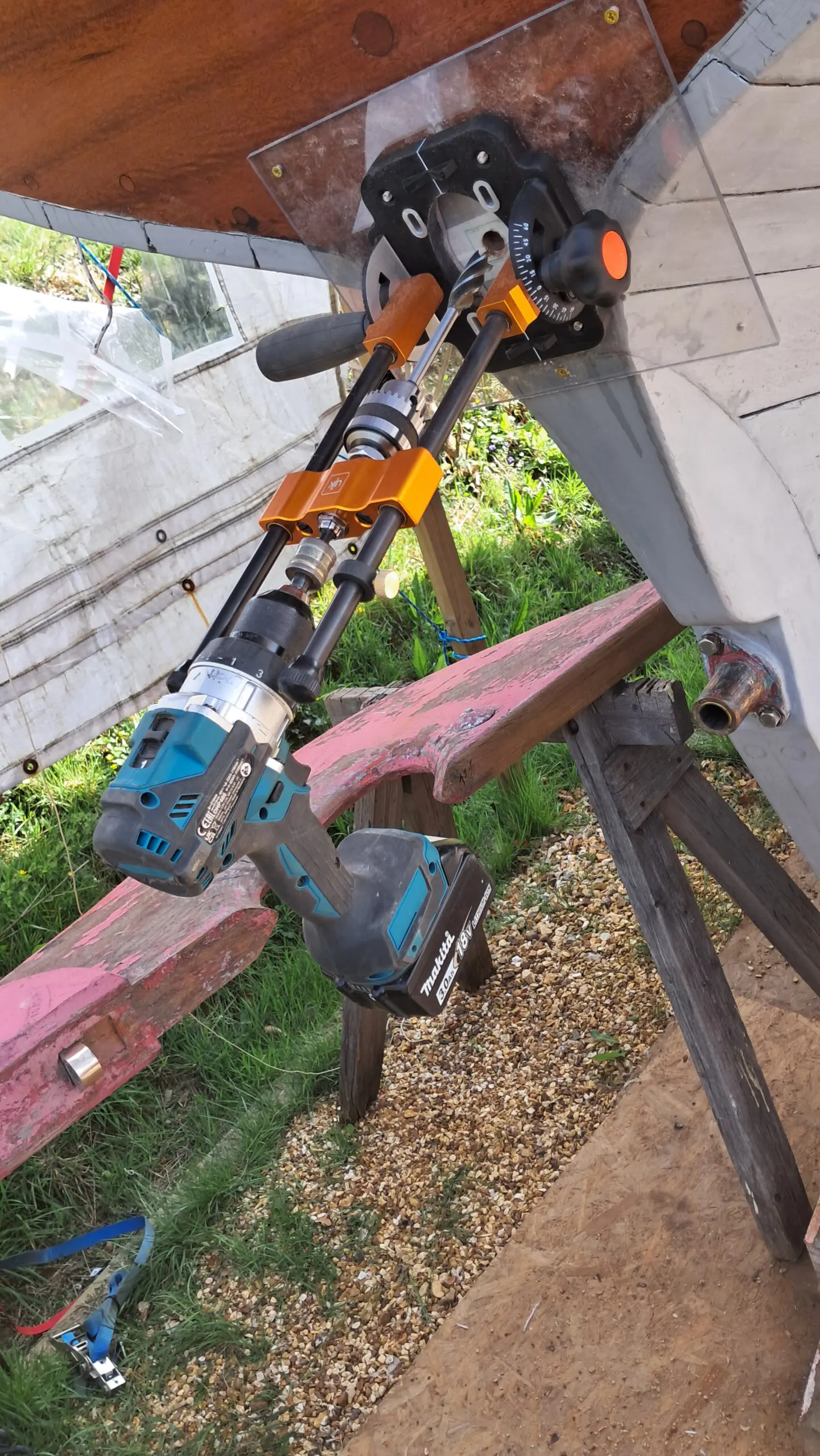
Well, I think that’s all for this time, so I’ll leave you with a picture of a mystery tool that I made for one of the jobs in the next update.
Any comments or questions welcome icebirdv45@gmail.com

__________________________
Gaff rigged Vertues
Some brief reflections by Roger Robinson
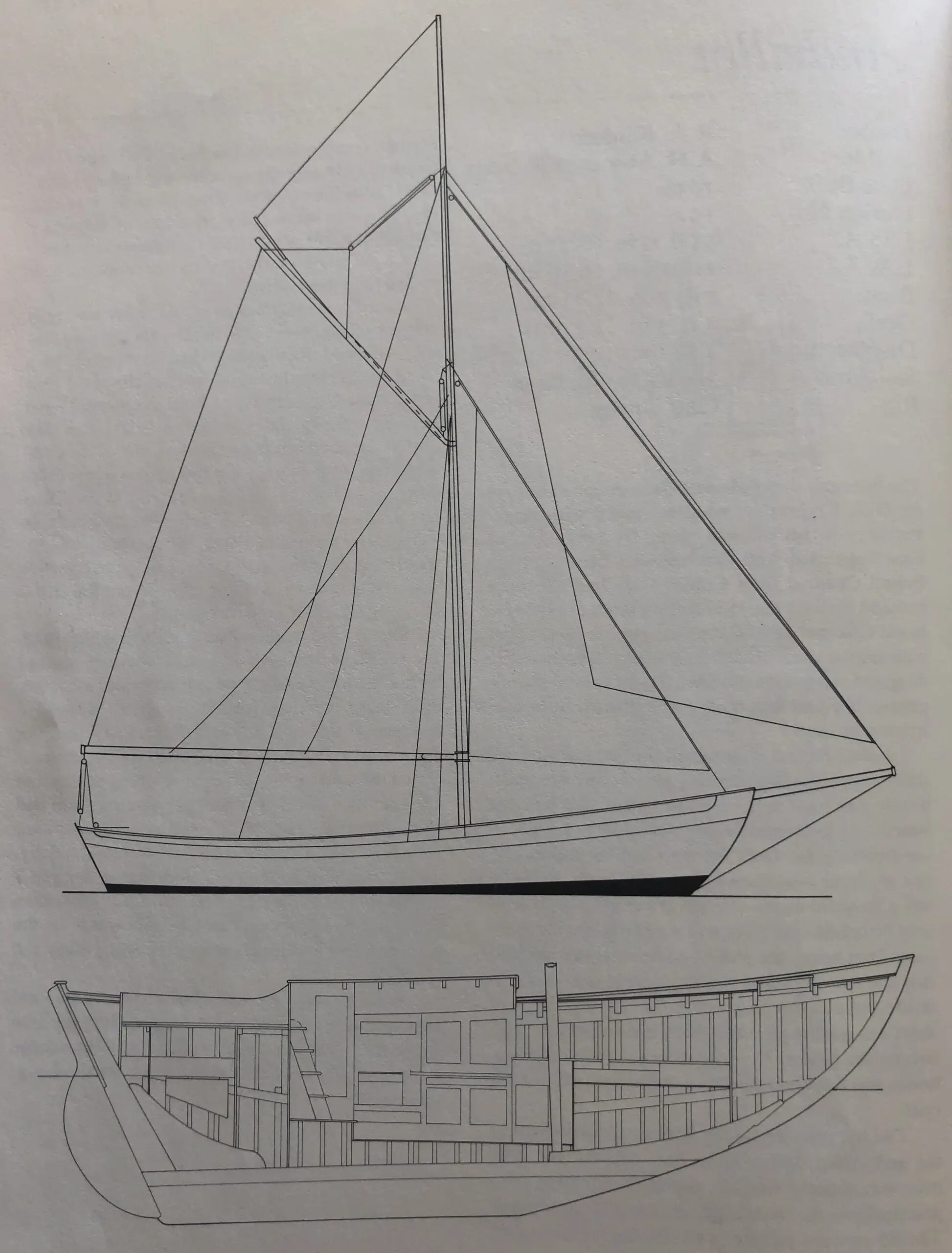
When Jack Giles drafted the lines of Andrillot in the autumn of 1935 he would never have guessed that the next gaff-rigged boat to the design would not be commissioned for almost 40 years, or that she would be built by a very talented Aussi in his lean-to garage!
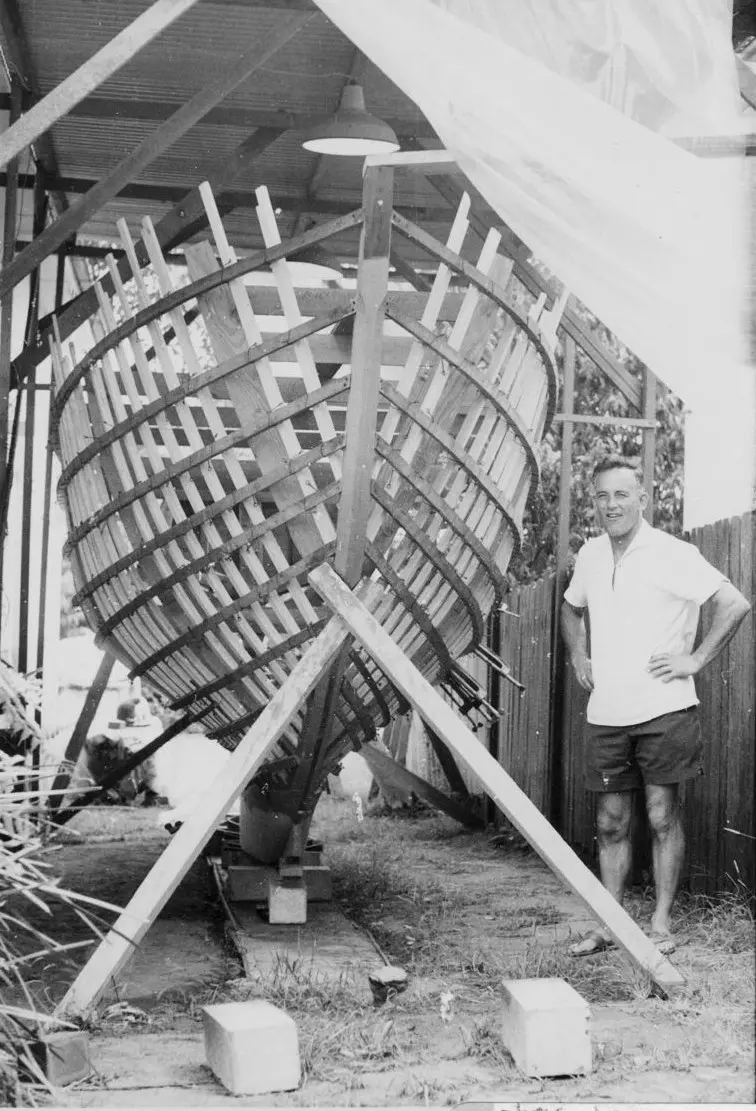
Chris Larrewyn standing proudly under Fionn‘s bow, at home in his sandles!
The third gaff cutter, Patience, was built in the 1990’s at the IBTC, and also had the ‘ocean’ coachroof but she was followed by a delightful throwback to the original short, low coachroof and low freeboard of Andrillot herself. This fourth boat, Canvasback was named after the local marine ducks of the Pacific Northwest, so it must have seemed like just the right name for a hardy little boat built in Port Townsend, Washington State, although it may sound a little strange to us. She was built of conventional plank on frame construction, unlike Tegra, which was the last of this select group of boats and was strip-planked in the mid 1990’s.
____________________________________

Andrillot with her cut-down bermudan rig and extended coachroof.

Andrillot as built.
Whilst I have struggled to understand how anyone could consider replacing Andrillot’s original sophisticated gaff cutter rig with a cobbled-together bermudan replacement, it can quite easily be restored again to the original, so I won’t bang on about it any more for now!

Looking closer at Wanderer II‘s rig, commissioned alongside Andrillot, it is interesting to see how Eric Hiscock’s brief to Giles resulted in a slightly more energised version of the rig, complete with running backstays from the quarters to the masthead. This enabled Hiscock to set the huge, magnificent, light-weather genoa jib from bowsprit end to masthead and in his youthful days it illustrates to perfection how keen and athletic he was as a single-handed cruising yachtsman in the later 1930’s.
Andrillot was sailed to Germany by her new owner a few years ago and I’m afraid I’ve lost touch with him so cannot pass on any up to date information about her.
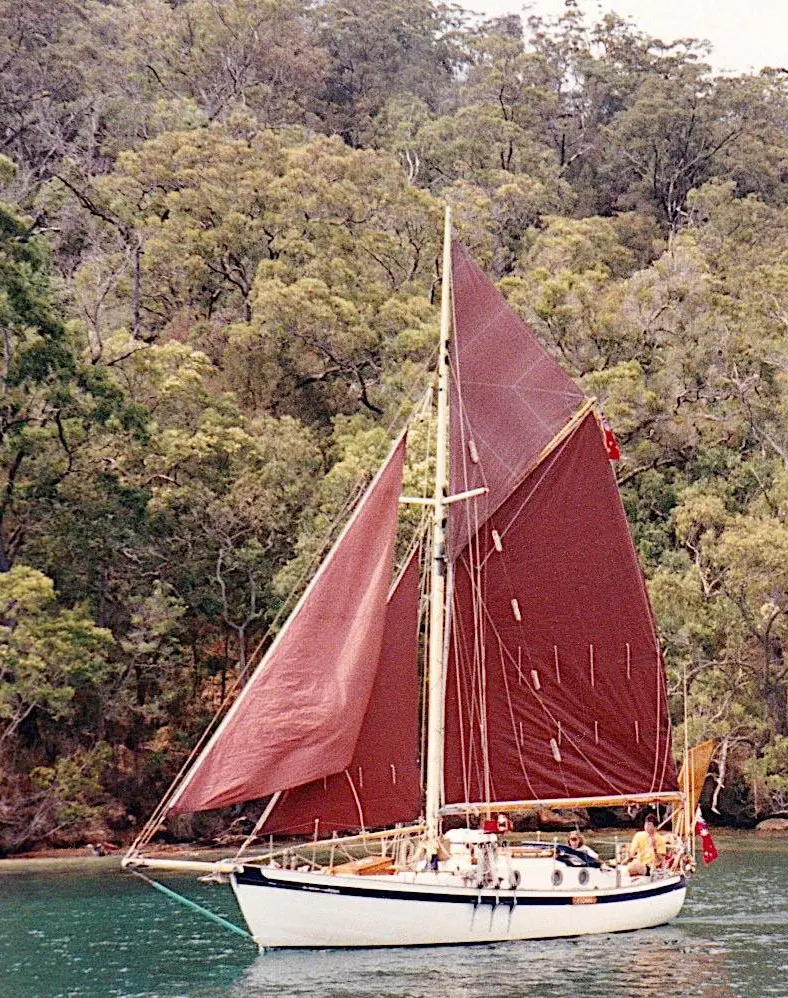
Fionn sailing in her early days near Sydney, Australia.
Fionn, the second of these five special boats has recently changed hands and the new owner is already pressing on with some maintenance. He too, may be heading abroad but keep watching our regular Newsletters and I will keep you posted. She sold as a result of our ongoing Vertues for Sale section of the website, and this is apparently where anyone thinking of buying a second-hand Vertue will look first.
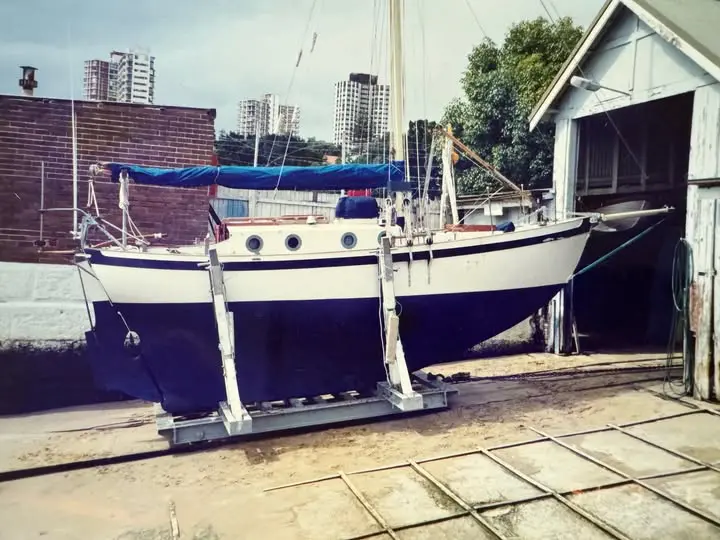
Fionn in Sydney.
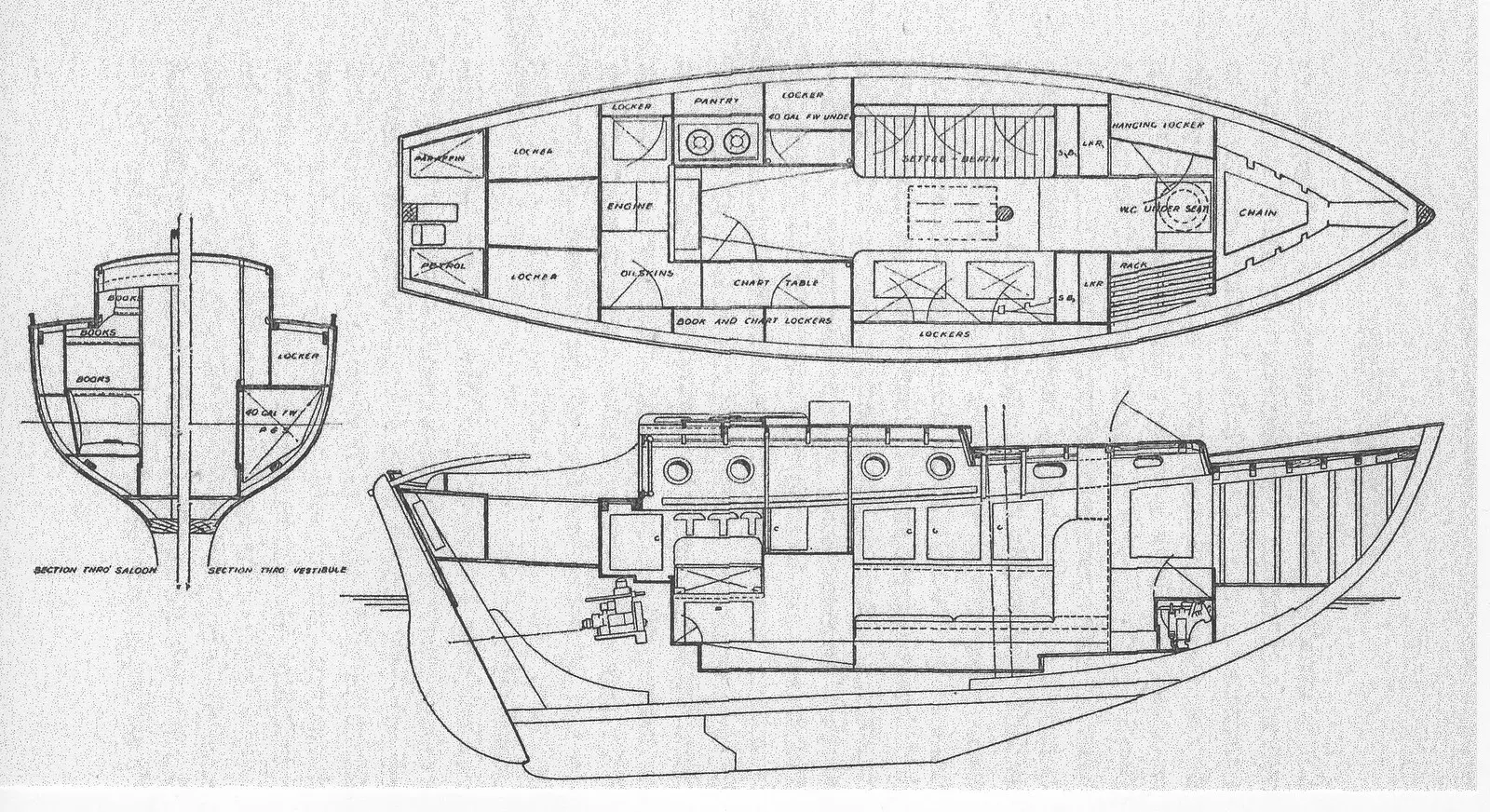
Fionn was built to the Ocean Vertue configuration, as were both Patience and Tegra.

Patience was built with a more conventional shorter mast which complicates the rig somewhat by requiring a yard to the tops’l. She was beautifully finished on deck and below as can be seen, but I’m afraid I have been unable to reach her latest owner for any up-to-date information. She is now called Natural Selection.

Patience looking very smart indeed alongside this pontoon.
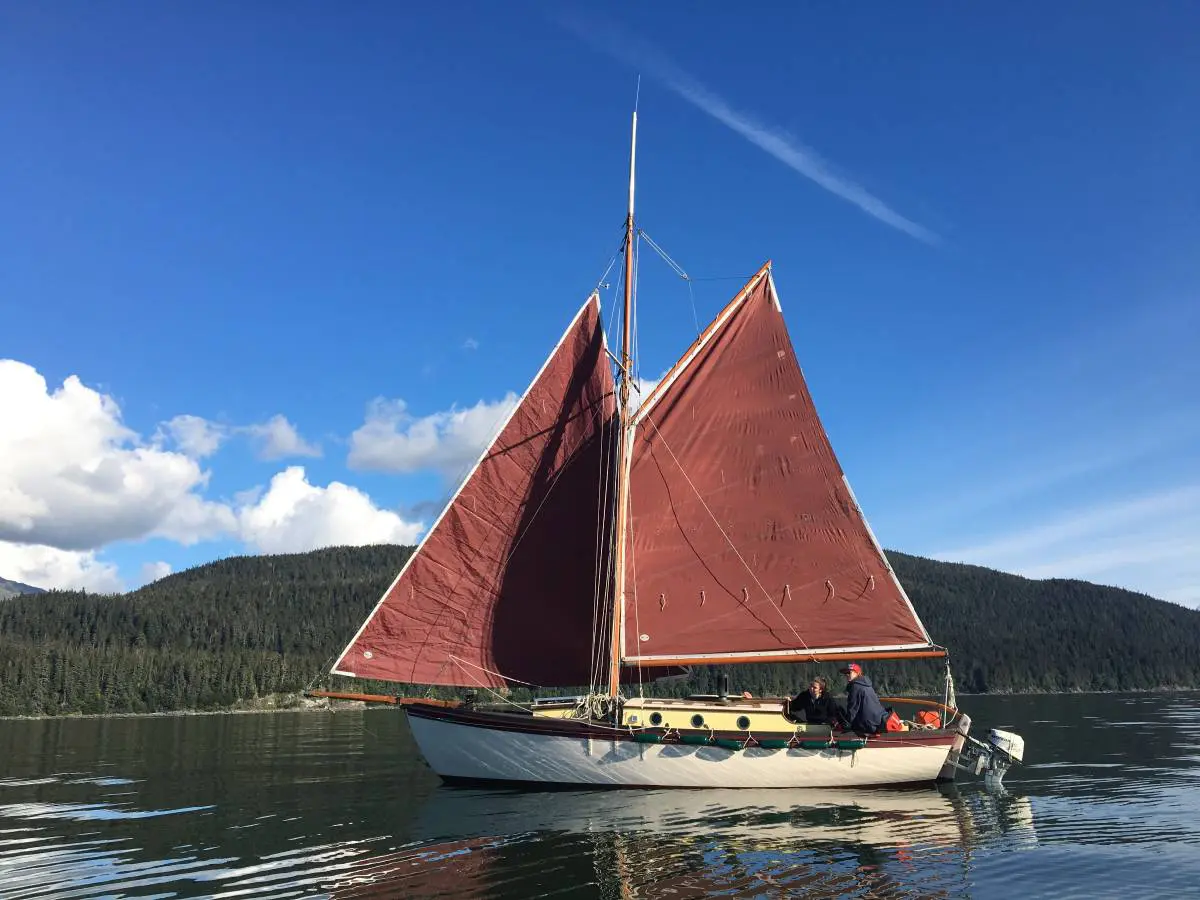
Canvasback is the closest sister-ship to the original Vertue Andrillot

A fine gaff rig over Canvasback’s nearly flush deck.
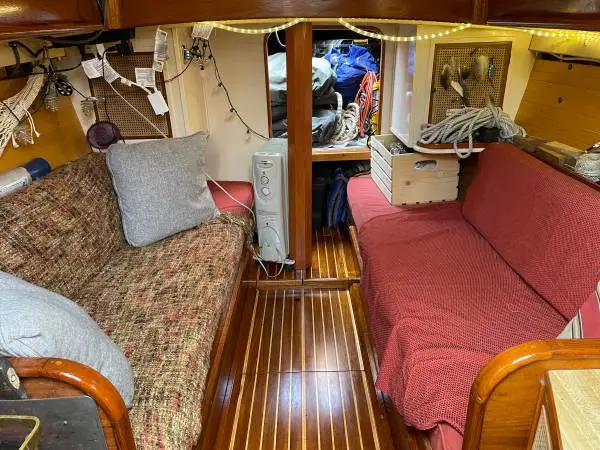
Canvasback‘s very homely saloon.
Perhaps the most elegant of the gaff-rigged Vertues, Canvasback has recently been sailed from Juneau, Alaska, back to Port Townsend, where she was built. Her original low freeboard, short low coachroof and properly proportioned gaff cutter rig make her one of the outstanding Vertues afloat. Sara Gering, her owner has recently put her on the market to go salmon fishing, and her email address is on the boat’s ‘Page’. From the photos it looks as if this boat’s saloon must be one of the snuggest afloat! Just email Sara for full details.
As we all know, Vertues can be found all over the globe, and the location of Tegra, in the British Virgin Islands, could not be more different from that of the Pacific Northwest. But luckily for her she was beautifully built of epoxy strip planking by N. Piersen in Exmouth, so there will be no danger of any seams opening up in the sun. She is very roomy below and although her rig looks a bit snug she makes the most of those northeast trade winds……..Once again, I’ve lost contact with her current owner, so once again, I can’t pass on any new news about her.

I do wonder if there are any other gaff-rigged Vertues still sailing somewhere else on the globe. If you know of any, please let me know……
___________________________
Vertues for Sale
As we all know well the second hand yacht market is pretty slow just now. We have listed several Vertues for Sale elsewhere on the website, but here are some more that are currently available. Interested purchasers can email the owners directly by looking at each boat’s ‘page’ which lists the full details of each boat and her owners, where known.
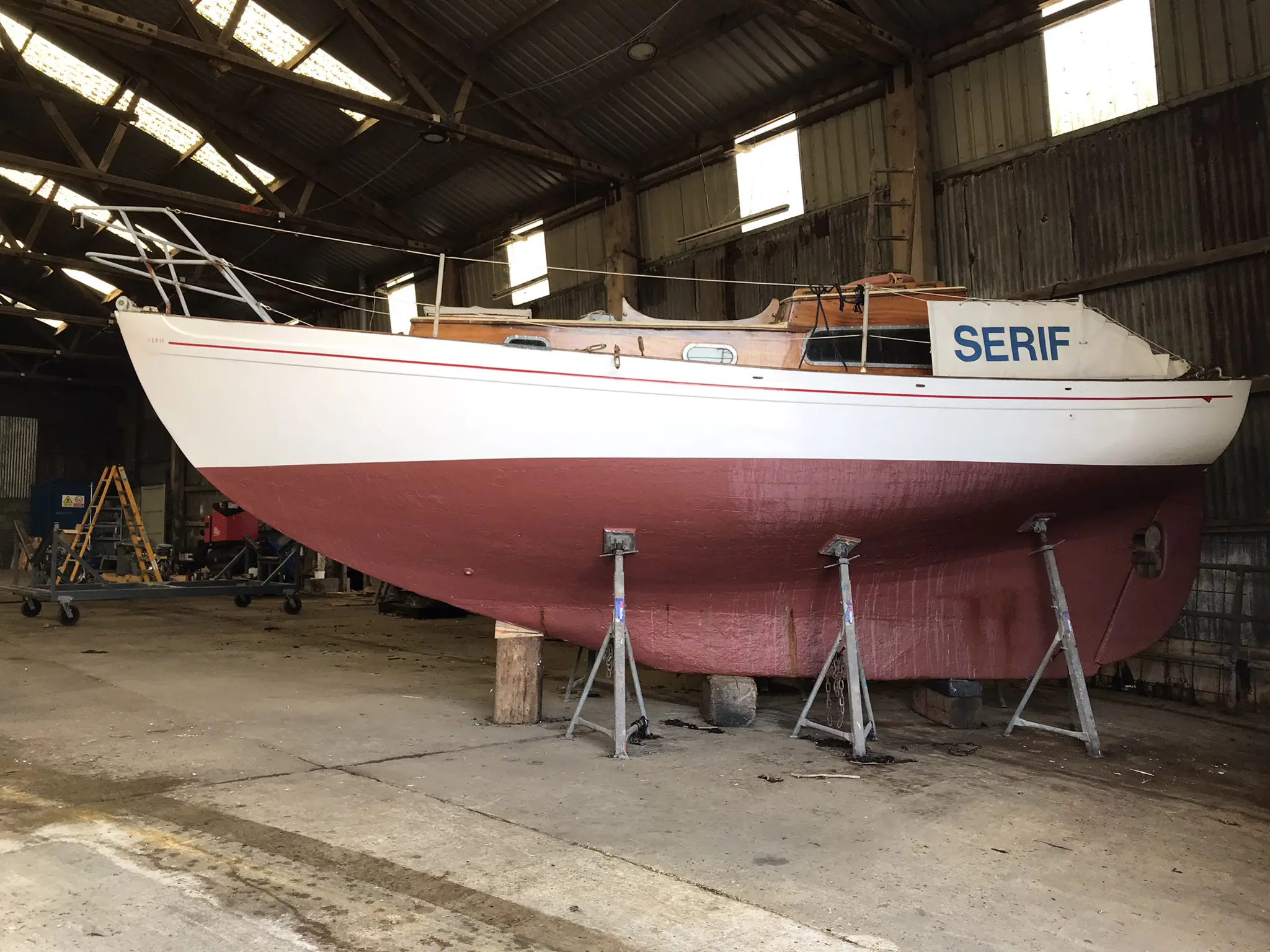
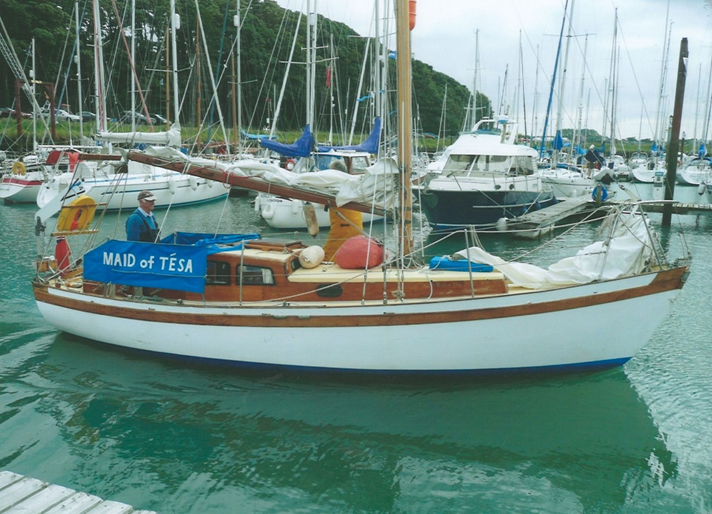
Serif is near Plymouth. Maid of Tesa is laid up in Falmouth.
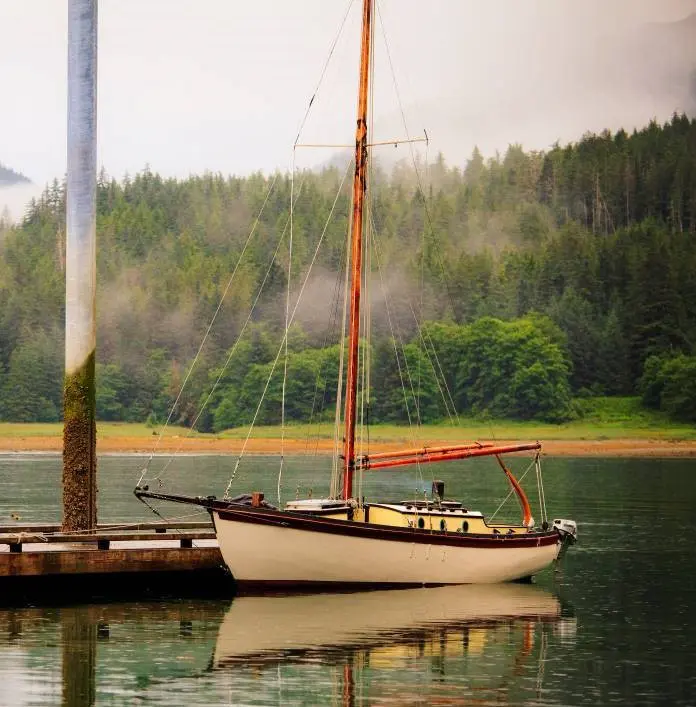
Canvasback is in Port Townsend, Washington State, USA.
__________________________
GRACE is now afloat again!
By Juan-Pablo Olaberria and Duncan Fawkes

After five years of restoration work, our 1947 Vertue, Grace, spent the better part of this summer back afloat. The initial launch revealed a few issues, requiring us to haul her back out for a fortnight to address some persistent leaks around the keel-to-stem and sternpost joints. The second launch was more successful; the intake has now dropped to a minor trickle that is perfectly manageable for the time being. We followed this with a few trial sails in the Solent to test the sails and rigging. An engine problem briefly hindered progress—it refused to reach full revs, even when out of gear. Following some troubleshooting, we discovered the fault lay not with the engine itself, but with a cheap aftermarket tachometer we had fitted.

With that sorted, Duncan and I decided on a short cruise from Keyhaven to Lulworth Cove to give her a proper trial. We broke the outward journey into two legs, stopping for a quiet night on a mooring in Studland Bay.

The following morning we completed the second leg to Lulworth, where Grace performed well. The return journey provided a good opportunity to test her on a longer single passage through two tidal gates. She handled beautifully under sail, steered by the old autopilot that came with the boat. It had sat unused for well over a decade, but like the rest of Grace, it proved reliable and did its job without fuss.

After five years of work, seeing the boat handle the open water properly was a highly satisfying milestone.
______________________________
In the Stern Locker
Readers will have noticed that most of this Newsletter was written by Vertue Owners…..hoorah! This was always our intention……..but it does need continuing committment from more owners to come up with more content, however modest or short. You may also have noticed that I have been unable to contact several owners who might well have contributed something, however short, to keep this Newsletter, as the Vertue Owners’ mouthpiece, going. Please, please just get in touch…….speedwelltwo@gmail.com
Fair Winds & Following Seas
Roger
_________________________________