

CARDINAL VERTUE DOUBLES CAPE HORN SPECIAL SPRING NEWSLETTER EDITION-34-1

Cardinal Vertue
It’s unbelievable that Bill Nance’s high latitude single-handed passage from Auckland to The Horn in December 1964 remains largely unrecognized by the world’s media. His bravery and the outstanding seamanship necessary to drive his little Vertue, Cardinal Vertue, alone across the Southern Ocean at an average speed of 122 miles a day for 38 days was indeed beyond belief at the time. This was two years before anyone else had even attempted it. Now, once again, he is being put forward for recognition by the International Association of Cape Horners, IACH, by his close friend and associate Paul Zeusche who lives near Bill and his wife outside the salty town of Port Townsend, WA.
Sadly, Cardinal Vertue became derelict ashore in Florida, some time after Bill had sold her, but we still have some images, some of which can be found on the boat’s ‘pages’ in this website’s database.

CARDINAL VERTUE
Paul has now made a formal application to the IACH for Bill to be belatedly accepted into their “Hall of Fame” which was set up to recognize outstanding seamanship by those who have double the Horn, 52 deg. S to 52 deg. S, under sail. Here is a copy of a statement that we have prepared for them in support of the application:
Bill Nance Single-handed Circumnavigation
In January 1965 Cardinal Vertue skippered by Bill Nance completed a single-handed circumnavigation of the globe. This was the first time it had been done following a consistently high latitude route across the great Southern Ocean.
Having previously reached Buenos Aires single-handed from Brixham, England, in 1962, Nance set off for Cape Town and thence “ran his easting down” to Fremantle for repairs. From there he sailed to Melbourne and eventually on to Auckland in 1963. Leaving Auckland on 1st. December 1964, his outstanding passage to the Horn in only 38 days, averaging 122 miles a day, was a fantastic achievement, especially in such a small boat. He returned to Buenos Aires on 22nd January 1965, 53 days out of Auckland.
Nance had bought Cardinal Vertue from Dr. David Lewis who had sailed her into third place in the first OSTAR in 1960. This second-hand, standard Vertue class yacht, 25’3” loa x 21’6” waterline length, had been built back in 1946.
Vito Dumas had doubled the Horn alone in 1943 aboard his nearly new ketch Lehg II, 31’2” loa x 26’9”wl, sailing from Valparaiso to Buenos Aires. In 1967 Chichester was filmed passing the Horn aboard Gypsy Moth IV, 53’1”loa x 38’5”wl. He had averaged only 131 miles a day, despite the boat having been designed and built especially for this single-handed circumnavigation. Note the enormous difference in the waterline length of these boats, which is a recognized indicator of the potential sailing speeds of sailing yachts. This design factor had also enabled Chichester to win the first OSTAR in 1960.
It could be argued that by sailing directly from Australasia to the South Atlantic, Nance’s second long Southern Ocean passage was a much greater ‘feat’ than that of Vito Dumas; but this is splitting hairs. Similarly the Bardiaux circumnavigation did not involve doubling the Horn from 52 deg S to 52 deg S and could be viewed as being not quite comparable with Nance’s Southern Ocean passage to the Horn. The IACH’s criteria for a genuine ‘qualifying’ doubling of the Horn specifically states that it should be “part of a non-stop passage of at least 3000’ which passes above latitude 52deg. South in both the Pacific and Atlantic oceans.”
This statement of facts has been prepared to provide some background to the current application being made to the IACH Hall of Fame for the outstanding seamanship of Bill Nance to be recognized. Roger Robinson 15 4 26
________________________________
Keen followers of our modest website will remember that Paul Zeusche wrote a longer account of Bill’s circumnavigation which they compiled, working together, to ensure complete accuracy. This was the first time it had been done, and we are priviledged here at VertueYachts to be able to publish it again. This now seems to be an appropriate time to do so, in support of the current application:
Bill Nance, Cardinal Vertue and their circumnavigation via the three great Capes.
Introduction
Passages round Cape Horn were pretty rare before the mid-1960’s. Bill Nance’s remarkable voyage with Cardinal Vertue is believed to have been only the third small boat, single-handed doubling of the Horn, and most certainly the first by a lone Australian sailor. He was only preceded by Norwegian Alfon Hansen aboard the Mary Jane in 1934, and Argentinian Vito Dumas with Lehg II, in 1943. Both had much larger boats. Then, thanks to the single-handed ventures of Chichester, Rose, Knox-Johnston, and others, which were very well publicized by British newspapers to boost readership, everything changed. Cardinal Vertue remained the smallest vessel to double the Horn during a circumnavigation until 1973.
As Bill is a quiet, unassuming fellow, this is the first really accurate account of his endeavours and was related to this writer and proof read by Bill himself and wife Marie over a period of several weeks, hopefully correcting many small factual errors in 2nd hand accounts by others over the years. This account is as much about the small engineless Laurent Giles designed Cardinal Vertue as it is about her youthful and initially inexperienced Australian skipper, between the years 1962 and 1965.
The Skipper
Bill Nance was the first Australian to circumnavigate alone in an engineless small boat via the three great capes of Good Hope, Leeuwin and the Horn. Without sponsorship, fanfare, or cheering crowds, to witness his quiet departure from Brixham, Devon, England in mid-September 1962, the 24 year old skipper, with scant blue water experience and minimal navigation skills, departed, ultimately with a first landfall at Funchal on the Portuguese island of Madeira in the Atlantic en-route to Buenos Aires, Argentina. Learning to navigate whilst at sea, using Mary Blewitt’s book ‘Celestial Navigation for Yachtsmen’, and teaching himself to use a sextant, Nance’s first blue water passage was successful and completed without incident.
Nance was born in the bush hospital at Yarra Junction, in the Yarra Valley, a rural community some 35 miles east of the city of Melbourne in December 1937. The second child and oldest son of a South African father and an Australian mother, with five younger siblings to follow, Nance aged 18, like many antipodean kids, had the urge to venture overseas, often to former British colonies and the UK, colloquially known as the Great OE, or ‘Overseas Experience’. Passage was made aboard the diesel powered passenger ship Fairsea in 1956. She had been converted from an aircraft carrier and made regular return passages to England as part of the ‘assisted immigrant program’.
Being a keen cricketer, Bill had a ‘fantasy goal’ to find some way of working and playing cricket all the year round! Ideally this would be in England in the northern hemisphere summer and in South Africa in the southern hemisphere summer, where he had numerous relatives on his father’s side.
In pursuing that ambition an opportunity arose to move from England to South Africa through the recruiting efforts of the South African government embassy in London. He was offered a place in the government Miners Training School to undertake an 18 month paid practical training program in the Gold mining industry, with opportunities to secure work upon completion of the course.
At the conclusion of his training, Nance continued to work for 6 months in the mines of Stilfontein, where he had trained. There, in the western Transvaal, as a hard ‘rock miner’, working under extraordinarily challenging conditions over a mile underground, in excessive heat, blasting rock in the search for gold. The European recruits now armed with practical experience underground were in charge of clearing debris from the previous night’s blasting, and drilling to insert new explosive charges at the seam face. Nance was in charge of up to 100 men, mostly native labourers, all working in what now would be classed as dangerous and appalling conditions, up to 6,000 ft underground. Six months of this was enough, and a new job was sought, eventually finding a place in a mine in Northern Rhodesia, (now Zambia), and still deep underground. Although only about 3,000 feet deep, the work was somewhat similar, but a different type of operation, now mining for copper but still grueling and dangerous, with scant attention to health or safety.
The work week was 6 days (out of 7) and in his limited spare time Nance learnt to sail on the nearby lake. The Firefly dingy class was produced by Fairey Marine on the Hamble River, Southampton, using the aircraft wood veneer, hot-molded manufacturing techniques developed by De Havilland during the war for the Mosquito bomber and other aircraft of the day.
After 5 years in Southern Africa, Nance left in September 1961 to return to the UK with the vague idea of sailing a boat of his own back to Australia. In an effort to expand his rudimentary nautical knowledge he found a crew position on a motorized barge owned by R&W Paul out of Ipswich, Suffolk, transporting grain from there to the London Docks. But upon seeing the Cambria, the last surviving coastal sailing barge, he jumped ship, so the speak. She was owned by the Everard Steamship Company, and at 95′-6” long and 109 tons she was usually just crewed by a Skipper, Mate and a “boy” who could be any age. Before long the mate quit, leaving just the skipper and Nance, the boy, to manage the large spritsail-rigged barge on their own! Typically, loading cargo in London, at the Royal Docks, she sailed down the river Thames to Ramsgate and then up the east coast of England, as far north as Great Yarmouth, usually returning empty to London.
Her very experienced skipper was A.W. Bob Roberts, who, after his retirement, variously became a British folk singer, songwriter, author, journalist and story teller. He had completed a couple of blue water passages, with a friend, in earlier days from London. One was through the Panama Canal to Cocos Island, where the vessel was wrecked after dragging her anchor during a sudden squall, ending up ashore; his adventures were recounted in the book, ‘Breeze for a Bargeman’.
Under Bob Robert’s tutelage, Bill Nance expanded his seagoing experience and, in the search for an affordable boat, was lucky to have Bob along for advice when eventually a suitable boat was found. Fortunately, Nance had Cardinal Vertue surveyed, which revealed serious electrolytic corrosion between her galvanized iron floors and copper bolts and through adjacent frames and planking. This was ultimately deemed repairable, and forced the sale price down with agreed repairs completed at Priors Yard in Burnham-on–Crouch. The problem also necessitated some lower plank replacement, amongst other structural defects.
Thus, Nance became the new and proud owner of Cardinal Vertue. owned at the time of sale by none other than ex-pat Kiwi, Dr. David Lewis, who had recently completed the inaugural 1960 Single Handed Transatlantic Race against 3 other competitors with relatively small boats, around 25′, and Francis Chichester in a much larger 40′ boat. Chichester arrived first in 40 days and David Lewis came third in 56 days, including having to return to Plymouth to repair his mast which broke at the upper spreaders, less than a day out! His return to the UK that autumn was an incredible feat of endurance as the boat was hit by gale after gale but Lewis was tough enough to cope, and arrived in the Shetland Islands almost 26 days out of St. Johns. The following year he sailed the boat south and eventually sold her to Bill Nance in the summer of 1962.
This brings us to Cardinal Vertue, and the beginning of rest of the story!
The Boat
The original Vertue, Andrillot, was designed by Laurent Giles in 1935, as a gaff cutter. The design evolved over the years and by the late 1940’s, when Cardinal Vertue was built, had been modified to carry a double-spreader bermudan mast stepped on the coach roof with running and standing backstays. The short doghouse over the companionway completed her revised profile. Some had small motors, but many remained engineless and proved to be capable small boats for coastal cruising and as later found, with a very respectable turn of speed for such a short, 21’6”, waterline.
Cardinal Vertue was built in 1948 by Elkins, a long established and still extant yard in Christchurch, Dorset, for predominantly local cruising in the UK and remained in single ownership for 10 years until sold to Dr. Lewis. With the OSTAR in his sights, he replaced the single standing backstay to its boomkin with a pair of backstays to the quarters. This allowed space for the simple self-steering vane to rotate freely.
More than two hundred Vertues, with several design variations, have actually been built over the years, and the majority are of conventional plank on frame, timber construction, with strip planked and glassed over hulls becoming available since the 1980’s. Most were built by British boatyards, but the Cheoy Lee Shipyard in Hong Kong were chosen to build over twenty boats over the years, largely because of the availability of good quality teak at a competitive price.
About forty grp Vertues were moulded by Bossoms, near Oxford, after several earlier hulls had been finished by different owners. Of these, the Sparrow, was completed by father and son team Daniel and David Hays and sailed 17,000 miles around South America from their home on the northeast coast of the US. She became the second Vertue to double the Horn, almost 20 years to the day after Bill Nance.
An excellent and informative web site <http://www.vertueyachts.com> has much detail of the 250 or so, that are known to have been built, and is highly recommended for those interested.
Many Vertues have completed remarkable ocean passages. One of the earliest was Humphrey Barton’s crossing of the north Atlantic from east to west aboard Vertue xxxv in 1950, with one other crew member. More than a dozen multi-ocean voyages over several years have followed, and long ocean passages have become quite common.
Back to the voyage.
Following the repairs being completed by Prior’s Yard, Bill removed the small Stuart Turner petrol engine, in order to accommodate more fresh water storage, and later in Cowes, Isle of Wight, installed additional storage lockers. Still with scant experience, he set sail on Cardinal Vertue, coastal hopping down the east coast of the England at the onset of autumn of 1962, which included a full grounding in deteriorating weather in the Solent, fortunately without major damage, except perhaps to his nerves! However, he prudently put in to Cowes, and hauled out to check the integrity of the hull and complete other minor additions. Then he on down the coast, anchoring in Weymouth Bay to sleep at night, before continuing on to Brixham, Devon.
This was just the start of a character building period, which would continue for quite a while, as he anchored in Tor Bay, off Brixham Harbour, to avoid bad weather in the English Channel. Unwilling to enter the harbor under sail, Nance’s tethered dinghy broke loose during the stormy night, but was fortunately rescued by the crew of the cross-harbour ferry. Nance saw that his missing dingy was tied up in the inner harbour, so, next morning, he had no choice except to sail into the harbour and re-claim it!
Provisioning and preparation for departure had been largely completed in Cowes and on September 13th, 1962, Nance finally departed from the coast of southern England for his first ocean passage, taking him across the Bay of Biscay, keeping well away from the Portuguese coast, and out into the Atlantic to Funchal, capital of the Portuguese island of Madeira, making landfall on September 28th. 1962.
Navigation skills, as noted earlier, were acquired en route, using Mary Blewitt’s’ book, accompanied by Sight Reduction tables and a used sextant, purchased from a marine chandlery company in London. He also had a well-used surplus Royal Navy deck watch in lieu of an unaffordable (to Nance) chronometer. His inexpensive store-bought transistor radio, with Short Wave band, was capable
of picking up the BBC time signals, enabling longitude positions to be calculated from the noon (sextant) sights when weather allowed; not always easy on a small vessel at sea.
Minimal re-provisioning of fresh fruit and vegetables completed in Madeira, he departed Funchal 4 days later on October 2nd. 1962, Nance was fully prepared for the long passage down through the Atlantic to Buenos Aires, Argentina. He had initially planned to break up the long ocean passage with a short stop in Buenos Aires, instead of making directly for Cape Town, South Africa, as leaks from the aging canvas covered deck were rapidly worsening as he sailed south.
Initially, anchoring in the large commercial Port of Buenos Aries flying the Q flag to request clearance he was ignored by the authorities, so a move was made to San Fernando some distance up the River Plate to the hospitable Argentine Yacht club with repair facilities nearby. The deck covering was too far gone to save so, this was removed and replaced and Nance now could anticipate a dry berth for a change! The well-used secondhand Royal Navy deck watch, purchased in London was replaced by a regular wrist watch as it was not able to keep a consistent rate.
At this time, in the early 1960s, yacht passages from Europe to the South Atlantic were rare, so Nance had nothing to compare his 62 day, 4500 + passage time from Funchal to Buenos Aires including about 14 days through the Doldrums. The only comparisons were the old square-rigged sailing ships and Nance had to use the same British Admiralty Sailing directions as they did, because there was nothing else!
The self-steering on Cardinal Vertue, originally installed by Dr. Lewis, was not working reliably though it had served Lewis well enough on his two transatlantic passages, a local fellow at the Argentine Yacht Club claimed to have a better version of the gear, which Nance had installed, but as it turned out, was no better than the original.
Now patched up and re provisioned, Nance took his departure for Cape Town, heading southwest, seeking the westerly winds, for an uneventful crossing of 39 days for another 3000 + mile passage, navigation and passage making skills rapidly improving en-route, as he put the miles under the keel.
Bill had relatives on his father’s side in Cape Town, so several weeks were spent socializing as well as preparing for the long haul to Australia; he departed Cape Town March 21st. 1963, originally bound for his home town of Melbourne, however events overtook him, as we shall see. (2445 words)
END OF PART ONE AS PUBLISHED IN THE SUMMER NEWSLETTER 2023
BILL NANCE DOUBLES THE HORN WITH CARDINAL VERTUE
Crossing the Indian Ocean, running before a strong storm for a couple of days, not long after dawn on the 28th of April, the extinct volcano of St Paul was sighted ahead of Cardinal Vertue. Sailing with just a storm jib due to the wind and sea conditions, Nance kept to the northern side, and when almost past it, Cardinal Vertue was seriously pooped while Nance was in the cockpit and hand steering as conditions were too rough for the self-steering to function reliably. The breaking wave came aboard, over the stern, washing Nance overboard along with the top washboard of the companionway, the self-steering gear plus the entire mast above the lower spreaders, but still attached by the forestay and backstays. The storm jib was ripped to shreds. Luckily, the coachroof stepped mast wasn’t lost entirely and provided the basis of his jury rig.
Fortunately, Nance was tethered to the vessel’s cockpit by a short life-line and was able to pull himself back on board, catch his breath and assess the situation he found himself in. He had sustained a leg injury, but luckily nothing really serious. Being unable to go anywhere and just drifting westwards, Nance set about stripping the upper rigging away, repurposed a sail for the jib and used an old lifeboat sail on the boat when he bought her, as the new mainsail. The missing washboard had let a considerable amount of water into the boat and with this sloshing about as Cardinal Vertue rolled and pitched without the steadying effect of the mast, the interior was an absolute mess.
Amsterdam Island, about 60 miles N of St Paul, home to a manned French Meteorological Station, was fleetingly considered as a possibility to seek assistance, but was dismissed as it was unreachable with the remaining boat’s rig and with no chance of reaching St Paul either Nance was only going to get out of this by his own efforts. Once clear of the island and pumping the boat more or less dry, thought was given to erecting a jury rig from what remained. Eventually, in clearing weather and over the next three days, a new forestay and back stay were made to provide support to what was left of the mast as all that survived were the lower shrouds. What-ever remained was salvaged where possible and the rest cut free.
The short wave radio was water damaged and unusable, so his ability to accurately calculate his longitude was also lost, but a course was set, now amended toward Fremantle as the nearest achievable landfall, given no ability to go to windward at all. Fremantle was some 3,500 nautical miles away!
This put Nance to the north west of Cape Leeuwin, which, in itself is notorious for heavy weather as it forms the juncture of Indian Ocean and the beginning of the Pacific. Fremantle and Rottnest Island lie to the north west of the Cape.
76 days out from Cape Town, landfall was made on the southern tip of Rottnest Island, before dawn on June 5th, 1963, well-marked by Wadjemup lighthouse. Rounding Rottnest in daylight, Nance altered course for Fremantle Harbour, about 15 miles downwind. He had no charts of Fremantle Harbour (he had not planned to go there!) it being a busy commercial harbour without provision for pleasure boats. Nevertheless, he managed to sail in and go alongside a commercial dock wall, an unsuitable situation for such a small boat, due to the wind’s strength and direction. Happily, Jack Prince, owner of a private boat launch company, noticed the arrival of CardinalVertue limping in to the harbour under jury rig and dispatched one of his employees to tow Nance to a more sheltered, and safer, place to tie up. The young fellow, Murray Shaw, running the Princes’ launch, was about the same age as Nance and after ensuring that Nance and Cardinal Vertue were secure at the more sheltered location, asked Bill if he could do anything else for him. “I’d really like a bath” was Nance’s response, so Murray took Nance to his home for a much welcome bath. Murray’s mother, brother and sister were delighted to have Bill share a decent meal with them and get some rest ashore for the night.

Next morning, when he returned to the harbour, Murray had already gone to work; Nance had no more contact with him until June 2015! Members of the Freshwater Bay Yacht Club, on hearing of Bill’s arrival, had come down the River Swan and towed Cardinal Vertue upstream to the club and haul-out facilities, where, with much help from club members, Nance undertook all the repairs necessary to return the yacht to a seaworthy state. He had a lot to accomplish in way of repairs and with the hospitality of the Commodore of the Yacht Club, Merv Finn, Club Officer, Bill Jacobs and local resident Tom Robinson, this was soon underway.
A new mast of Sitka spruce was made locally to beefed up scantlings recommended by Laurent Giles, (in other words: a heavier and stronger mast), with permanent standing backstays, and the runners were retained just as a precaution. New sails and other improvements were undertaken over a period of several months, with gratefully received help from the very hospitable West Australian community around Freshwater.
The Customs authorities welcomed him with a demand for duty on an imported boat, at 83% of her assessed value, and in lieu of this, allowed him six months with a bond to either pay up or leave!
Following intervention by the Member of Parliament for Nance’s home constituency in Victoria and a bond posted by a Perth bank, Nance was permitted to stay in Australia for 6 months, with the option to either to pay up or depart Australia by the end of the year.
The germ of an idea of a circumnavigation via Cape Horn had been planted by a chance conversation with Vito Dumas in Buenos Aires the year before, but circumstances now strengthened this possibility.
With time sliding by, Nance left with his new mast being re-stepped once downstream and clear of the low bridge, and departed toward Melbourne, his next intended port of call and home town.
Well past Cape Leeuwin and south east of Albany, again in very heavy weather, Cardinal Vertue was seriously pooped and rolled. The boom, with most of the mainsail roller furled tore free of the mast at the gooseneck with the small amount of the mainsail still hoisted tearing free of its track, sending the whole lot flailing about, still attached by the halyard at the masthead.
In the wild conditions there was no hope of retrieving the sail and boom so reluctantly this was freed from its halyard and cast adrift, a very short life for a new sail! Additionally, daylight could now be seen through the forward planking and further inspection revealed the frames and deck beams in the bow had sustained considerable damage with several broken, and the seams were starting to open, to the extent that the caulking was gone and, once again, a lot of water had to be pumped out.
Albany, Southwestern Australia, is at the start of The Great Australian Bight, the last major port, and over 1000 nautical miles from Port Augusta and Port Pirie near Adelaide in South Australia, on the eastern side of the continent. Although past Albany, Nance headed back with just a headsail and for the second time, on September 12th, 1963, Cardinal Vertue limped into Princess Royal Harbour, Albany, under jury rig finding shelter, haul-out facilities and much help from the ever-generous West Australians. She was hauled-out, the bow damage repaired, and the mast at the lower spreader level was further strengthened, as well as taking care of other minor damage.
Once again, on Sunday, October 13th. 1963, Cardinal Vertue set sail, this time from Albany, to restart the remainder of the interrupted passage toward Melbourne, which was somewhat anti-climactic and incident free except for running into heavy coastal fog off Cape Otway in Victoria. This is considered the boundary between the Southern Ocean and Bass strait and only sound warnings from the lighthouse kept him out of the surf! Over the years eight ships had been wrecked off the cape despite a lighthouse being there since 1848. This was the first uneventful passage in several thousand miles, but his experience of heavy weather conditions was rapidly being attained!
Continuing difficulties with the authorities in regard to a returning Australian with a foreign built vessel forced a change of plan and the decision was made to continue eastward and complete a full circumnavigation at Buenos Aries. The nebulous idea of a circumnavigation had formed in the back of Bill’s mind since the departure from the UK, but this crystalized into a certainty after the inflexible attitude of the authorities and the approaching end of the 6 month bond period.
After a reunion with family and friends and an eye on the time of year for the now anticipated passage to Cape Horn, a short stop was made in Hobart, capital of the island state of Tasmania 200 miles south of Melbourne. So at the end of the year clearance was secured on January 5th for Auckland, New Zealand, 1500 miles NE of Hobart
This passage in part on the edge of the roaring 40’s can be lively at almost anytime of the year as there is nothing to the south except Antarctica. Rounding the tip of New Zealand’s North Island in very calm weather after a passage of 14 days Customs was cleared in the quiet settlement of Whangaroa on the east coast. Bill made his leisurely way down the coast to New Zealand’s largest city of Auckland in pleasant summer weather, where a convenient berth was found alongside a derelict harbour ferry at the commercial end of the large Westhaven marina close to Auckland city center.
Nance sought short term employment in Auckland, working first in the Wool Sheds, then, when work slowed down, at Baileys Shipyard and the Auckland Gas Company to bolster the cruising kitty.
Time off between jobs enabled Bill to crew on ‘Cotton Blossom’ a well known and fast racing boat, owned by Peter Spencer and he was invited to crew in the inaugural Auckland ~ Noumea ocean race and other harbour races locally.
Amongst other improvements, a new Blondie Hasler wind vane was installed on Cardinal Vertue, as well as making the final preparations and provisioning for the long haul down to the Horn before the southern hemisphere winter set in. All these distractions occupied most of 1964 but departure was made toward Cape Horn just as the southern hemisphere summer settled in.
After obtaining clearance from the New Zealand authorities, Nance quietly sailed out of Auckland on the 1st of December 1964, bound for Cape Horn and toward Buenos Aires in the south Atlantic, to complete his circumnavigation.
The weather remained light and variable until north of the Chatham Islands, a dependency of New Zealand, about 500 miles east of the South Island, NZ. Then he picked up the Westerlies that would hopefully persist for the long haul down to Cape Horn, some 5,000 miles south east.
Weather conditions remained favourable, predominantly downwind, and Cardinal Vertue reeled off the miles averaging about 120 miles per day, a remarkable speed for a 25 footer with a 21’ 6” waterline.
Conditions remained good until December 30th, at 51 degrees S, Cardinal Vertue was running before a full gale. Nance recalled, “Under a bare poles with 30 fathoms of warp and a tyre streamed out astern, a huge wave crashed aboard, breaking off the tiller at the rudder–head and forcing the vessel to lie a-hull.” He continued, “I have no great faith in lying a-hull and probably only survived because the weather eased and by the following day I was able to fit a spare tiller.” The breaking wave over the stern also badly bent the self-steering vane shaft above the upper bearing, leaving it barely functional.
He had to wait several hours for the seas to calm, so the replacement tiller could be retrieved from under the cockpit before repairs could be made. With the tiller replaced, it was back to hand steering until some kind of repair could be made to the self-steering vane, very difficult under the conditions and with the limited resources aboard.
Landfall was made upon sighting Diego Ramirez, a group of islands in Drake Passage, south and 60 miles west of Cape Horn itself. At about 56 degrees south, a weather station had been established on the largest southern island, although it is only resupplied once or twice a year.
Having a confirmed position, Cape Horn itself was rounded in daylight on January 7th.1965 in relatively good conditions, with a course change toward the straits of Le Maire. As there is a strong tidal set through the narrow straits, passage has to be made with the tide, but there is an anchorage of sorts on the mainland side that can be used if conditions are unfavourable.
Near the Barneveldt islands, SW of the mainland and the straits, the main halyard jammed and Nance had to climb the mast, unassisted, in an effort to free it; this was accomplished hand over hand, without the benefit of a bosuns chair. For those who have ever been up a mast they would know how difficult this would be, not to say without an element of danger!
Not long before Nance thought he’d not make it before the tide turned, but the wind increased enough to ensure safe transit and he made it safely through the narrow channel, thus saving having to find the anchorage or stand off until conditions allowed. The remaining 1400 miles to Buenos Aires remained uneventful and entry to the busy harbour was again made on January 26th 1965, after a very creditable 56 day passage from Auckland thus completing Nance’s and Cardinal Vertue’s successful circumnavigation, believed to be one of the first in such a small vessel, and remaining relatively unacknowledged until recently.
Cardinal Vertue again moved upstream in the River Plate to the yacht club much to the surprise of many who had said farewell to him only3 years before in 1962. After further minor repairs to Cardinal Vertue, including replacing the bent wind vane shaft, Nance made ready to continue his adventure.
Leaving Buenos Aires once again in May, and making for the Caribbean, Nance worked his way up the island chain through the Bahamas and across to the USA entering in Miami, Florida, in June, with the enticement of a crew position again on Ondine for the Miami to Acapulco race later in the year.
However, romance intervened and the crew position was abandoned, while Cardinal Vertue was prepared for sale. She was sold to a fellow with little interest in her, apart from making a quick profit, so an engine was installed along with other minor improvements before she was sold again. The newest owner lost interest and allowed her to slowly deteriorate in the unforgiving Florida climate, and so, sadly, ended the life of a very capable little boat. But at least her memory is perpetuated by all the boats that came after her, having been built to the same basic design.
Bill Nance’s long involvement with sailing has continued throughout his life, right into his retirement in the Pacific Northwest. Now in his mid ‘80s he lives a less adventurous life, close to the water in a very active boatbuilding community, on the shores of Puget Sound.
_________________________
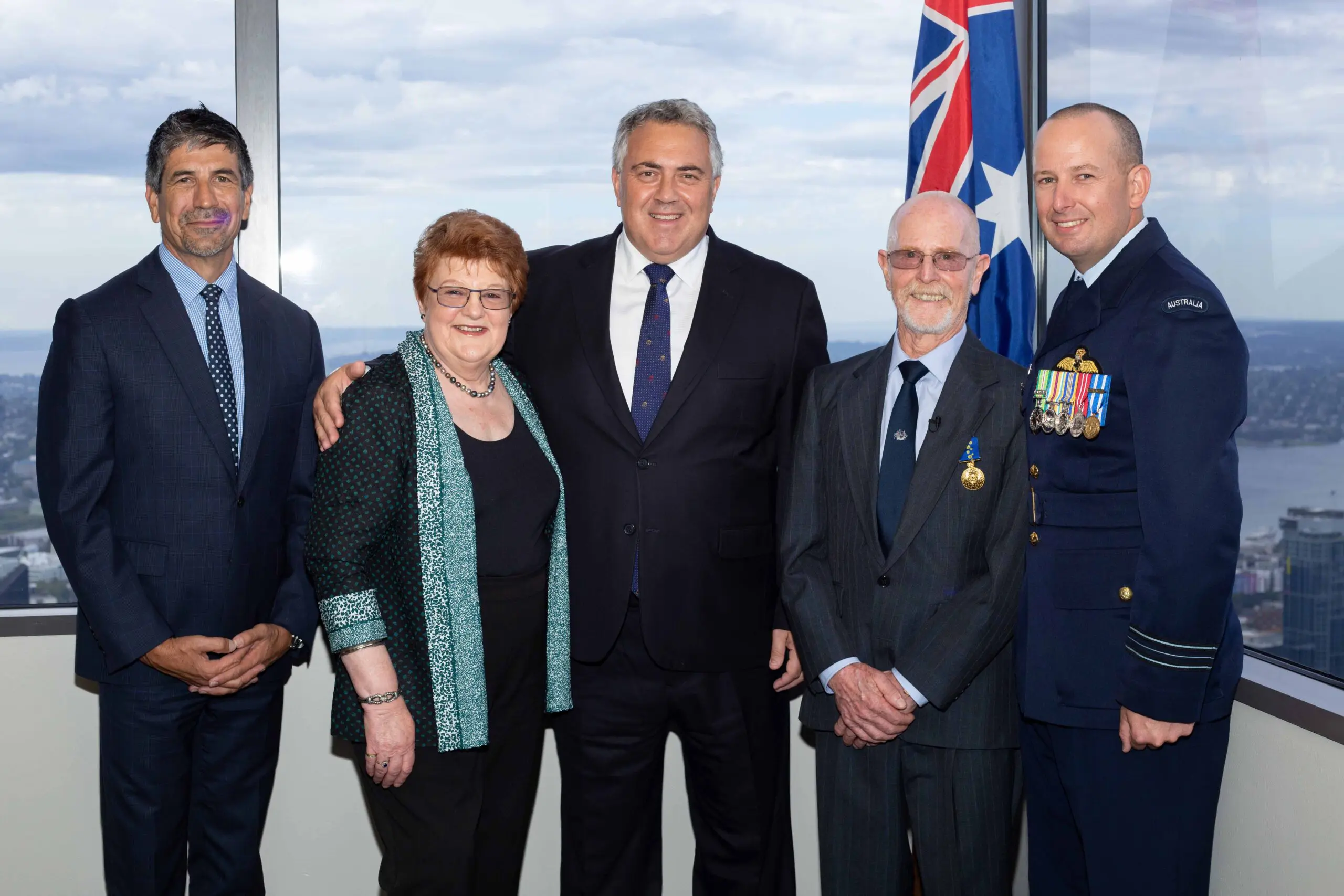
Bill accepting the Division of the Australian Order of Merit from the Australian Ambassador to the USA in 2019 in recognition of his single-handed circumnavigation.
____________________________
After Bill Nance completed his solo doubling of the Horn aboard Cardinal Vertue, he wrote to the Laurent Giles Partnership in Lymington who received this letter on12th February 1965.
“Arrived in Buenos Aires on 22nd. January, 53 days out from Auckland, after a fairly uneventful trip. Lady Luck smiled for a change.
My departure from Auckland was delayed when at the beginning of November I planed the tips of my fingers on a machine. Of six fingers I cut both index fingers and I had to have skin grafts. I sailed on December 1st. and had a good fresh breeze in the SW which gave me a fine start. While working to the SE an intense anti-cyclone to the east of New Zealand gave a prolonged period of fine weather. By the 18th I was in latitude 47deg.S and 2000 miles were astern.
Thereafter the wind set in from the westerly quarter and was usually quite strong. Sailing mostly with the working staysail and mainsail (more often than not well reefed down) I had some really great sailing covering the next 2000 miles in 13 days. It was a little wild in the rough sea as day after day Cardinal Vertue surfed along with the windvane doing the steering. I remember occasions, as she surfed on a crest, when it was not possible to see over the top of the bow wave. On deck it was always wet with water frequently filling the cockpit and of course the rain squalls which seem to be never ending in the south kept sending water down from above. Actually I had expected colder weather than I met with.
Stowage had been arranged so that there was practically nothing stowed in the ends. It meant it was a little cramped in the cabin, but I think it was well worth it. I am a great believer in following racing practice as far as stowage below and windage on deck go.
December 30th saw a severe gale which was to be the worst blow I met. As I was then almost 51deg. S it was very fortunate that it was of short duration. The sea was bigger than I had seen before and was quite frightening. During the heaviest of the squalls it was almost impossible to see for the rain and spray. Running under bare poles I had to dismantle the wind vane which was breaking up under the buffeting of the wind. I streamed 30 fathoms of warp, with a rubber tyre attached, astern. A crest which tumbled over the stern caused the tiller to break off at the rudder head, so I then lay a-hull. I had Tzu Hang very much in mind as I was in the same general area as she when she did her flip. I have no great faith in lying a-hull and probably I only survived because the weather soon began to ease. Next day I was able to repair the vane and fit the spare tiller. Another gale followed on New Year’s Eve but was not nearly so bad.
My confidence suffered as I progressed to the south and daily runs became shorter as a result. The barometer dropped to 28.73in as I approached the land but nothing came of it. Cloud cover as usual was heavy but I was almost always able to get sights.
On January 7th. I made landfall on Diego Ramirez Islands and later the same day ran close to the Horn just 38.5 days from Auckland, a distance of almost 5000 miles. A fresh wind and rain squalls at the Horn, which was good weather for that part of the world. I was relieved to have the crossing over and although there were still 1600 miles ahead I felt I was almost there.
Calm weather made it a battle to make the tide in Le Maire Strait. I kept well offshore in the Atlantic hoping to benefit from the Falklands Current. Light head winds and fog made it a slow trip and to make matters worse the luff wire in my genoa parted. Saw no ice and made my landfall right in the River Plate on the low southern side. The following morning I was moored in the harbour at Buenos Aires. Cardinal Vertue is amongst some fine yachts here (Ondine and co) but she has earned her place, I think.”
____________________________________
I hope all our readers will have enjoyed this Special Edition Newsletter. There is nothing more to add.
Fair Winds! Roger