

CHRISTMAS NEWSLETTER -29- DECEMBER 2024
We really do have a bumper Christmas Edition for you this year, and the best bit is that most of it has come from you! For starters I want to thank Ben Deveson for his timeless photograph of his elegant steel Vertue, called Virtue, that graces our front page.
I have started with a short piece about the Vertues currently for Sale, that illustrates some of the diversity to be found within the Vertue fleet. Then Juan-Pablo and his delightful Grace, who have featured here before, have checked in and it is good to see the amazing progress that he and Duncan have made over the past year. His report demonstrates how straightforward it is for anyone to contribute to these Newsletters, so please don’t hesitate; send me an email about your boat!
Regular readers will possibly remember some of the pieces I have written in an attempt to illuminate the outstanding design work of Jack Laurent Giles, and the Vertue’s place within it. So this month I have asked some new questions about what influences he might have had before he actually drew up the design of the Vertue.
I would especially like to thank Alasdair Flint for his quite astonishing story of his adventures with Sumara. As an inaugural piece of writing on the theme of ‘Me and my Vertue’ he has set the bar way beyond the reach of most of the rest of us mere Vertue enthusiasts. But this isn’t a competition, so I hope his remarkable story, told so straightforwardly, will inspire some more accounts to emerge for us all to enjoy in future.
It’s always a pleasure to be able to use some photographs of the elegant, early, Vertues. So I’m delighted to be able to publish the email I received from David Biddle, the son of Epeneta‘s first owner about his father’s boat and our own local ‘original Vertue’, Caupona, which Peter Gregson keeps nearby on the River Dart.
I’m also delighted to be able to publish a short report about the Lymington ‘L’ class from Joe Brumwell from Cornwall, who has kindly put together a brief description of the class. I’m hoping that he’s going to give us some more yarns about the boats in future Newsletters. Their design is, after all, very closely related to the Vertues, and some might even say that they could be seen as a kind of prototype for the class. Clearly they were created to provide for a less rigorous kind of sailing than some of the Vertues ended up being asked to achieve!
__________
WHAT IS A VERTUE?
I read an article about Vertues recently, written in one of the glossy yachting magazines. The trouble was that the author wasn’t given enough space by the editor, or whoever decides these things, to explain that the boat in question was only one, early, manifestation of what has really been a ‘development class’ of small cruising yachts. Surely part of their appeal for many owners is that they all have their own distinctly different character and appearance, whilst at the same time they remain recognizably Vertuous.
To illustrate what I mean, I thought it might be amusing to look briefly at the seven Vertues that are currently listed in our Vertues for Sale section of the website. It is a wonderfully diverse selection of boats. They cover most of the available types from the old, 1930’s Sally II, to the aluminium-hulled Luana, to a chunky gaff cutter rigged ‘ocean’ boat Fionn, and the high spec. long cockpit, Betsinda. Both Vertue Fidelis and Sparrow have now sold, but I’m leaving them up there because they are both outstanding examples of the class, and it seems a pity to remove their photographs just yet! (Although all the boats can be viewed in their own ‘Page’ under the ‘Boats’ heading above.) I have described them below in the order in which they were built.

SALLY II
All the pre-war Vertues like Sally II, and several later boats, were built with low, short coachroofs, and an un-cluttered appearance that is very beguiling. They are exquisitely proportioned, but only Sally and Karesta Ferida were built without thickened sheerstakes, which many might consider to be iconic Giles detailing. Of course he also designed many yachts without that detail, so her owner naturally also describes her as a Giles 5 tonner, sometimes. She sails like a witch and I often wonder if this might be partly because she isn’t loaded down with the weight of a longer coachroof, doghouse, and the extra topside planking that provides the freeboard of the later boats. She is also usually kept afloat, which must be kinder to an old wooden boat.
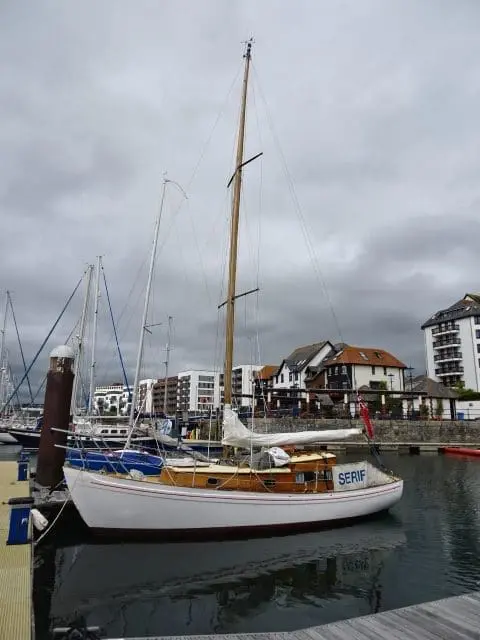
SERIF
I’m sure that most people would think of the profile of a boat like Serif when they think of a Vertue. She has a sheerline to die for. However, by 1949 when she was built, the most striking visual feature of the ‘new’ post war design was the little doghouse with its single window. But the real genius of the design is only appreciated on going below, where the complete absence of the ‘deck-stepped’ mast allowed for a staggering amount of internal volume to be utilised. The idea had actually been introduced by Giles in his much larger pre-war, shoal-draft, racing yacht Wapipi. Serif is very similar to Cardinal Vertue in many respects, and has an unusually spacious cockpit seating arrangement but she has had a rather more sheltered life than that enjoyed by her more famous sister-ship!
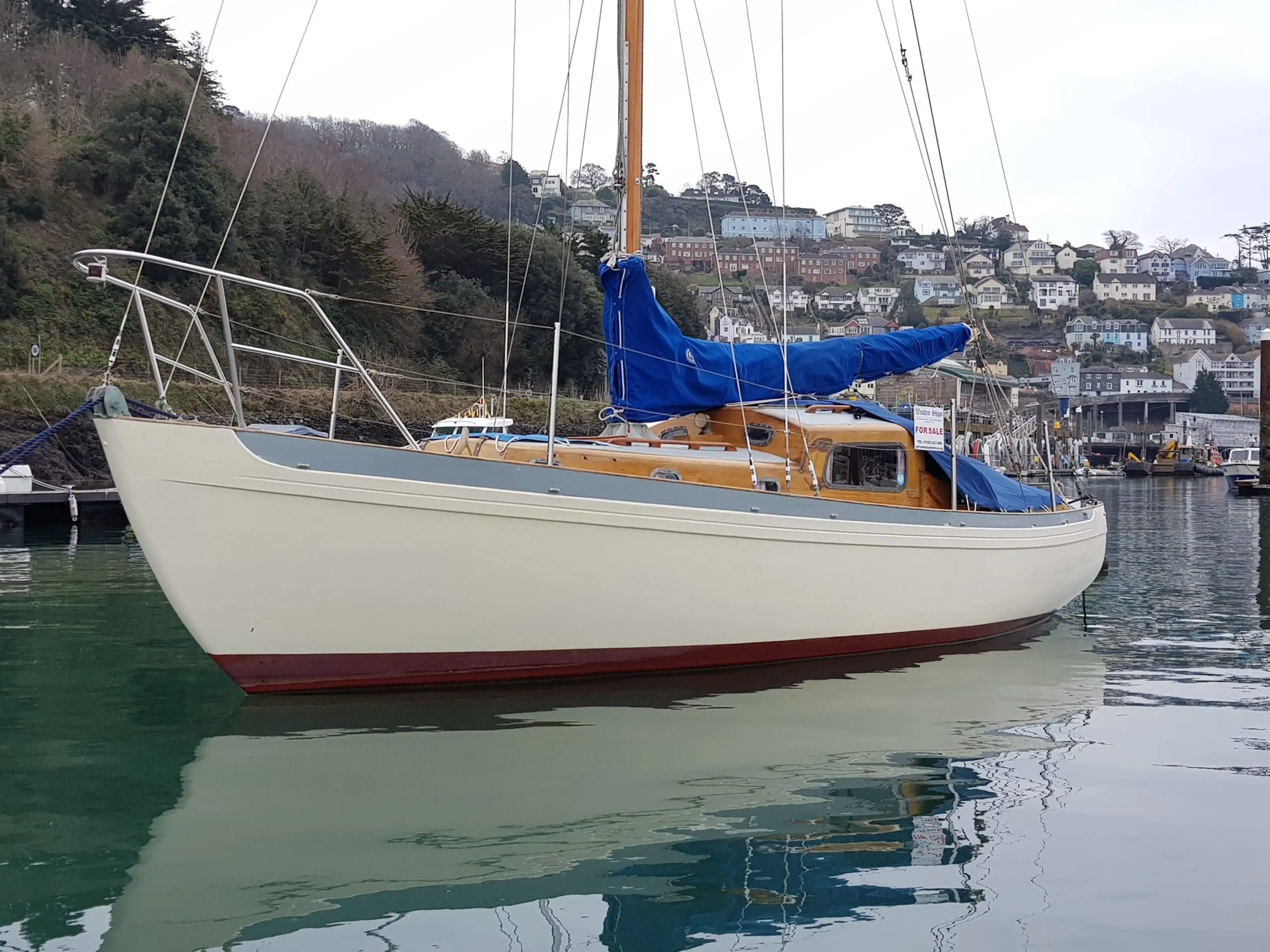
VERTUE FIDELIS
In early 1951 several boatyards sought to boost their sales by building extra-special examples of their stock boats in time to be displayed at the Festival of Britain. Vertue Fidelis is one of these, and she was originally named Festival Vertue. Built on the River Crouch in Essex by Stebbings, she has some outstanding joinery such as the recessed fore-hatch cover with ‘secret’ drainage to the sides of the coachroof. She has an especially attractive cabin interior and in common with other ‘long cockpit’ boats it appears to be more spacious than usual as the engine box doesn’t intrude into the accommodation at all.
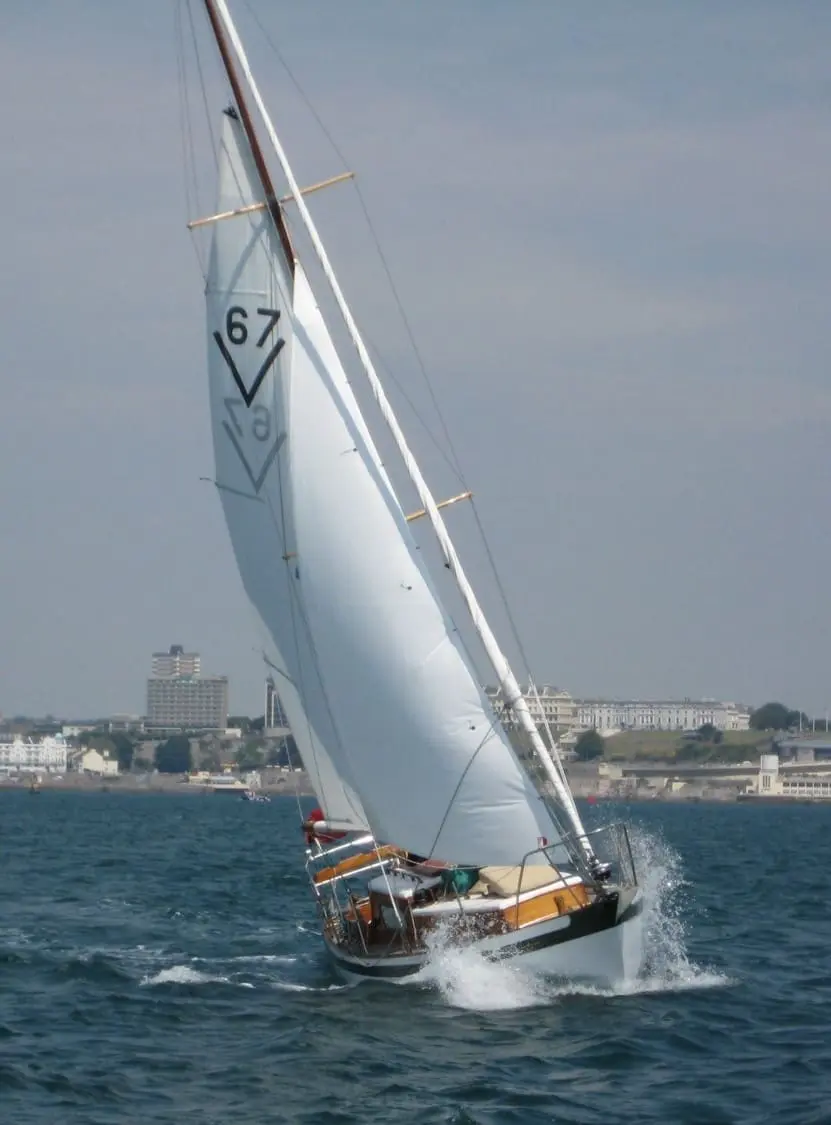
BETSINDA
Another boat for sale with similar accommodation and the longer cockpit is this beautifully built example of the class, using the best available materials. Betsinda was built by Elkins who built more Vertues in Christchurch than any other yard. They built this one in 1954 with mahogany topsides, and a teak bottom on English oak grown frames with steamed oak timbers in between. She has a lead ballast keel, bronze strap floors and is copper and bronze fastened throughout: what an enviable specification! No wonder her asking price is towards the top end of the paltry sums that are asked for these beautiful boats at the moment.
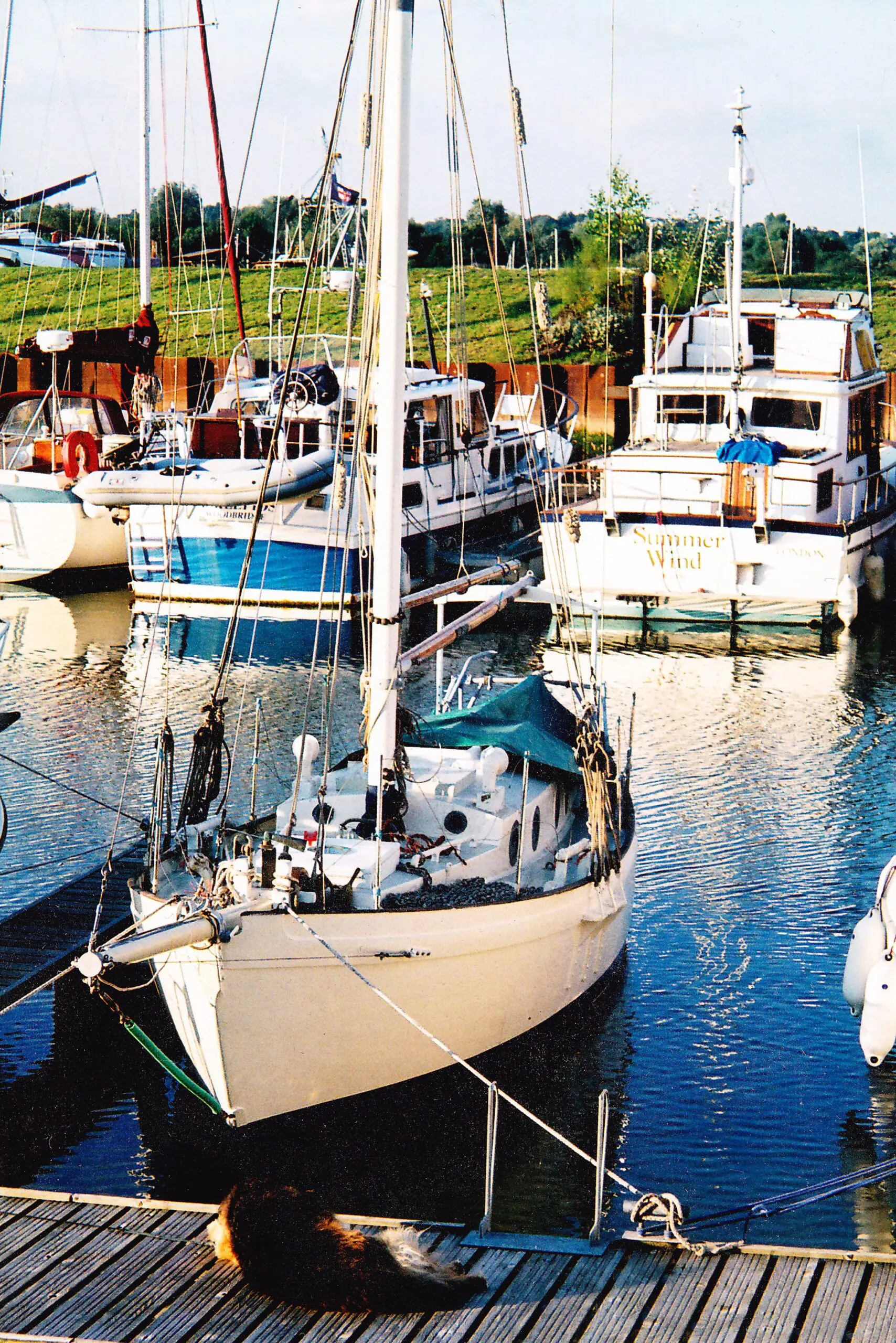
FIONN
By 1974, when Fionn was finally launched in Australia by her home-builder, Chris Larrewyn, the Hong Kong Chinese shipyard of Cheoy Lee had already built 23 Vertues for owners worldwide. Of those only 15 came to England, but Fionn followed them here in 1997, also as deck cargo rather than on her own bottom. She may be the only gaff-rigged ‘ocean’ Vertue but it certainly suites her and she is one of most workmanlike-looking boats you could wish for. She flourishes the working boat element of her genes with gay abandon and looks very much at home amongst the converted Essex oyster boats (and motor yachts!) where she has been based for many years.
SPARROW
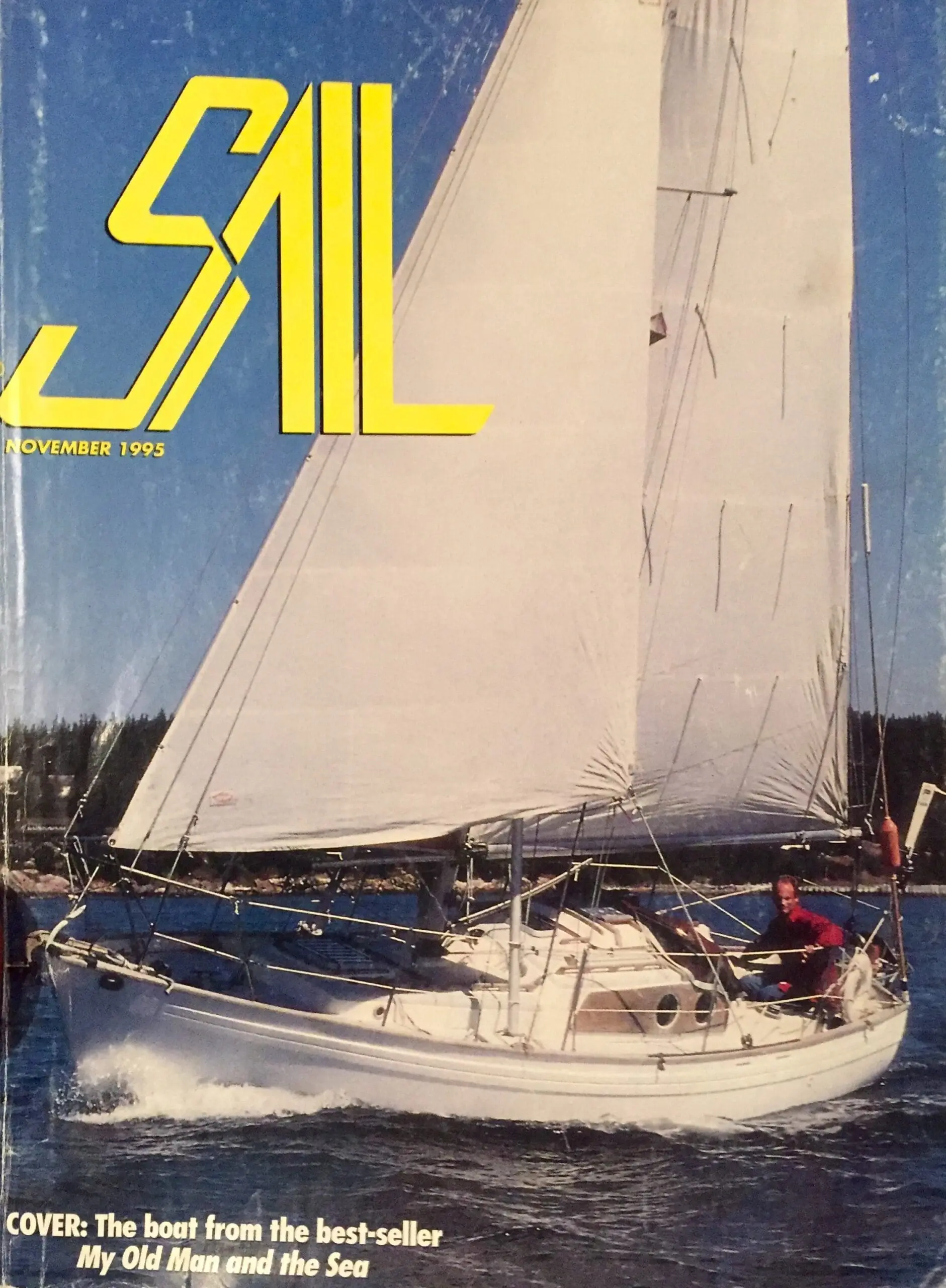
When Fionn was being built in Australia the new directors of the Laurent Giles Partnership were seeking guidance, if not permission, for the idea of designing a grp version of their most successful design. They canvassed opinion from existing Vertue Owners Association members, and others, although it was not until 1979 that the first actual VII boat, Vertue Voyager, was shown at the London Boat Show. The most famous grp Vertue, Sparrow, astounded any remaining sceptics about the suitability of the material for standing up to offshore conditions by doubling the Horn in 1985. This was almost exactly 25 years after Bill Nance had quietly sailed that way during his solo circumnavigation with Cardinal Vertue.

LUANDA
In 1954 when Laurent Giles were supervising Elkins’ completion of Betsinda, the first of three steel Vertues was being built in the Netherlands. Virtue is still cruising those waters but not far away, in Germany a fourth metal-hulled Vertue is now for sale. Luanda was built, very expensively, in 1996 to specially drawn Giles drawings and a comprehensive specification for her aluminium framing and hull. She looks to be a serious cruising boat and I am hoping that she will soon be bought by an equally serious owner who will take her on some really serious cruises……so please watch this space!
So there are Vertues to suit every pocket and every taste, as this very brief description of those currently for sale illustrates. They are sometimes misunderstood and their capabilities under-estimated, and they look very diminutive alongside most modern cruising yachts. Actually, they are usually sailed alone or by couples, and whilst many of those built after the 1960’s have four bunks I doubt that many serious cruises are completed with this number of crew aboard nowadays.
I have no intention of becoming a Yacht Broker, but it would be as strange to ignore the selection of Vertues that are for sale as it would be to leave out, say, all the grp boats. I like to celebrate the way in which the design of these boats seems to have remained true to their origins whilst also embracing those sensible improvements in yacht design that enhance their performance and appearance. Perhaps someone will fit Vertue V500 with foils………?
__________
GRACE
I am very lucky to remain in touch with dozens and dozens of Vertue Owners all over the world. Much more locally, though, Juan Pablo has been keeping in touch about the wonderful deep refit he and Duncan have been steadfastly carrying out near Lymington, in Hampshire. I have left the email, and photographs more or less unedited, to show the rest of you how simple it is just to keep in touch about all your boats, and keep the Newsletters coming. There are several Vertues in various parts of the world being quietly restored and refitted by their owners: I know of at least 14! Please just drop me an email if you know of any such projects and we will mention them, or give them a feature, if they wish.
| Subject: Re: VertueYachts Christmas Newsletter |
| From: Juan Pablo Olaberria <jpolaberria@gmail.com> |
| Date: 10/12/2024, 10:46 |
| To: Roger Robinson <speedwelltwo@gmail.com> |
Hello Roger
We are making good progress but the photos, as you can see, do not really do it justice quite yet. We have finished all the interior fit out but it is still in bits, getting the last coats of paint and varnish.
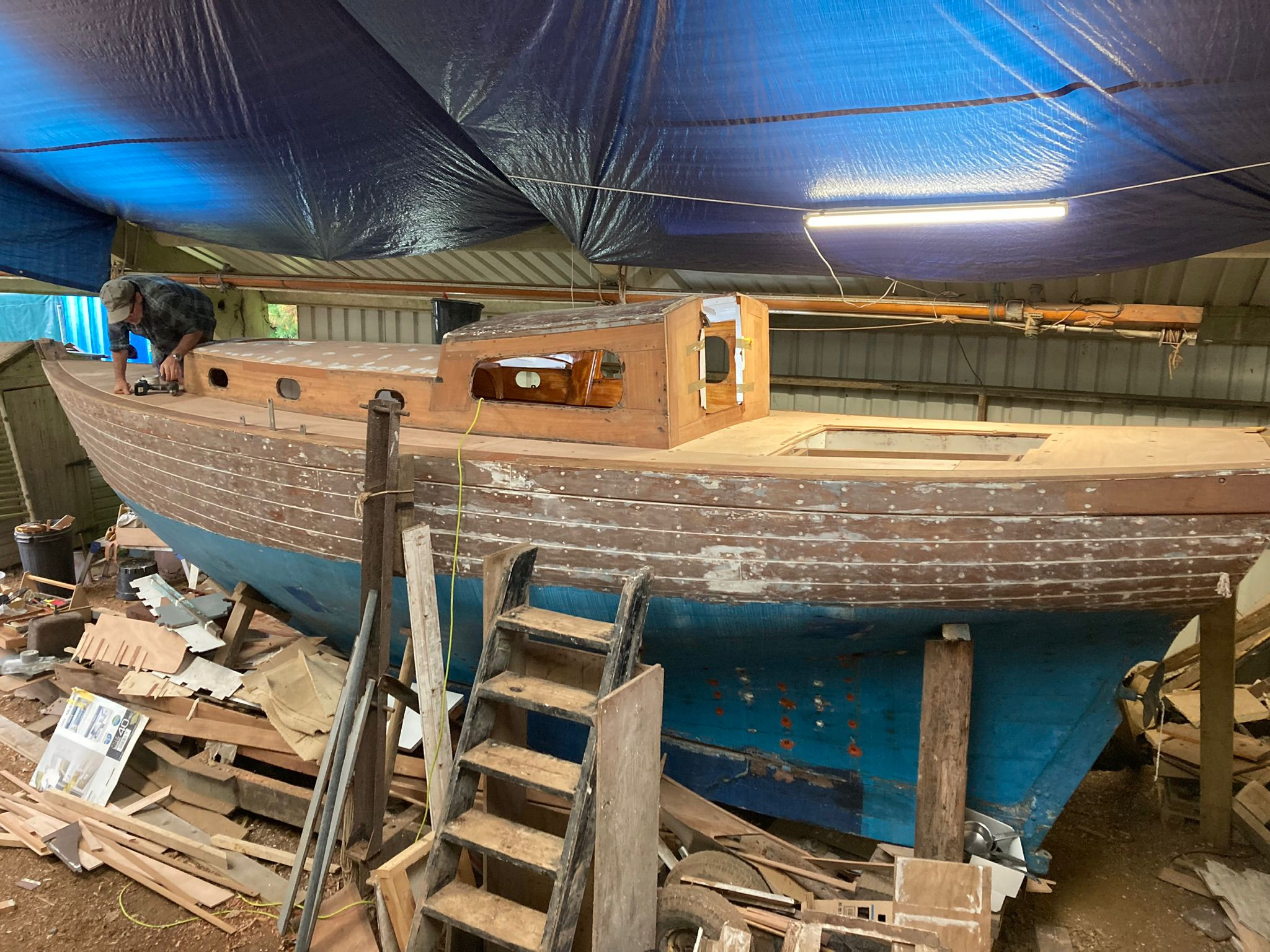
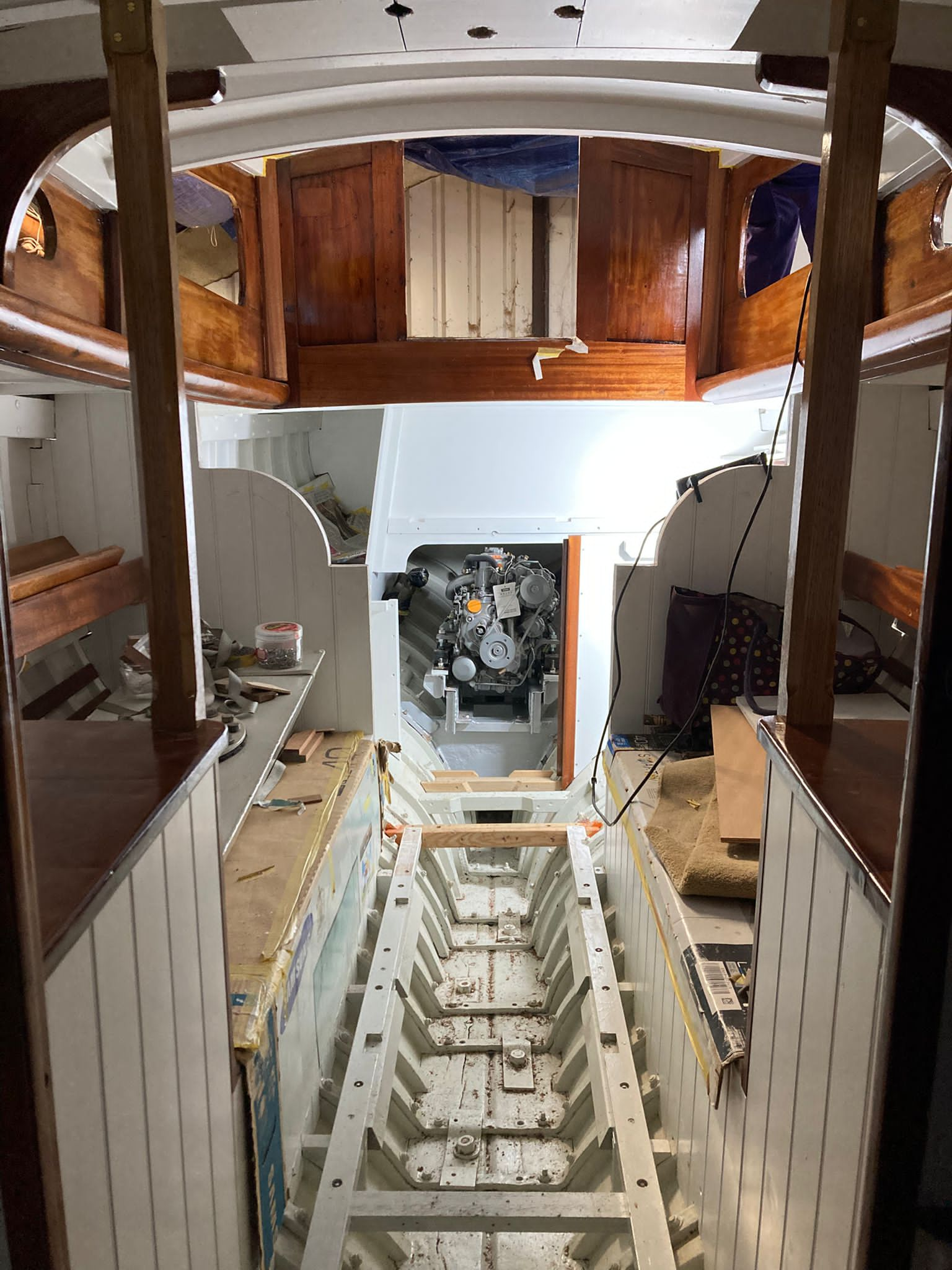
The engine is in and the plywood deck is on. We hope to have all the interior assembled by the New Year but I hope that these photographs will be enough for the newsletter.
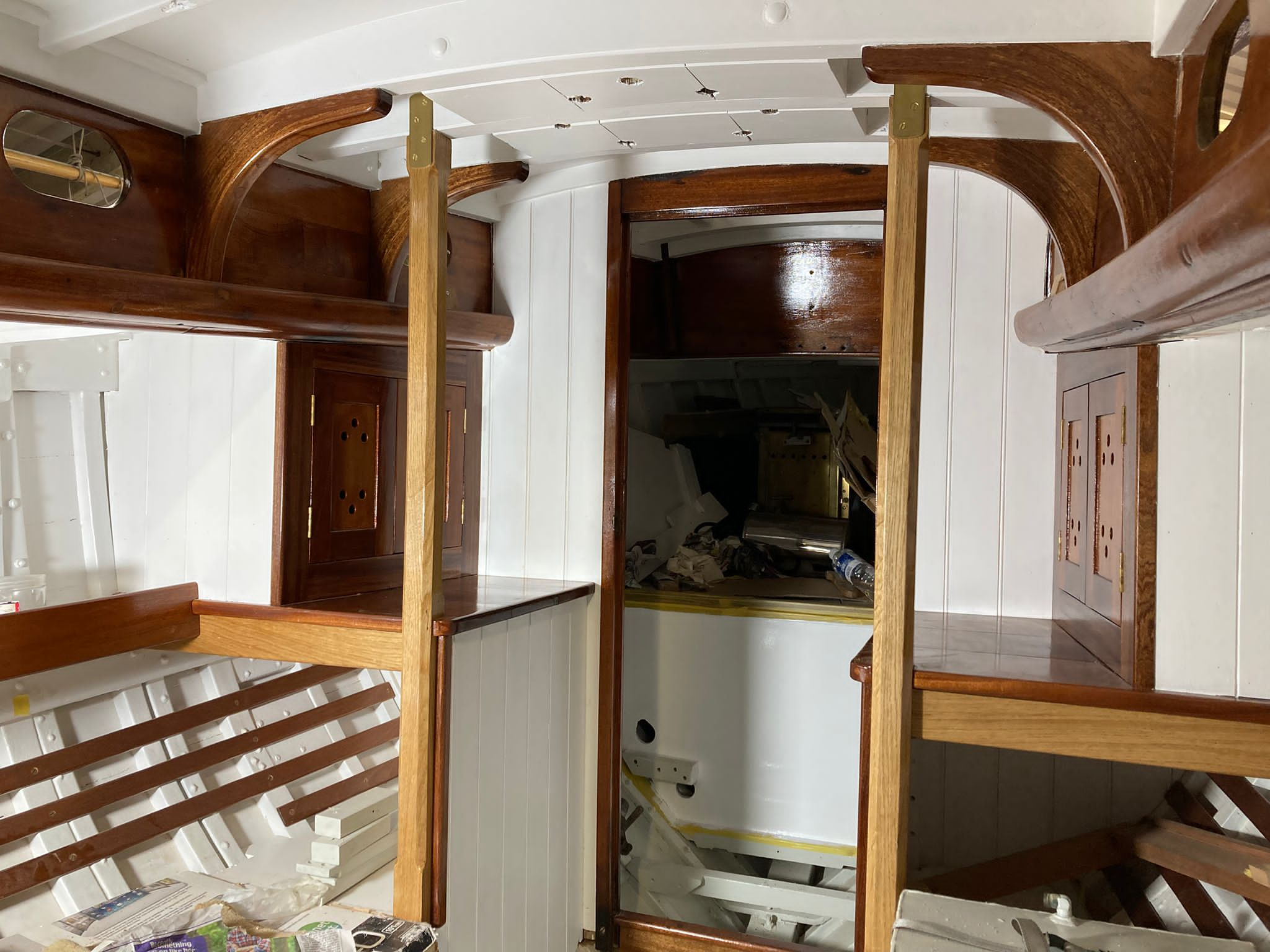
As you can see, we have substituted the galvanised knees joining the mast-support beams to the coachroof sides by laminated sapele knees. We have also moved the mast support posts. In the original arrangement, the base of the mast was supported by three beams, and the compression posts were supporting the fordwardmost of these three beams. We have modified the design by moving the posts to the middle beam, thus transmitting the compression loads a bit better. The knees reinforce the beam to the coachroof connection of the forward and after mast-support beams.
There is another design change which I cannot remember if I told you about. Instead of the chart table on the starboard side, we have made a pilot berth. We hope to include some kind of arrangement where one could open up a chart but this is only a sketch at the moment.
It was fortunate that Grace had been fitted with a Yanmar 1GM10 engine although it did not come with the boat when we bought her. My brother just happened to have an unused Yanmar 1GM10 engine (about 10 years old, still in its crate) so it fitted onto Grace’s engine beds without any modifications!
I hope you can use the photographs. We will keep you posted.
Merry Christmas
Juan-Pablo Olaberria and Duncan Fawkes.
__________
VERTUE ORIGINS
For several years now I have been attempting to cast some light onto how the design of the Vertue class fitted in to the diverse collection of work that Jack Laurent Giles produced. Elsewhere in this Newsletter we have welcomed a guest writer to tell us something about the Lymington L class, which is generally accepted to have been part of the design development of Andrillot. I must point out that I have had no formal training as a naval architect but have spent a lifetime learning from the likes of Douglas Phillips-Birt how to develop an ‘eye for a yacht’.

This exquisite drawing is entitled “Form Draft of Cutter Yacht Jolie Brise” “Lifted from Ship October 1928 by J. Laurent Giles AMINA Yacht Architect”
I have recently been examining some of the influences that Jack Giles must have come across in his early years. If Andrillot can be seen, to some extent, to be following Isabella, L 1, what came before her, and where did the young Jack Giles look for inspiration once he had decided, when still at school, to make a career of designing yachts?
Looking for clues in answer to this question, I have recently re-examined some of the work of Albert Strange, Charles E. Nicholson, Dr. Harrison Butler, the Warrington-Smyth family and several others. After all, Jack Giles was brought up living just round the corner from Albert Strange in Scarborough; he later worked for a couple of years in Charles Nicholson’s office; and he would have read Yachting Monthly and the other sailing magazines. As Olin Stephens said: “Over the years one read the yachting press and studied the design sections of the magazines, becoming familier with the work of certain designers”. In these magazines Jack would have seen the working-boat influenced designs of the Cornish design dynasty, and the exquisite draftsmanship of both Albert Strange, the artist, and Dr. T. Harrison Butler. In 1928 Jack Giles had been commissoned to lift the lines of Mons. Paumelle’s masterpiece, Jolie Brise, and would have studied those with delight once he had delivered a copy to her new owner, Bobby Somerset. But in 1931,when the European ocean racing world was stunned by the incredible performances of Dorade, and he sat aboard the Jolie Brise as that slender yawl disappeared ahead over the western horizon on her way to the Fastnet Rock, he must have wondered how that had just happened.
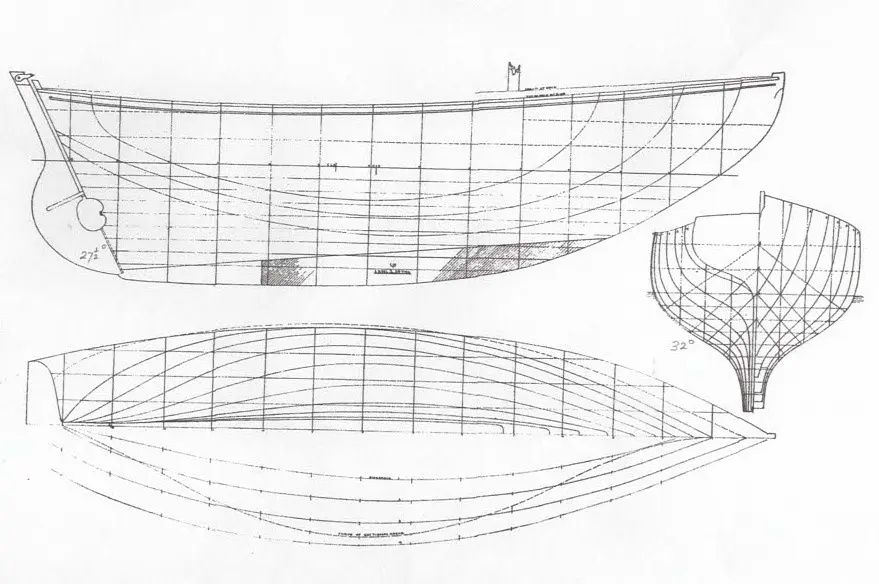
The JILT
On being asked about the design of Andrillot some years later Jack Laurent Giles remarked that whilst the design might have “maintained the general outward character of the pilot-fishing boat, she had the benefit of the concentrated thought on the design of sea-going yachts, which the activities of the Ocean Racing Club had by then fostered.”
Whilst I believe that Jack Giles will have looked closely at the lean lines of such yachts as Ilex, Patience, and Dorade, one of the most remarkable features of the Vertue is its diminutive size! So whilst he will have run his eye over the sweet, easy lines of these boats, as well as Jolie Brise, they are all much larger boats than the Vertue. Yet one of the key features of this boat is the amount of accommodation it provides in such a small overall length: and they have continued to turn in extremely respectable runs for day after day, often in the hands of single-handers, across all the oceans. So where did the inspiration for solving the problem of creating a small, comfortable, fast, good looking, easily handled, nimble but steady little boat come from?
This challenge, of designing modest cruising boats was a familiar one to Albert Strange, who is best known for his beautifully designed, canoe-sterned yawls. But his small transom-sterned craft like Phantom (and the Jilt) might well have been studied by Jack Giles when he was thinking of how to fulfil Richard Kinnersly’s specific requirements for Andrillot. These were for a small, nimble, easily handled gaff cutter with some of the appearance and characteristics of the traditional pilot cutters and fishermen of the western English Channel.
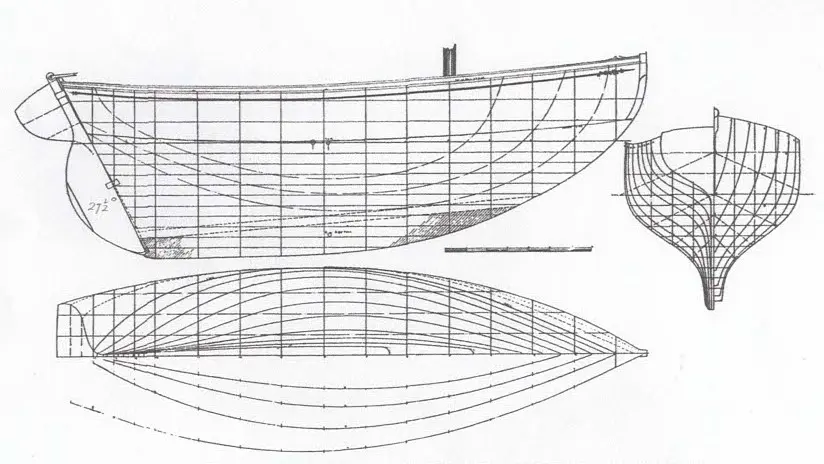
Dr. Harrison Butler also designed both canoe-sterned and transom-sterned small craft, and by 1931 had produced the Yonne, a master-piece of hydro-dynamic balance. He too had the knack of creating the most wonderfully practical and beautiful small living spaces aboard his small yachts, and seemed to revel in the creation of delightfully, intricately detailed drawings. Like those of Albert Strange, the drawings themselves were sometimes works of art.
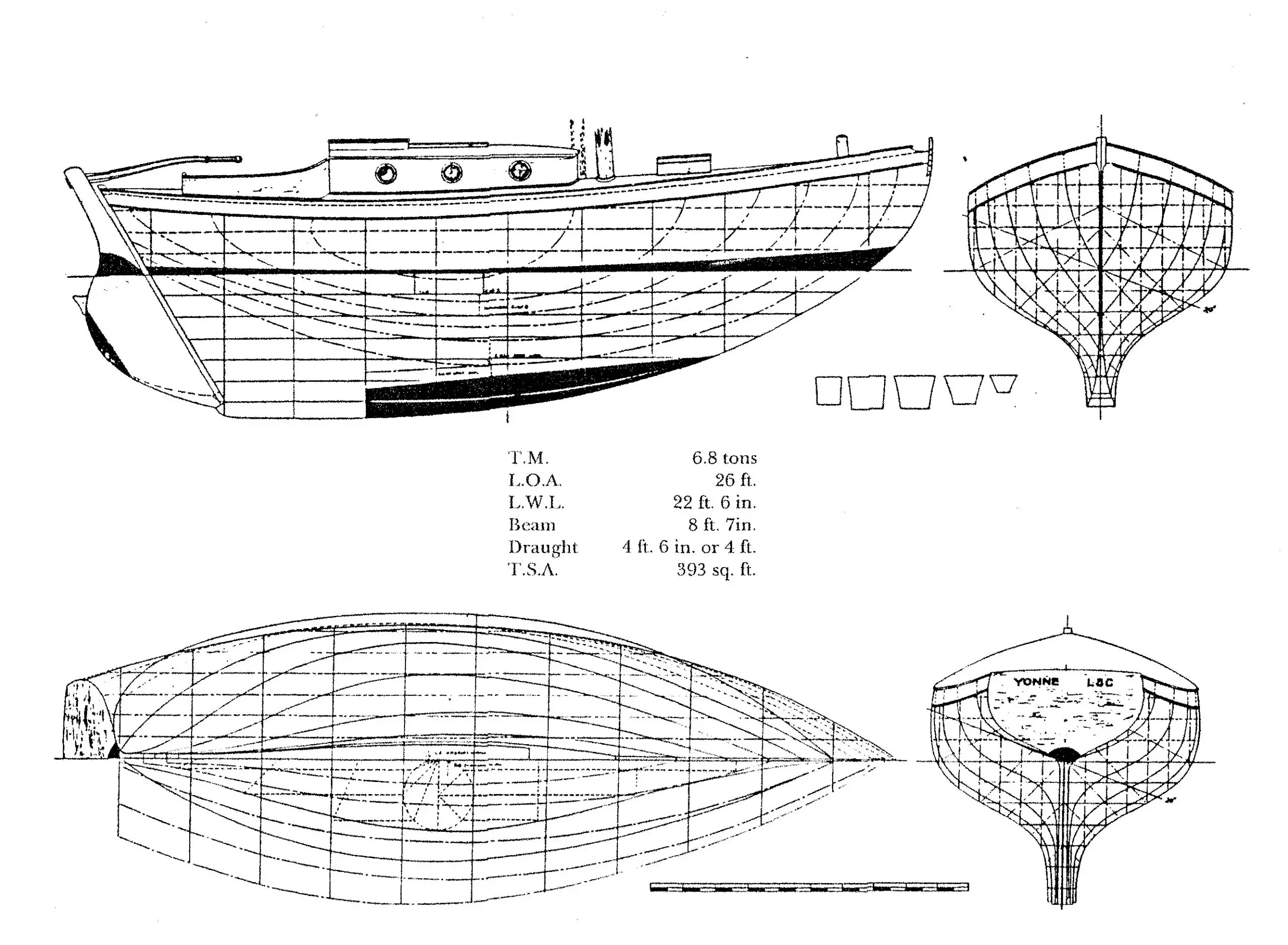
YONNE
So while there are similarities between the dimensions and hull profiles of some of these yachts, quite clearly Albert Strange was blazing a trail for others to follow. Part of their task was to find space for accommodation, so slack midship sections went some way to lowering cabin soles in the smaller designs. But this had somehow to be combined with subtly shaped bow sections and profiles, long, ‘easy’ buttocks, stability and balance. The 27.5 degree stern-post rake of Andrillot happens to be the same as Yonne and Phantom, (Isabella has 32 degrees) but their bow profiles and sections are subtly different. For, by 1935, when Giles was designing Andrillot, perhaps he had recognized the growing trend towards slightly longer, modest bow overhangs with slightly fuller sections that gently lowered the yachts’ bows into the sea ahead, increased waterline length, and therefore potential speed, and balanced the after sections more successfully than some of the more vertical, finer bows of the past. Thus both Dorade and the Maid of Malham, who had both also benefitted from that ‘concentrated thought’ mentioned earlier, had similar but more extreme versions of the bow profile and sections of Andrillot. And that’s the thing about Andrillot: everything about her hull shape is somehow understated; restrained and harmonious, modest yet powerful. No wonder Jack Giles claimed in later years that he knew of no way to improve upon her lines.
__________
Me and My Vertue
By Alasdair Flint
Roger asked whether I could do a little piece entitled “Me and my Vertue”. It is hoped that it could become a regular feature about other Vertues. I asked whether there was a format that I could follow, but Roger was reluctant to make it too formulaic and said I could do whatever I wanted.You might think having that freedom would make things easier but quite the contrary. I have owned Sumara since 1991 and rather a lot has happened over those 33 years!
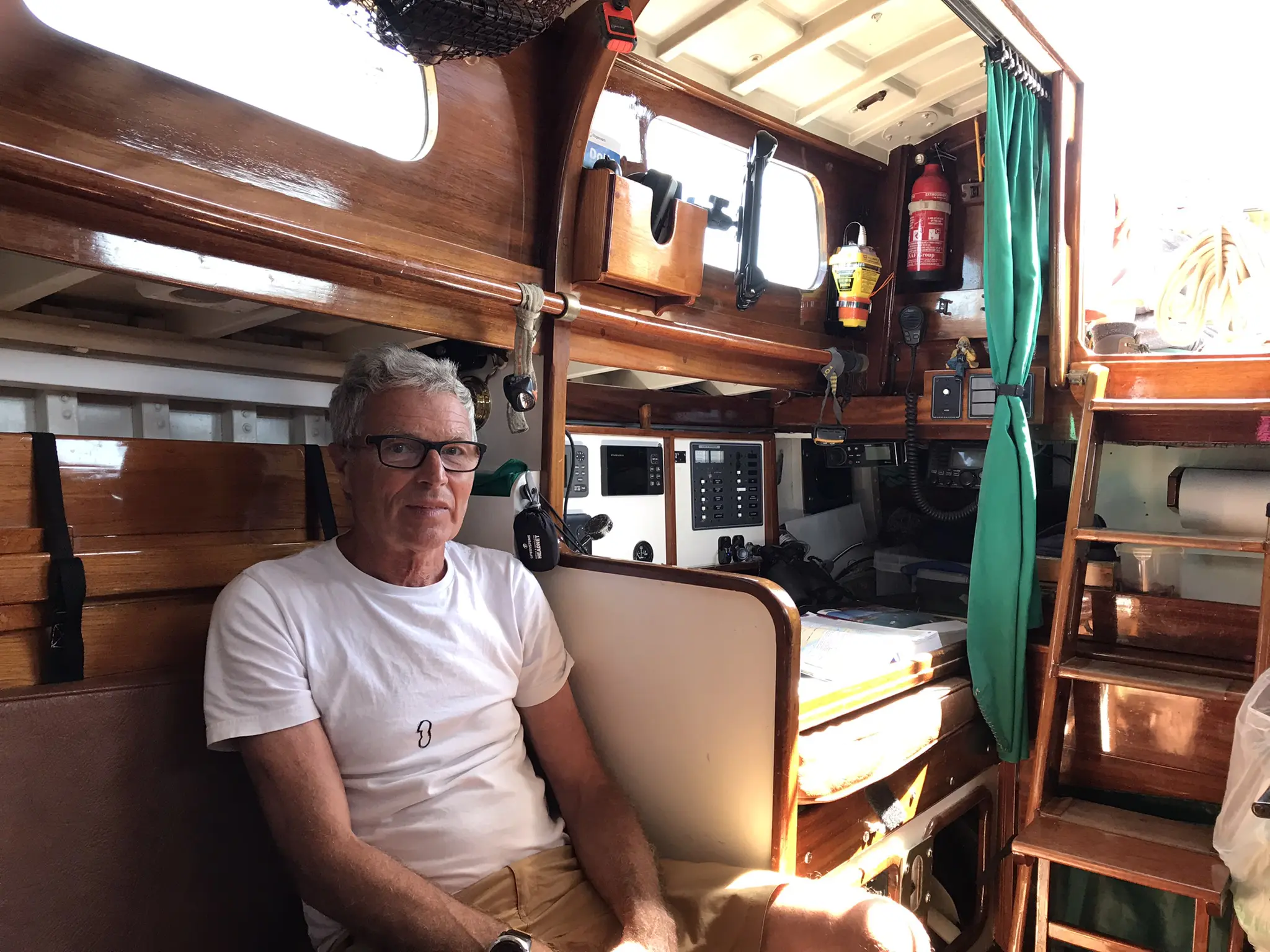
Aboard Sumara in Salcombe this year.
The first yacht I owned was a clinker-built Guy Thompson offshore racer. I renovated her and installed a new engine, rubbing strake and hatches. In those days I had a swinging mooring just downstream of Tower Bridge and a scenery building workshop in Chambers Wharf overlooking the boat. I could row out to the boat after work! I got into all sorts of trouble in that yacht with no VHF or GPS, just a compass and towed log. It also gave me a good understanding of what is involved in owning a wooden yacht.
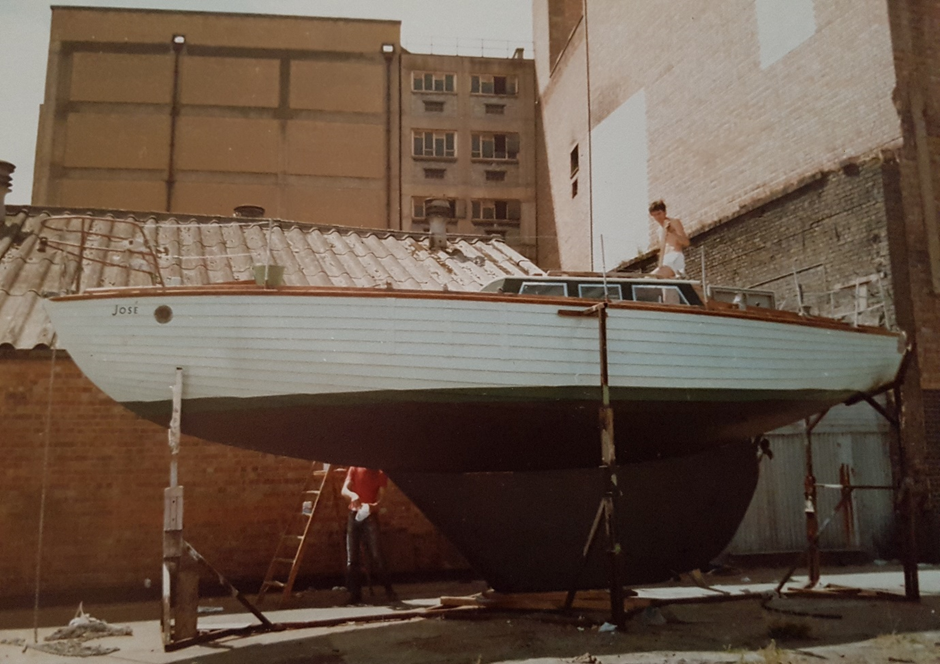
My first boat Jose of Dover.
After I sold her, I sailed on lots of other yachts including one called Danegeld, a beautiful varnished wooden boat, on which I crossed the Bay of Biscay several times.
Eventually I decided the time was right to buy myself another boat. It had to be the smallest seaworthy vessel capable of ocean crossings but, most of all, she had to be varnished wood!
I contemplated Twisters and Folkboats, but the Vertue was top of the list. I didn’t want a bundle of trouble, and I knew how and where wooden boats can start to rot if not properly cared for, so when Sumara came on the market at just 1 year old it was the perfect boat for me. I was slightly suspicious why anyone would sell such a beautiful boat having just spent eight years building it! The only criticism my surveyor came up with was that it might need some quadrant around the Sampson post to stop leaks. Terry, the builder, got a bit irritated and assured me it didn’t need any quadrant and indeed after 33 years the Sampson post has never leaked.
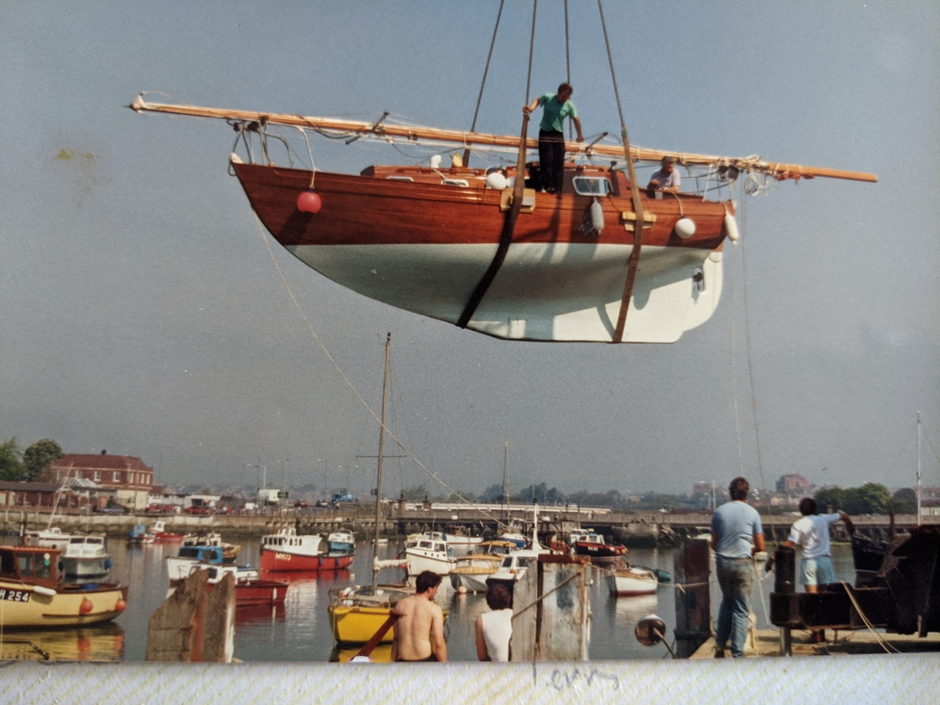
Sumara in suspense
So, in 1991 I became the proud owner of a beautifully built varnished Vertue made from one log of iroko on oak frames and with an elm/lead keel.
Terry Newman, the builder, really knew what he was doing and put a great deal of thought into building Sumara. It has a keel stepped mast made from Douglas fir and is cutter rigged with a hanked-on Yankee and staysail. The decks were teak on ply screwed and plugged but I had the teak replaced by Johnson and Loftus boatyard in Ullapool in 2020. The new teak is just glued down and caulked with TDS which the boatbuilders recommended.
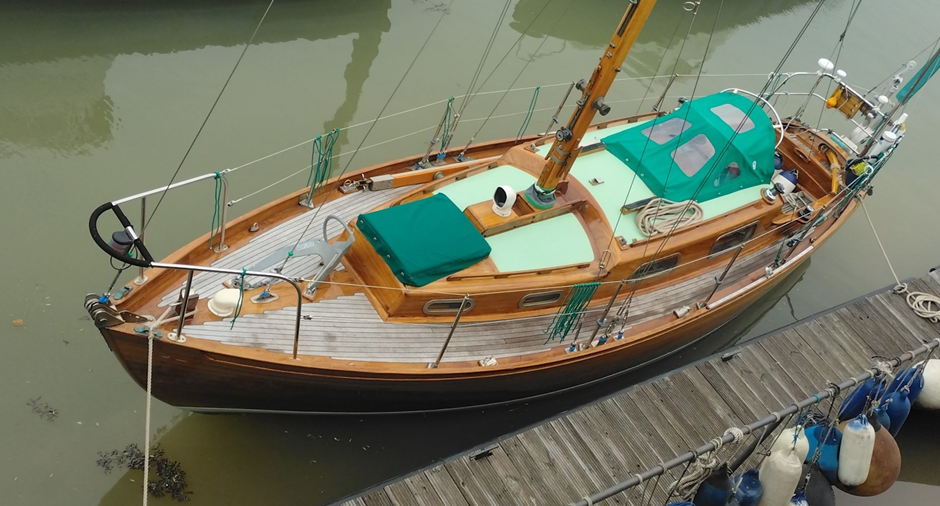
Some of Sumara‘s beautiful varnish work.
Down below there is a galley to port and a large chart table to starboard. When I bought Sumara, it was fitted with a Decca receiver and a radio direction finder, which was very hi-tech for me and took away some of the worry of relying on my dead reckoning and dodgy sextant sights.
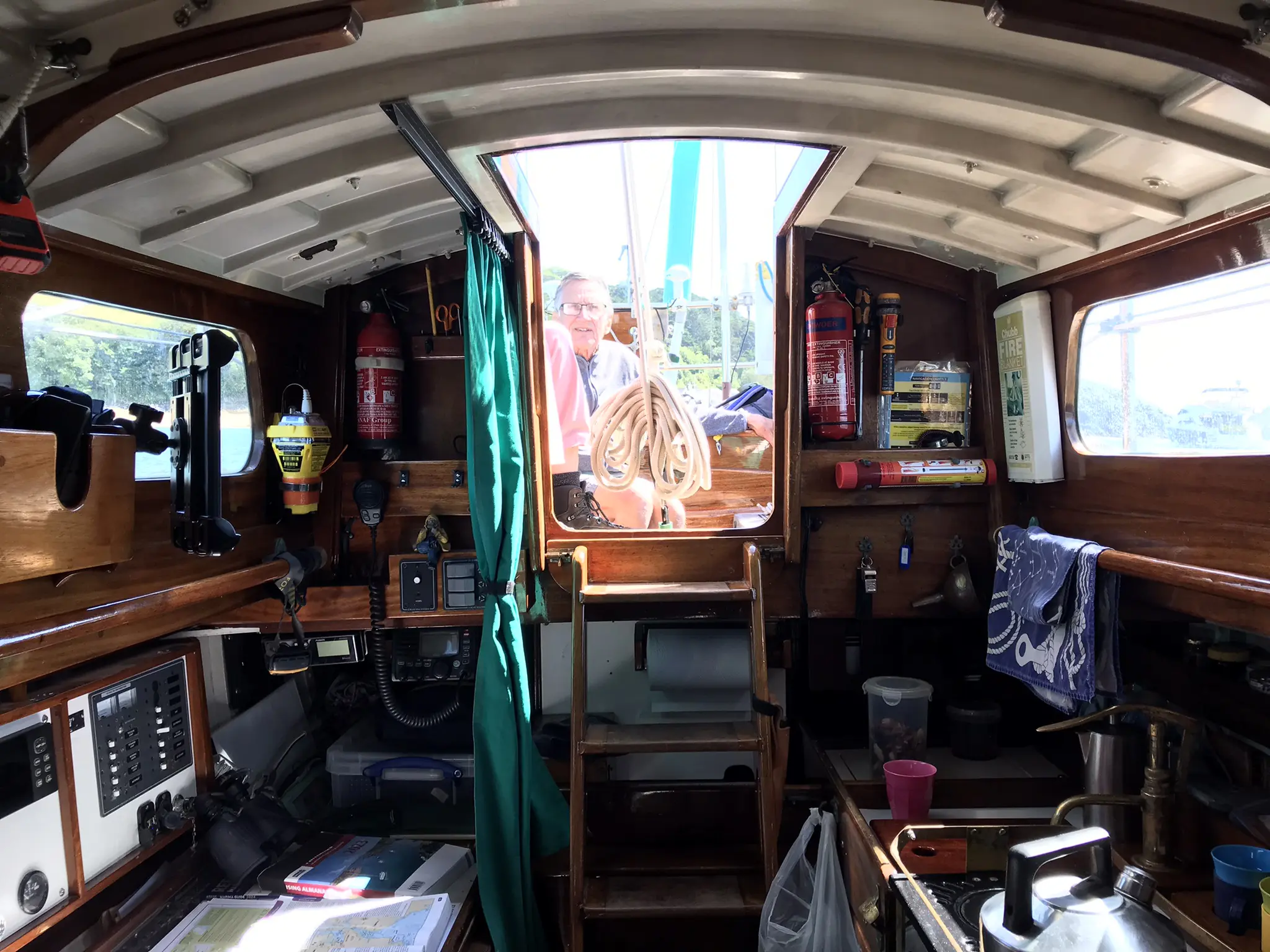
The chart table to starboard folds up against the instrument panel and reveals a snug quarter berth. For those new to sailing, a chart table could be a mysterious thing as it is often missing on modern yachts. It is the table where charts made from real paper are laid out and drawn on with the help of a soft pencil, parallel rules and dividers – yes, some of us still prefer the old ways!
There are two very fine sea berths positioned mid-ships so that they hardly move, even in rough weather. A panelled door leads to the forepeak which has a Baby Blake toilet centrally mounted with a sink to starboard.
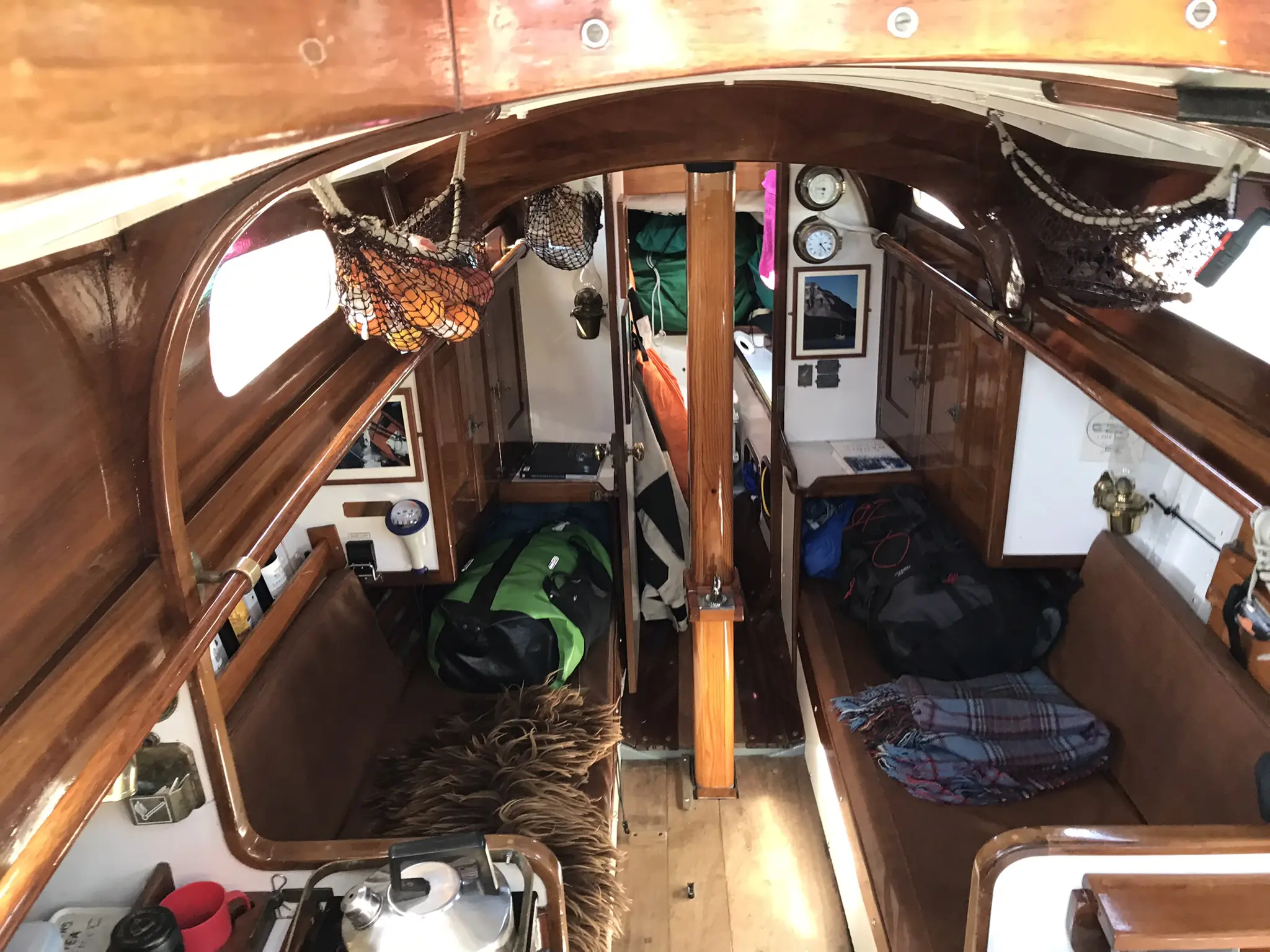
The sink is actually a large cooking pot which is emptied via the Baby Blake to keep things simple. The forepeak also houses deep bins for storage plus a pressurised paraffin tank to feed the Taylors cooker. There is also a large aluminium paraffin storage tank with a tap over the “sink” for filling the oil lamps. The 60 m length of grade 7 x 8 mm anchor chain is stored in a bin forward of the toilet. A hatch can conveniently be opened to give unlimited headroom and a beautiful view around the anchorage whilst cleaning your teeth.
I find life below very civilised. Sumara doesn’t have a fridge but the two stainless steel water tanks under the berths provide a cool surface when they are full, otherwise the bilge chills beers nicely without needing any power. As I often sail north, I have fitted an Eberspacher D2 heater, partly to warm the boat as a treat for the crew, but mainly as a means of drying wet gear which can make watches pretty unpleasant. The heater is mounted in a really awkward position on the inside face of the transom. I dread servicing it.
On deck I carry a rather heavy Rocna 15 kg anchor, and below I have an aluminium Fortress as a kedge and a folding fisherman’s anchor just in case. I have a Windpilot Self Steering gear which works wonderfully, and a little Autohelm Auto Pilot which is still working after 15 years. A little canvas dodger covers the companionway hatch but provides no shelter to the crew who have to brave the elements in the cockpit.
The original hand marinized 12 hp Kubota engine was replaced in 2020 by a more powerful 16 hp Beta engine.
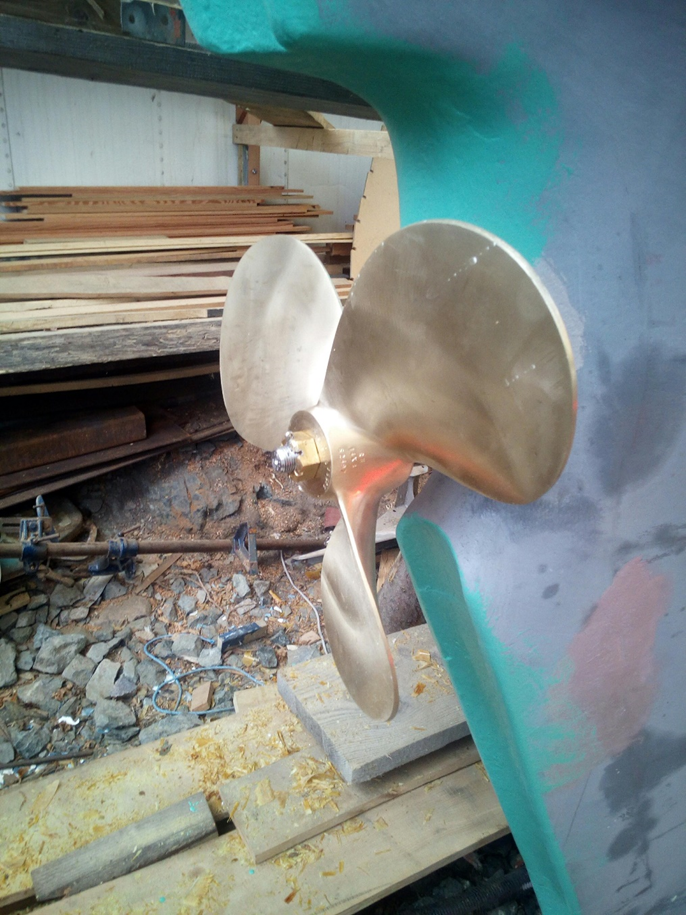
The new propellor was cast in aluminium bronze to help withstand contact with ice.
I can’t really understand the desire for boats to be bigger and bigger unless you need room to carry more crew, and you may require more crew simply to handle the larger boat! Large boats introduce so many new safety risks as they often depend on powered winches handling ropes under huge tension, and furling gear which can go horribly wrong at any time. The average length of yachts entering the ARC rally is now 48 foot, quite ridiculous in my opinion.
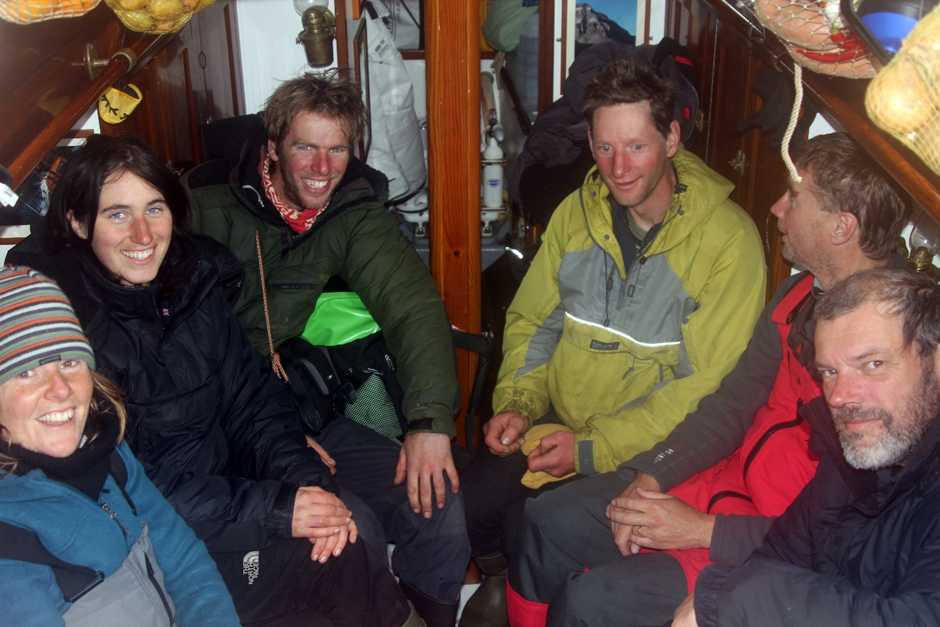
Plenty of room for a pre-climb gathering in Sumara’s saloon whilst anchored off Jan Mayen
Talking about crossing the Atlantic, Sumara made the trip in 1996. It was following an off-the-cuff handshake with a friend who had never sailed before but had read all the classic sailing books. I actually wanted to sail to St Petersburg, but Ray insisted on the Atlantic or nothing, so we shook on it and sailed via Cape Verde Islands to Barbados. Ray returned by plane and I sailed Sumara back single-handed but not before entering the Antigua Classic Boat Regatta where I recruited some Norwegian friends to crew for me. They suggested that I should enter the Norwegian Risor Wooden Boat Festival and were somewhat surprised to see me turn up there in 1998!
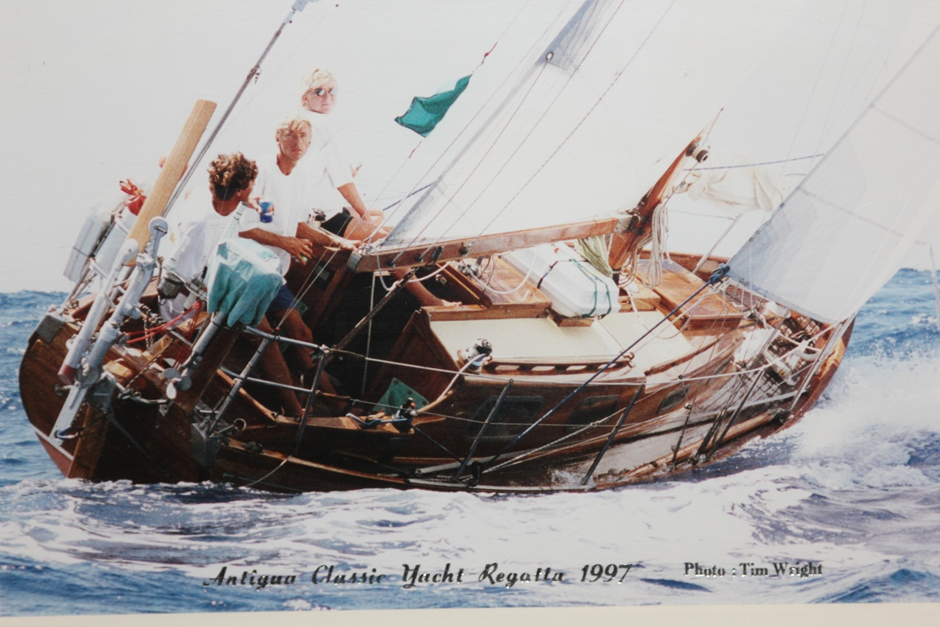
This started my passion for sailing northwards. I sailed to Risor four times, and it was on one of these trips when my eye was caught by a picture of a polar bear in the last chapter of the Norwegian pilot book. Now that would be a thing!
So, in 2002 I went on a most ridiculous summer holiday cruise. We left South Dock Marina in London and sailed non-stop up the North Sea through the Arctic Circle to the Lofoten Islands, a voyage well in excess of 1,000 nm northwards. From there we ventured further north to Tromso and then on to Bear Island, eventually anchoring in dense fog in Hornsund, Spitsbergen. We cruised the area for a few weeks and did manage to have a very exciting encounter with a polar bear in Tryghamma!
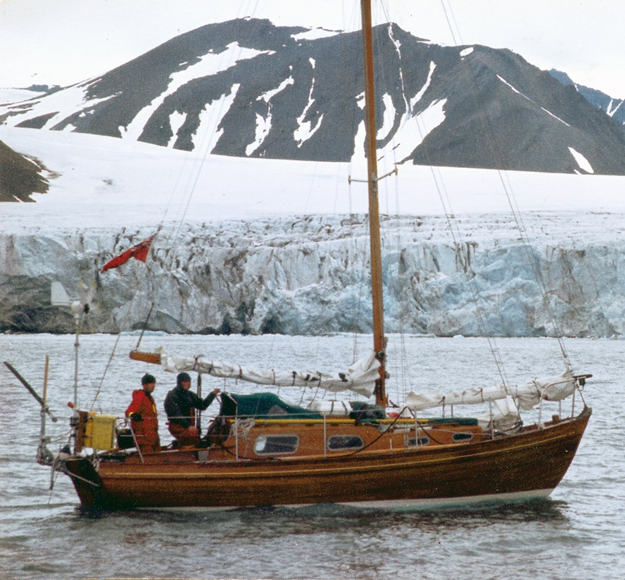
Sumara in Hornsund Spitsbergen!
The return journey was direct across the Greenland Sea to the Faroe Islands; not a voyage I would recommend, especially in the days before accurate weather forecasting. After several gale tossed weeks, we eventually spotted the islands through the murk. On arrival in Torshavn the Harbour Master, seeing this tiny jewel of a varnished boat, asked where we had come from – expecting us to say “Scotland”. When we replied “Spitsbergen” he looked very surprised and promptly called us “The Crazy Ones” whereupon the next day we were asked to help crew on their tourist tall ship.
After that adventure I made many more trips northwards to Norway and Iceland before deciding to embark on another big trip, this time one that we could genuinely call an “expedition”. When sailing across the Greenland Sea I was intrigued by a little Arctic Island called Jan Mayen. I bought an antique Bleau map of the island and hung it on my wall. Inevitably I decided to sail there and for some reason attempt to climb Beerenberg, the world’s most northerly volcano. This was going to be the big one!
I gathered the interest of Tim Loftus who was a talented climber and had built a fine wooden yacht called Thembi. To gain permits and to solve various logistics problems we encouraged Siggi from Iceland to join in the fun.
We did succeed in summiting the 2,276 m high volcano and were awarded the RCC Tilman Medal for our efforts. It was our intention to sail onwards to Scoresby Sund on the Northeast Coast of Greenland, but strong winds and ice proved too much. Instead, we headed to Iceland and climbed Snæfellsjökull as compensation, before returning to Scotland.
Scoresby Sund was to prove elusive. In 2019 I tried to sail there in Will Stirling’s yacht, Integrity, but the ice was stubborn to clear so we cruised the coast further south. In 2022 I decided to attempt to reach the Sund once again. This time in Sumara, but fierce weather held us pinned to the north coast of Iceland and I eventually had to abandon the trip and sail back to Scotland.
Being a stubborn person, I would like to try once again and make a final determined attempt to reach Scoresby Sund in 2026. By then I will have owned Sumara for 35 years. The boat is now so much a part of my life that I can’t imagine ever parting with her. It is interesting to note that of all the boats I met whilst doing the Atlantic Circuit, I was the only person who still owned the same boat three years later. Small boats are often admired in remote areas whilst the “super yachts” are just ignored. Fishermen wander over and make admiring comments, youngsters think that maybe one day they could own a little boat like that. The huge super yachts are simply out of their league. Hopefully I will have the strength to pull the ropes, and haul that anchor, for a good few more years.
.
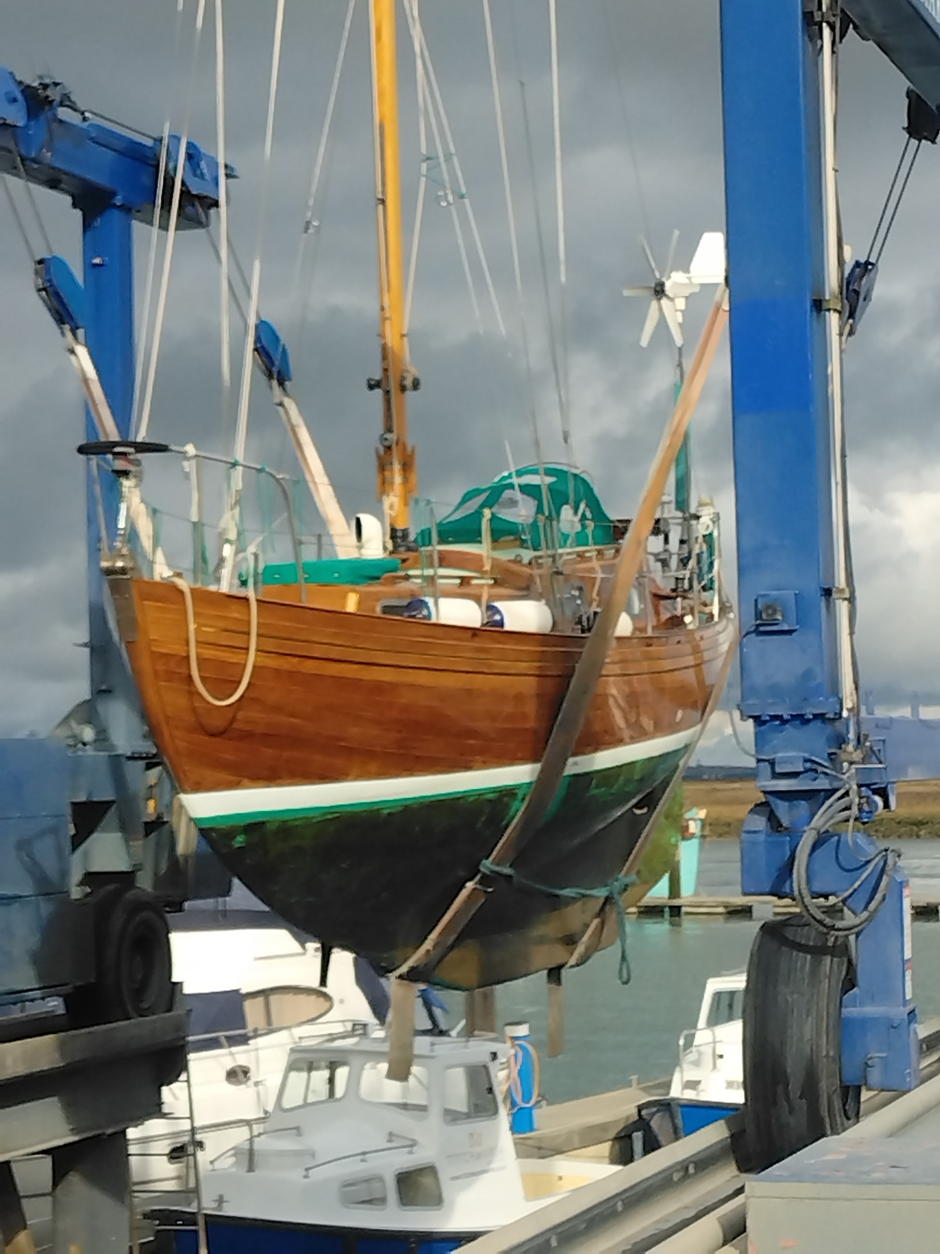
Sumara in suspense, again!
__________
Caupona and Epeneta
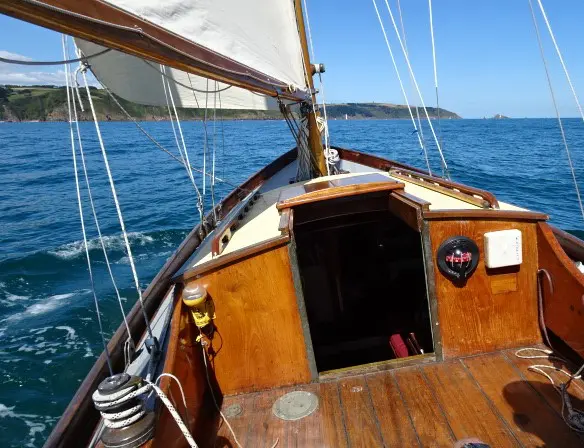
Caupona sailing off Dartmouth
Dear Roger,
I much enjoyed Peter Gregson’s article on his Vertue Caupona in the most recent edition of Yachting Monthly. Built by Woodnutts at St Helens in Bembridge Harbour she must have been a twin of Epeneta which my father had built also by Woodnutts in 1938. She had no engine but nevertheless my father sailed her to the Biscay coast and back in 1939 winning the Little Ship Club’s Vertue Cup for his log of the cruise, hence the name of the class. In the Little Ship Club’s history the historian’s enthusiasm for his subject evidently got the better of him because he added the fateful words “in Lancashire” after St Helens.

Epeneta setting sail.
One of the many questions I failed to ask my father was how did he manoeuvre Epeneta in harbour and what happened when he was becalmed? I suppose the answer to the second question was that he just sat it out but what happened in harbour? My guess is that he carried an oar which he could use to scull over the transom but that does not answer the question of how you sail a boat into Dartmouth against a spring ebb tide. Of course in those days there were few, if any, marinas and much greater capacity to drop the hook wherever you wished.
Peter’s article could have been written by my father in his general dislike of anything mechanical or electrical that can go wrong. Like Caupona the WC was bucket and chuckit and there was a healthy disdain of guard rails and the later doghouse. The only thing missing was my father’s usual comment that guard rails ensure you go in head first rather than feet first.
David Biddle
__________
THE LYMINGTON L-CLASS
By Joe Brumwell
Ahoy there Vertue owners and enthusiasts! I have been invited to subscribe something to your Newsletter about the L-Class yachts based on Jack Laurent Giles’ Design No 8.
I acquired Mermerus L14 in 1993 having seen her advertised in the Western Morning News, Truro edition. She appeared to resemble many small yachts – SCOD, Deben 4-tonner – and rowing out to her mooring off Noss Mayo the impression was much the same. It was only when hauled out for a survey on Mixtowe Quay that her lines became apparent: she was as graceful as a 23 footer could ever be.


Mermerus
Well, knowing there were only 17 boats afloat out of the 18 built in the 1930s, I had to locate them, and when they were mostly accounted for I introduced the L-Class Update so owners could contact each other if they so wished. I became Commodore, Secretary and Archivist, acting, unpaid – and self-appointed, the best way to run things.
It proved to be a very interesting few years with all boats traced and several of them visited.
I believe the Newsletter has explained the development of Laurent Giles’ smaller yachts: L-Class owners like to boast that the Vertue, which “sprang from the lines” of the smaller vessel, is not as attractive as its forbear: each to his own. (Whilst I do agree that they are pretty little boats, perhaps I should have ‘edited out’ this blatant heresy! Roger)
Rather than discuss dimensions, materials and construction, which are covered in Classic Boat magazine Issue 102 and Lee + Philpotts Laurent Giles An Evolution of Yacht Design, I will attempt to present the boats and their owners by means of anecdote and imagery.
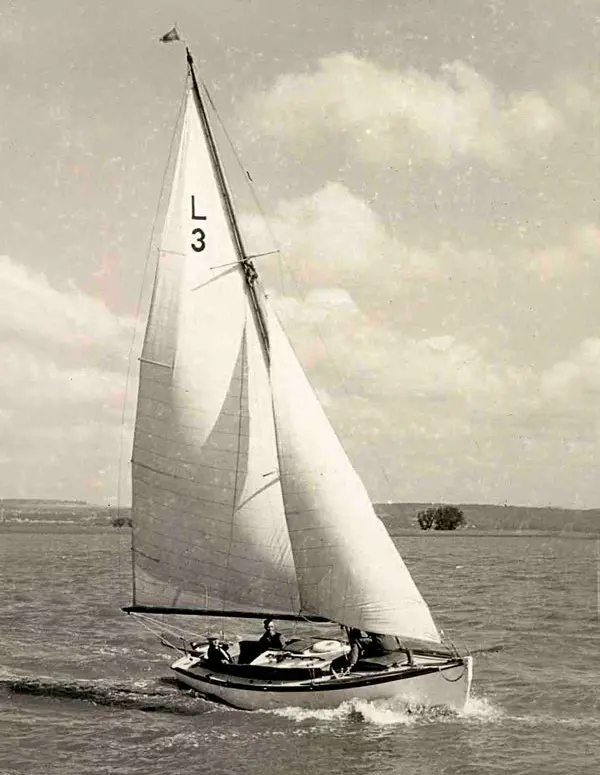
Windsong
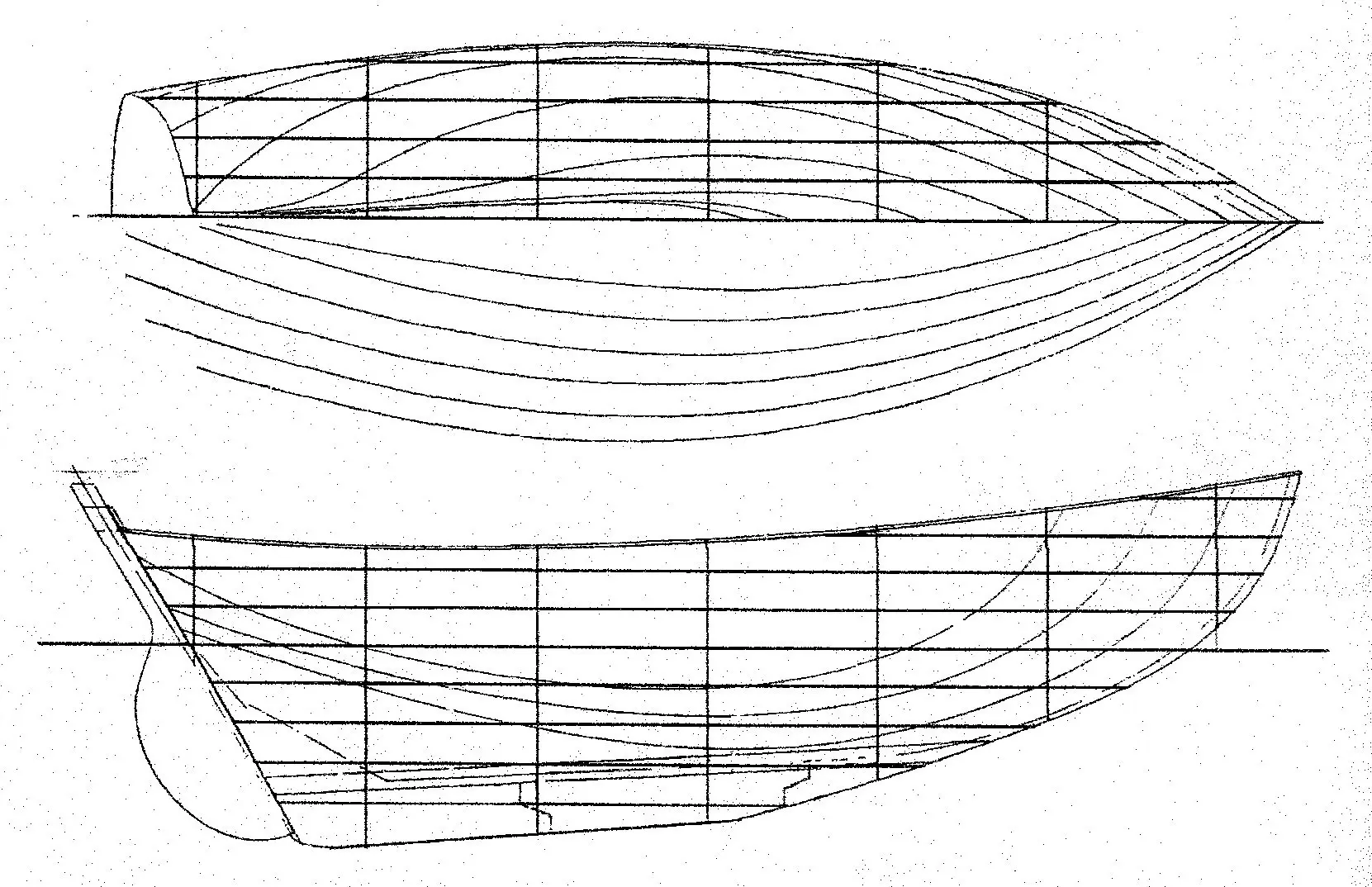
Lymington L lines drawings

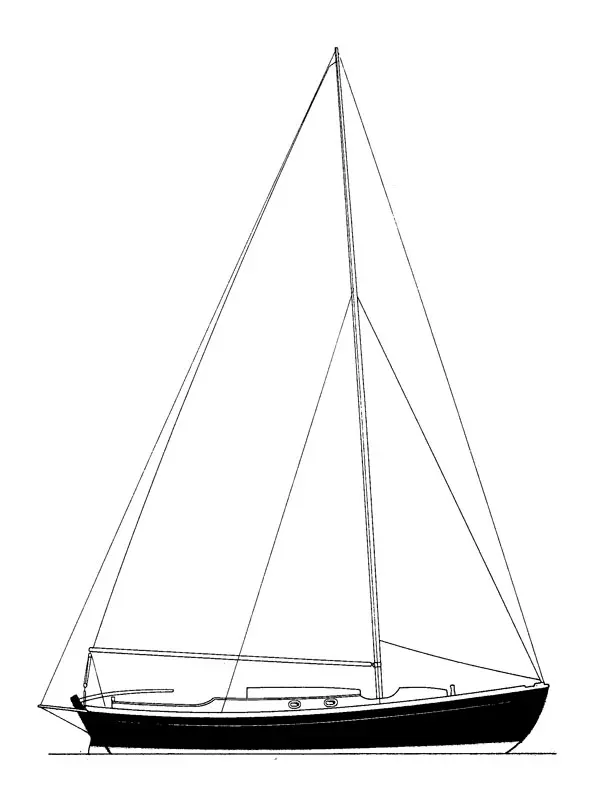
The 18 boats built so far are shown below with their yard names & current names in italics.
1933 Isabella L1, Penguine L4
1934 (Shuna) Isolde L2, Windsong L3, Sally L5
1935 Shaheen L9, (Bonita) Wavecrest 2 L6,
(Jane) Grey Jane L7
1936 (Lympet) Skipjack L11
1937 Mayflower L8, (Madeline) Syvoma L13
Peri of Keyhaven L12, Mermerus L14,
Saving Grace L15
1938 Malista L10, Aryba L16
1939 Iduna L17
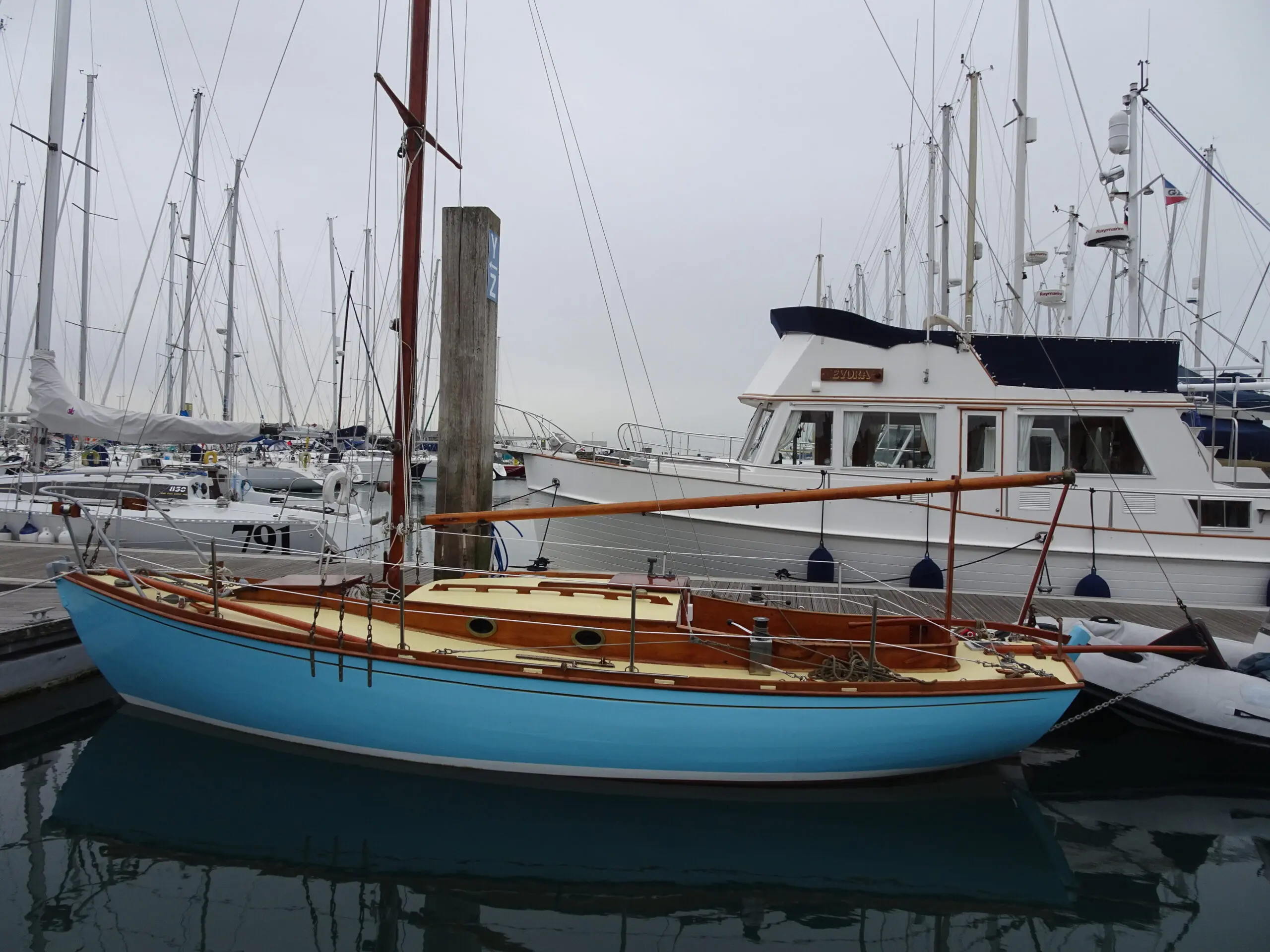
IDUNA the last L Class to have been built so far.
Anecdote:
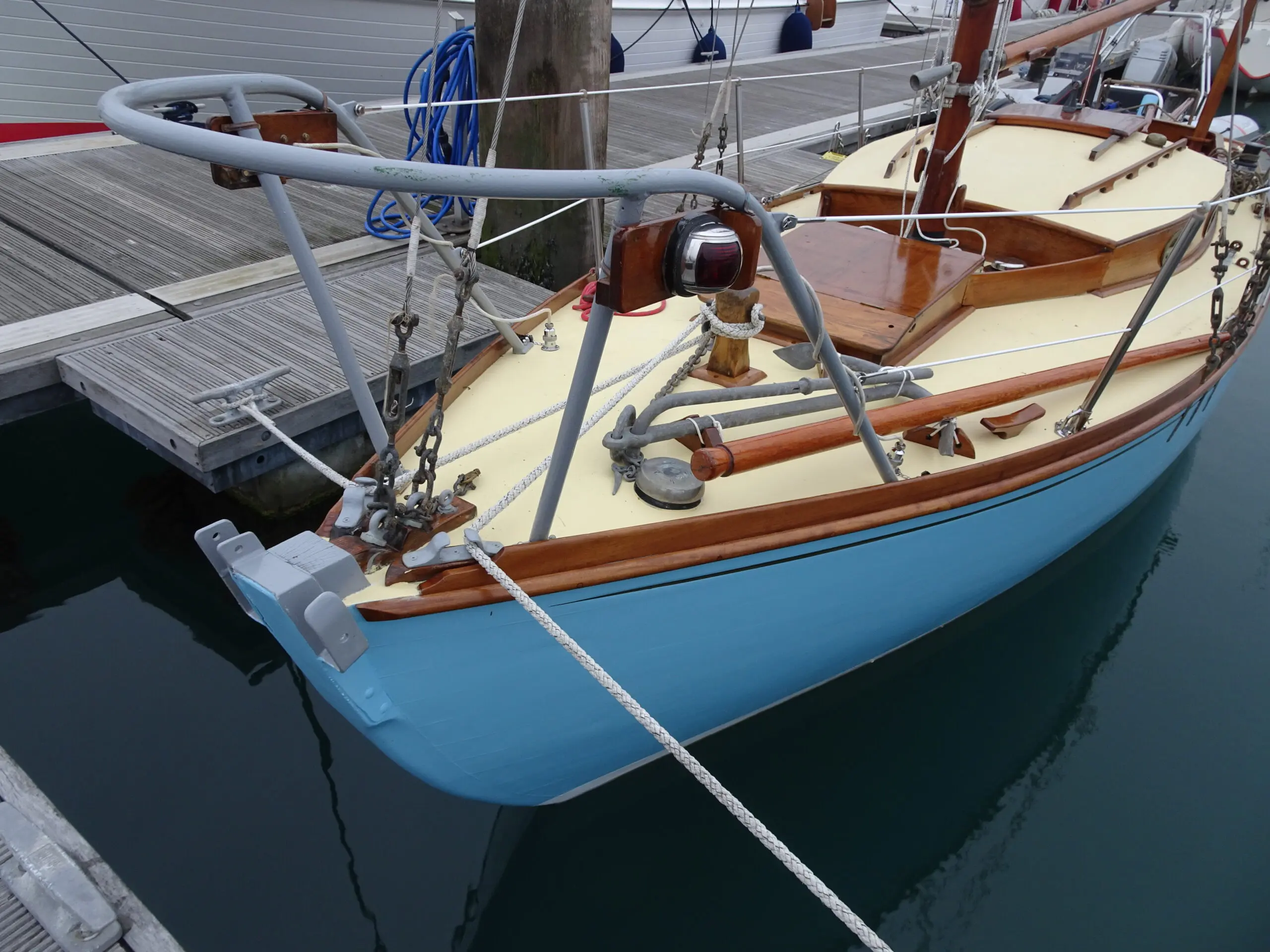
Col HG Grace, His Majesty’s Bodyguard, submitted “a happy augury” to the October 1945 edition of Yachting Monthly, “believed to be the first entrance to a Continental port since war began, of a private yacht sailing as such from any port in the British Isles.” On 31 August 1945, with Admiralty permission and sailing instructions from NCSO Southampton, Shaheen L9 left Lymington, entering Cherbourg around 1900h on 1 September. The crew – Col Humphrey Grace MC, his cousin Roddy Mac Donald and their uncle Alec Mac Donald – were well entertained by the captain, officers and crew of Q170 (US Army) having been invited to lie alongside. Shaheen returned to Lymington in a little over 18 hours.
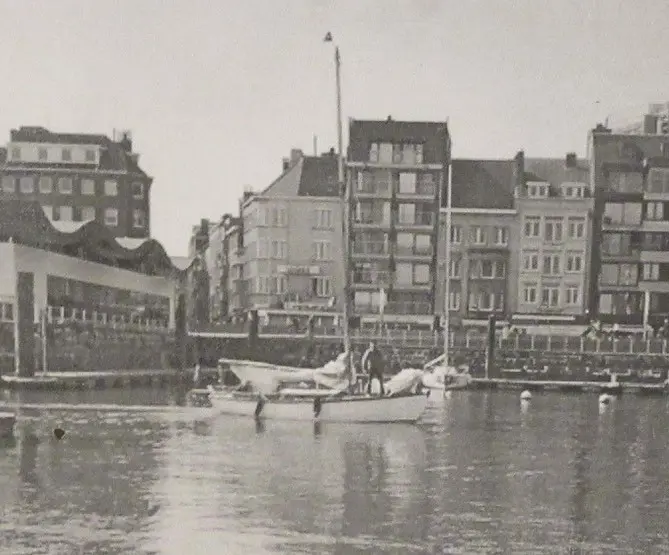
Being without a photograph of that significant voyage, please accept a different boat, a different port and a different year in tribute to the MacDonalds, and of course Shaheen. The different boat is Sally L5, pictured entering Ostend harbour in 2018, 24 hours after leaving Southwold. The return took 16 hours with no need for the engine.
___________
I hope that you have all enjoyed this latest edition of the quarterly Newsletter from VertueYachts.com . Now that you have seen how simple it is to contribute to ‘our’ Newsletter please don’t hesitate to send in your contributions in good time for the Spring edition. Meanwhile, may I wish all our readers,
MERRY CHRISTMAS and a HAPPY NEW YEAR
and continuing, fair winds!
Roger
speedwelltwo@gmail.com
____________________