

SPRING NEWSLETTER – 34 – MARCH 2026
Spring sprang a few days ago here in south Devon, where everyone is feeling winter-weary, and hoping for some more sunshine soon. So, to lift our spirits further, here is another selection of Vertual delights to propel us onwards towards the Summer.
Regular contributor Alasdair Flint has got us all off to a flying technical start this time with some great insights into some of the more technical aspects of how he likes to rig Sumara. He has sailed thousands of miles aboard this beautiful boat, so he is certainly worth reading. Then Hugh Davies treats us to a description of how he’s planning to make Eden Marindin as bullet-proof as possible, ready for racing across the Atlantic this summer, and Mike McKeon tells us how he was tweaking some of Austral Vertue‘s rigging back in the early 1970’s. Both Matteo Richiardi and his elegant Mea will be familier to most readers and this time he too explains some of the intricacies of his rigging preferences after thousands of sea miles together. Whilst Alasdair fears that he may have got carried away with his ‘pen’, I am clearly much more guilty than he…..and if you don’t believe me, just take a look at my gentle examination of….. yes, you really won’t believe it, the ‘fascinating subject’ of ‘Sheerstrakes‘! Enjoy! Then, there to bring us back down to earth is Massimo Zanco’s piece describing how he is looking forward to restoring the one and only Stelda, which he has now transported to the Adriatic sea. The Italians seem to be gathering an excessively high proportion of some of the best Vertues around….? Welcome to another quarterly Newsletter that is written for anyone with an interest in these staunch little cruising boats that have the most loyal following of any in the world.
_________________________
Sumara of Weymouth‘s Rig
Alasdair Flint
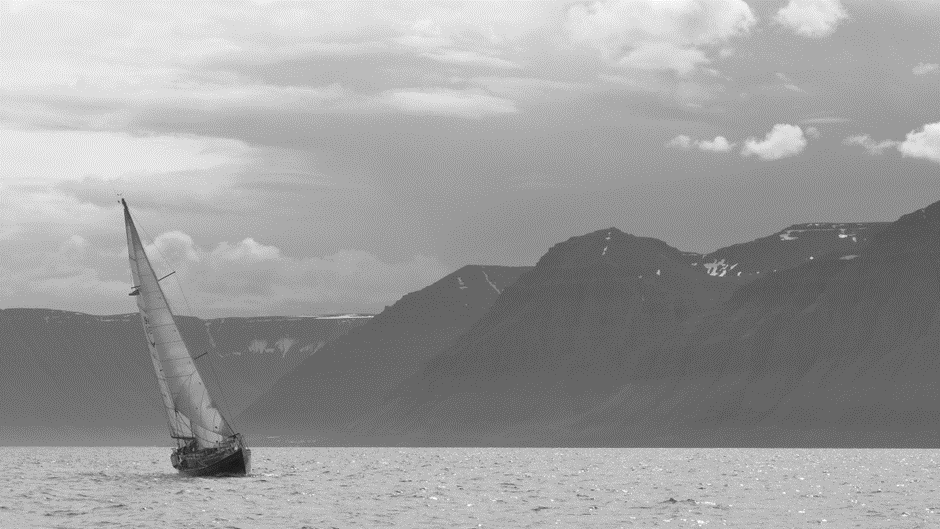
Sumara’s mast is keel-stepped and has double spreaders. It is a hollow box section made from four pieces of clear Douglas Fir with staggered scarfs. It was glued using resorcinol resin. The running rigging is all external but the cables for the lights and the antenna run down the inside. The cables all exit inside the cabin. I understand some people shy away from keel stepped masts due to them letting water into the boat. However, I ensure that there is a good deck seal by using a Hypalon mast coat secured with a Jubilee worm drive clip and this is then backed up with a wrap of caulking cotton secured with self-amalgamating tape. I find it much easier to rig a keel-stepped mast as the crane jib can be quickly cleared out of the way leaving me in peace to set up the rig. The spreaders are anodised high grade aluminium tubes
The boom is an old gymnasium parallel bar and is also clear Douglas Fir. It is suitably heavy enough not to require a vang which is lucky because the life raft storage would be in the way.
The mast and boom are varnished every year with one or two coats of Epifanes Gloss Varnish. In the winter the mast is unstepped, derigged and then laid on trestles and covered with a stout canvas cover. The boat is cutter rigged with running backstays to support the mast at the second spreaders where the inner stay attaches. The runners are tightened with bronze Highfield levers and secured forwards when not in use with tricing lines. There is some adjustment in the Highfield lever attachment, so the tension is set up at the start of each season. If I am sailing downwind, I can release the attachment from the Highfield lever to allow the runners to go forward as far as the spreaders.
I have hanked-on fore sails which I prefer. My many reasons are explained here but basically I prefer to keep things simple and in heavy weather I wouldn’t appreciate the extra top hamper caused by a furled foresail.
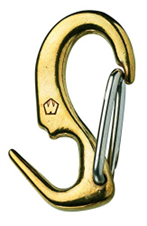
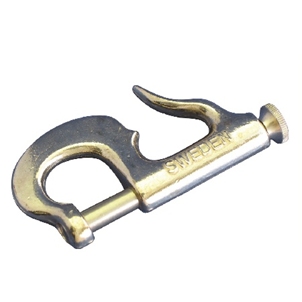
My last set of sails used Wichard clips, but I have now reverted to Swedish Hanks on my new set of sails (2026). I found the Wichard clips easy to put on but very stiff to remove.
All the rigging is KOS stainless steel 6 mm 1×19 except the twin backstays which are 4 mm 1 x 19. The runners are 4 mm 7×7 for flexibility. The roll swages are either Stalok or Blue Wave and all the bottle screws are chromed bronze by Stalok. Further technical details and the rig tensions can be found here.
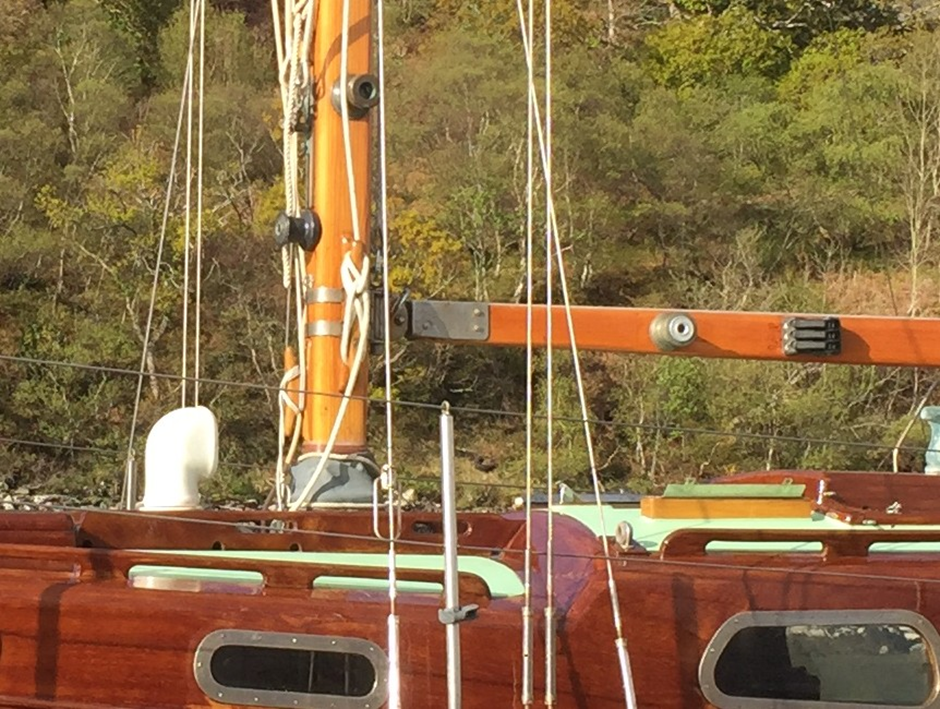
All the sails can be reefed. The mainsail has three slab reefs. I used to find it tricky putting in a reef while the boat was heeling over onto the reefing winch mounted on the boom, so I have doubled up the reefing system with a triple Spinlock clutch and a bronze Harken winch on both sides of the boom. This works well, allowing me to reef whilst always being on the upper windward side of the boat.
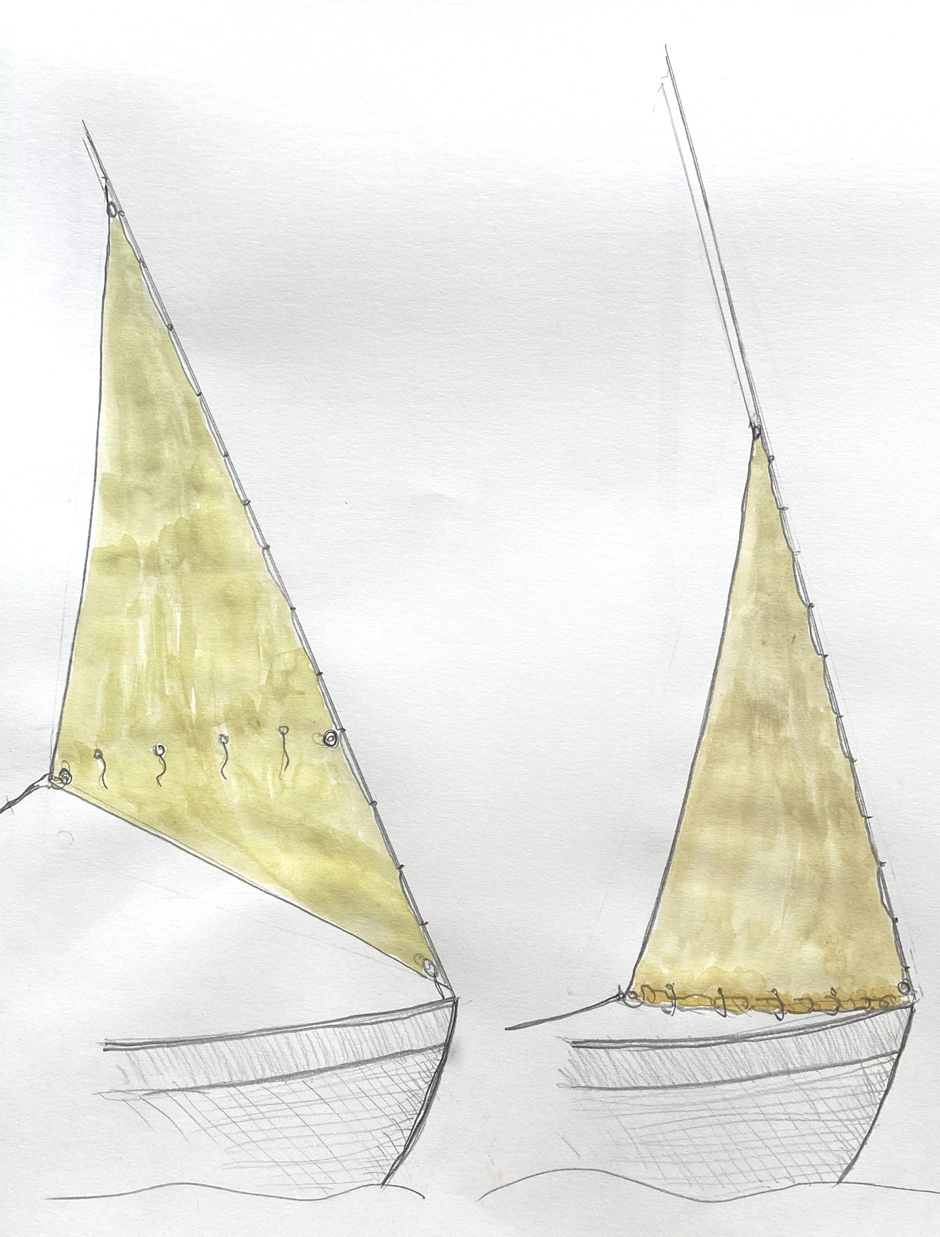
The Yankee can be reefed by lowering it a few feet and re-attaching the tack pennant to the second eye. The sheets can remain tied to the clew but the car needs adjusting. The triangle is then rolled up, and the excess part is tied to the pulpit. There may be a better way, but I am yet to discover it.
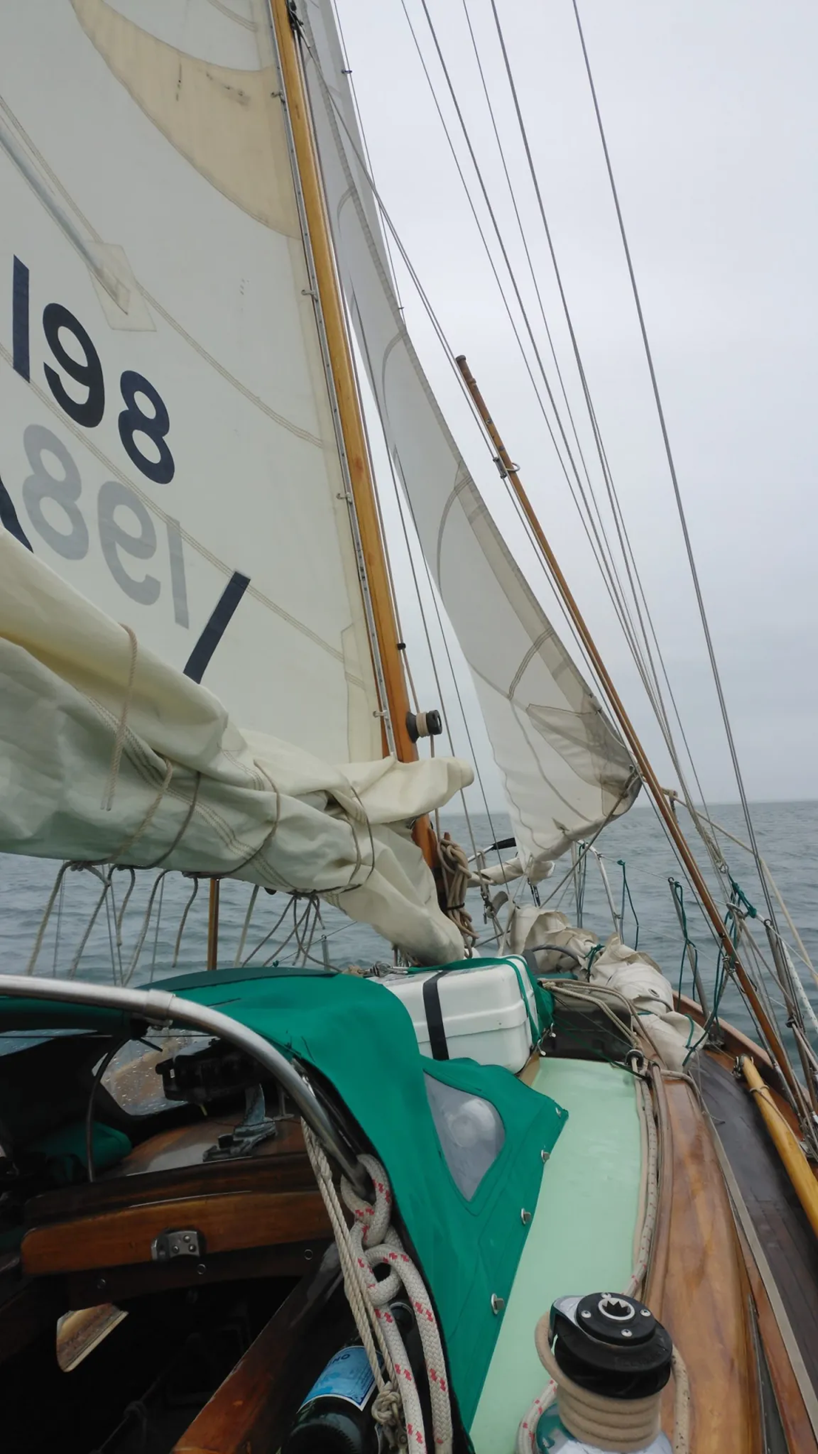
Hove-to, awaiting the tide, with reefed yankee and triple reefed main.
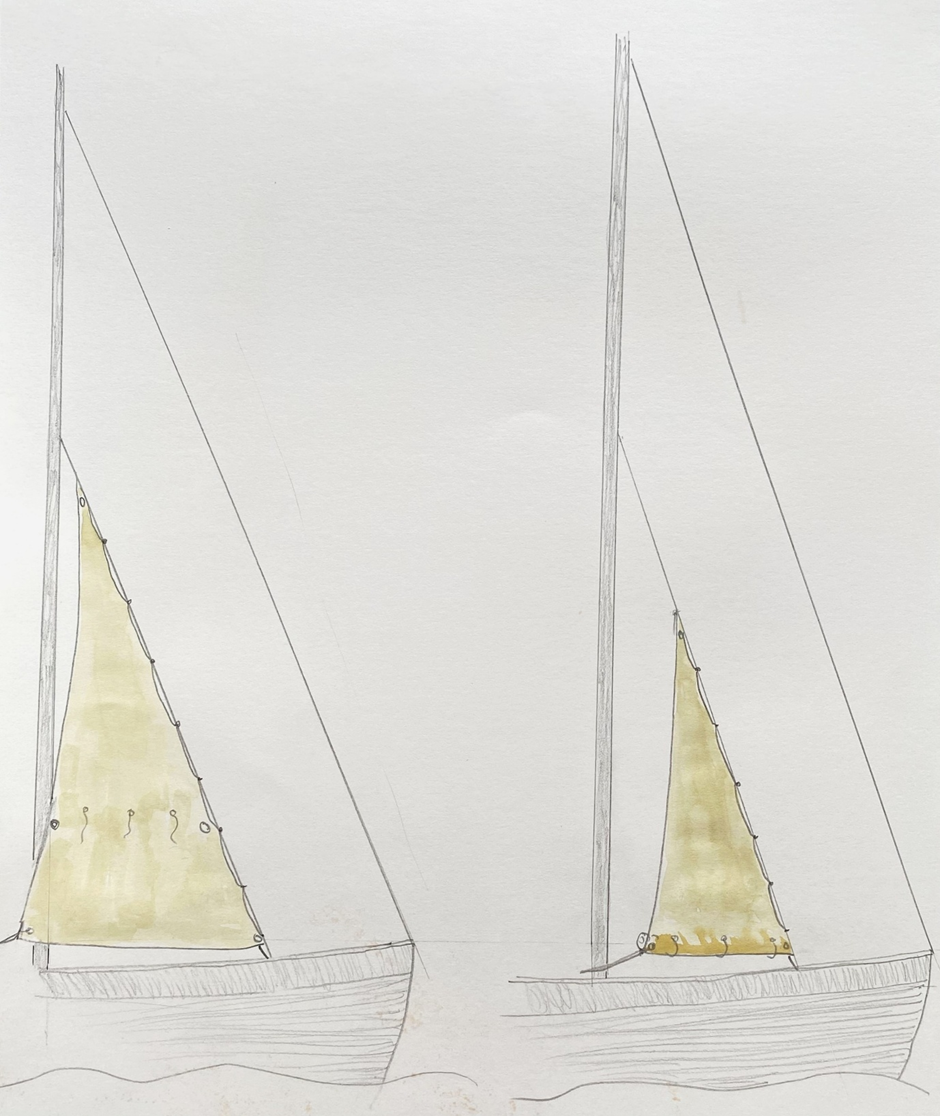
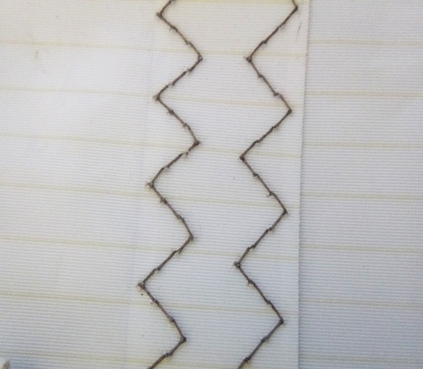
The staysail reefing does require the sheets to be moved up the leech of the sail. The tack pennant is then reattached further up the luff, and the loose part is rolled up and tied with the reefing pennants. My new sails are all made in DP 073 Vectran on the advice of Peter Sanders at Sanders Sails. They are stitched in brown thread on the advice of Eric Hiscock! This time the seams are double stitched, rather than triple stitched, but each zig and each zag has three small individual stitches. It is apparently stronger.
If the weather is very severe, I also have a storm jib. The storm jib is hoisted on the inner stay. It requires a floating block on a short Dyneema strop to guide the sheet to the winch. These blocks are packed with the storm jib ready for deployment.
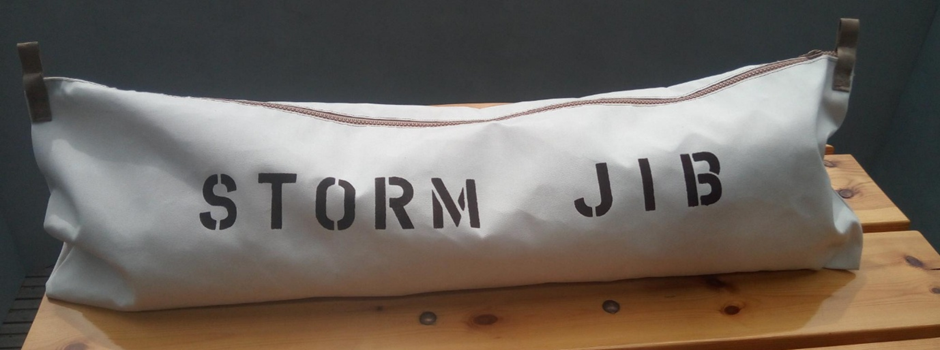
I do not carry a trysail, feeling that it is too complex to rig in bad weather. The boat is very snug with a storm jib and triple reefed main even in strong gales.
I do own a cruising chute but only carry it when heading south to save space onboard.
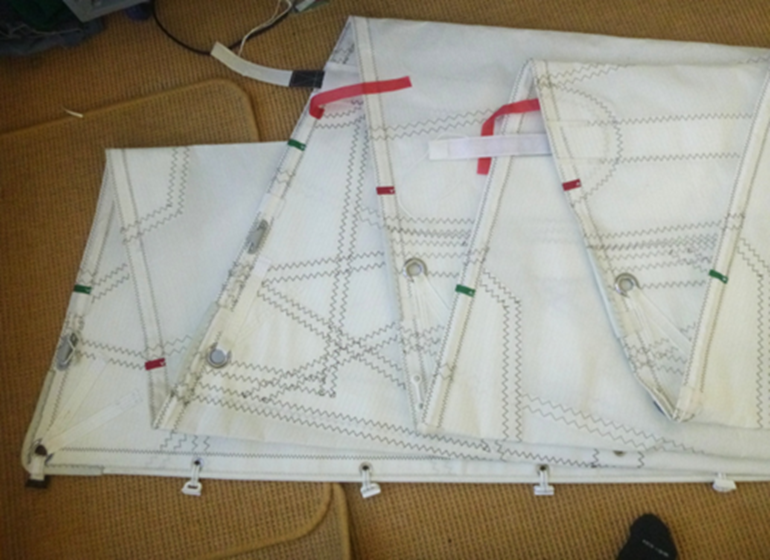
I don’t use Lazy Jacks, Stack Packs or a Dutchman, preferring, when by myself, to simply crash the main onto the deck and then sort out the mess. If I have crew, I can flake it whilst it is being lowered. My new sails have port and starboard webbing “flaking markers” in the leech and luff so the crew can theoretically grab the correct point to haul back aft as the sail is lowered. I am yet to see if this works. Hopefully it will prevent the usual “Up a bit” “Down a bit” conversations and reefing will be a silent operation but maybe not.
None of Sumara’s halyards are led back to the cockpit. I prefer to avoid the added friction, and I enjoy working on the deck. The halyards are all made from Liros Herkules which is a very robust polyester braided rope with little stretch. I have put an eye splice in one end to attach to the sails via a shackle for the main and snap shackles for the fore sails. There is a Flemish eye in the tail end so they can be reeved with a mousing line if necessary.
Knots will not hold in this rope, so I use the softer matt Liros Seastar braided polyester for my sheets which I tie to the clews.
My topping lift is three strand polyester. I like some stretch in the topping lift so that when I am moored I can make fine adjustments to the angle of the boom by hauling down on my mainsheet. This is necessary to make a snug fit for my boom tent. The topping lift also has a length of bungee attached by a rolling hitch about a metre from the boom end. This is then stretched down and clipped onto the boom. It holds some tension in the topping lift and prevents it from wrapping around the spreaders when it is slackened off and the boom is let out.
The mainsheet is also the soft matt braided Seastar rope. It is reeved through a Barton fiddle block attached about ¾ along the boom and then through a fiddle block with jammer onto a single strong point on the bridgedeck bulkhead. It is conveniently placed directly in front of the helmsperson. I have thought about putting in a track but decided I would prefer to keep the cockpit benches clear. Sitting with my back to the cabin bulkhead is a favourite spot when anchored.
There is a “preventer sling” attached to the underside of the boom at the same point as the mainsheet. This nylon sewn sling runs to about halfway along the boom and is then attached to the gooseneck with a bungee. This allows me to clip on the preventer anywhere into the sling when the boom is let right out avoiding the need to stretch outboard or having to haul in the boom. The preventers go through two snatch blocks on the stem head. When the preventer is winched in, the round sling’s bungee stretches outwards to allow the preventer and round sling to form a straight pull line. The preventer’s snap shackle when not in use is clipped to the guardrail via a nylon cod end ring.
Gosh I went on a bit, sorry about that!
_________________________
EDEN MARINDIN
Hugh Davies
Preparing for the Jester Newport Challenge 2026
During EM’s refit for the Jester Azores challenge “Drogue plates” were fitted on the quarters for a Jordan series drogue . Extensive research at Southampton University and later by Mr. Jordan after whom the JSD is named has shown this is the safest both for the yacht and crew. It wasn’t patented so many are made successfully at home. Smaller yachts can be “Pooped” by breaking waves.
This meant creating a more substantial “washboard” arrangement for the V2 companionway were the sill is below the cockpit coamings was necessary. A single hinged washboard was retrofitted easily in three parts with some trim.

A fellow Jester had a partial inversion on his return from the Azores in a force 6 by a rouge breaking wave. He ended up sitting on his coachroof whilst inside seeing the power of the wave with water jetting between the gaps in the secured washboards more than half way down the cabin. On righting he was knee deep in water with the entire yachts interior soaking wet in the middle of the night !!
My new arrangement just wouldn’t cut it in a knockdown so back to the drawing board. The solution I was seeking must not require structural alterations, had to be removable and not look like a carbuncle.
Many mockups later a simple design was settled on with careful measurement and manufacture it provided an ideal solution. Fifteen millimetre marine ply reinforced with carbon fibre cloth and epoxy resin then gel coated and polished the inset companionway was made to fit inside the previous adapted companionway with an aluminium and polycarbonate waterproof hatch. For coastal cruising the watertight hatch is removed, and on the ocean it is installed with machine screws on captive nuts. It’s no harder to negotiate than the current arrangement. I don’t bang my head on it down below and can open it easily from inside and out. Additional teak outside handles were made for cold hands !
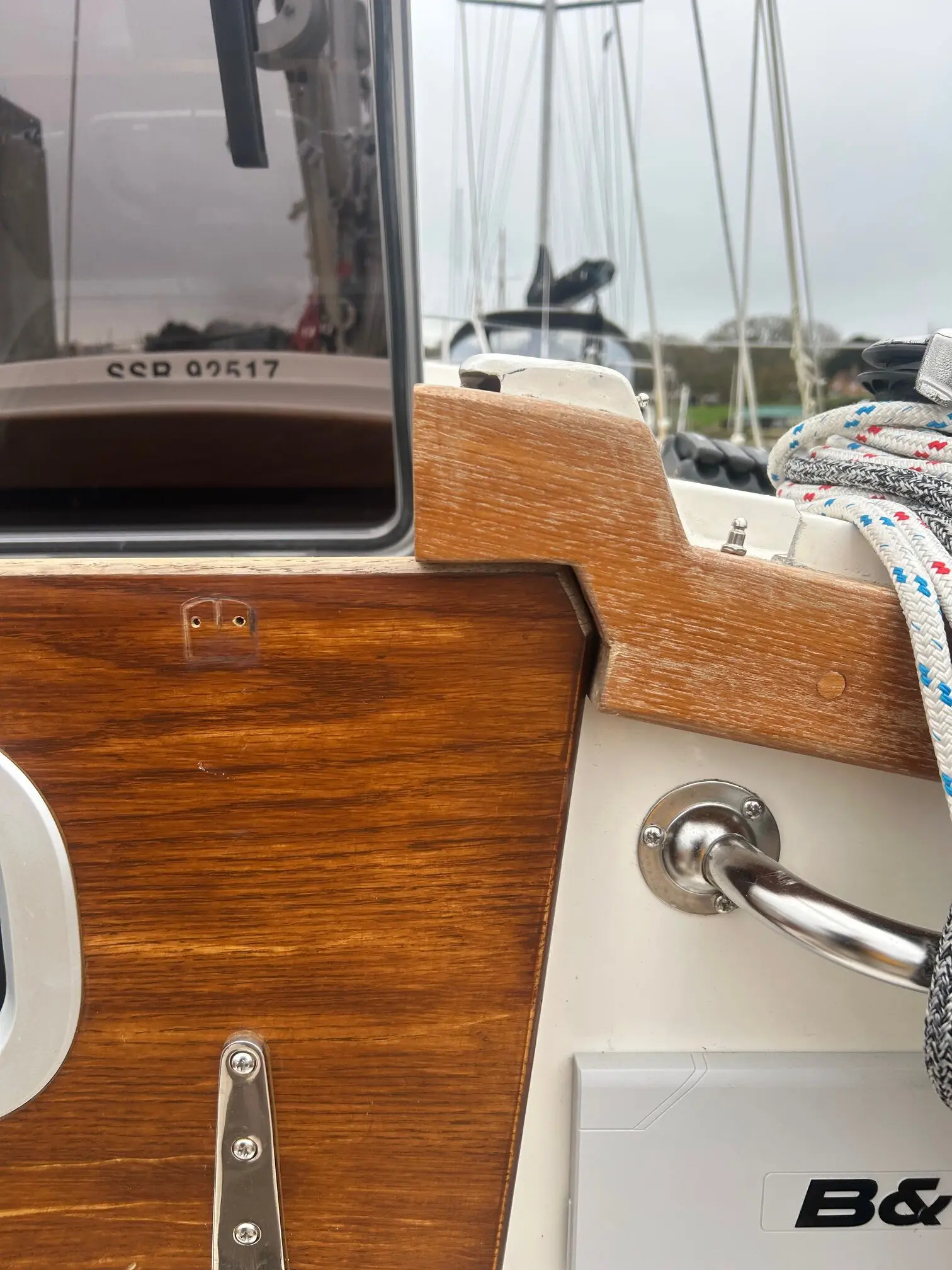
I have not had enough time with all the other tasks going on to throughly test EM’s new Solent rig. Which whilst not ideal for coastal sailing will be a great help in my attempt at the Jester Newport Challenge, reducing foredeck time ? JNC26 starts on the 10th May. It’s a challenge not a race as I’m up against some much larger yachts, one of which is a Tradewind 35 ! So expect I’ll arrive a week or so later if not more !
I had considered just a temporary stay and witchard ratchet for the working jib, similar to the cutter stay for the storm staysail. I worry about the extra windage and weight of the rolled working jib ? I have a suitable hank on Working jib I could use. It’s not too late to change ? Any constructive comments welcome.
__________________________
Austral Vertue
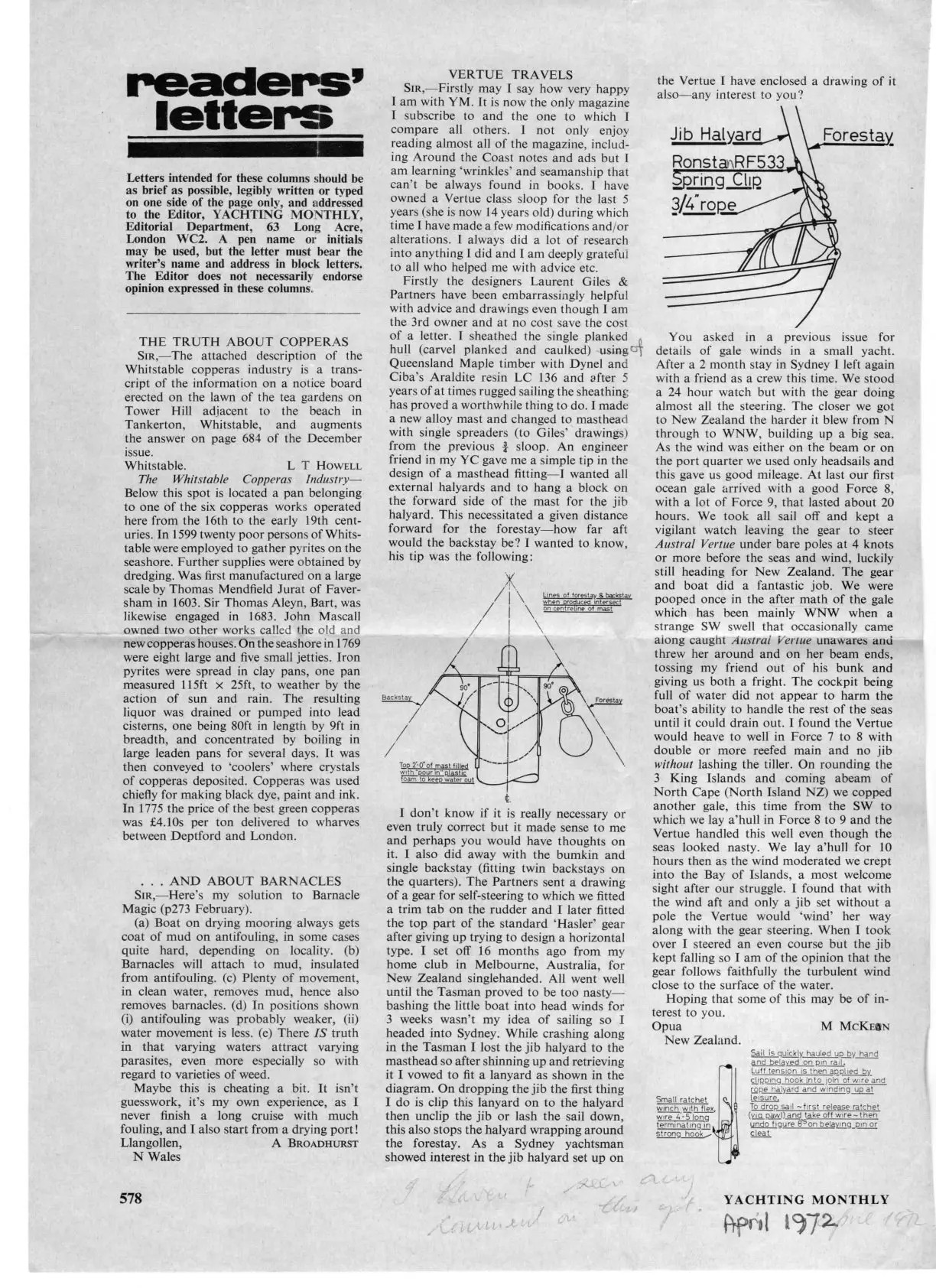
Meanwhile, back to the subject of rigging, here are some thoughts from one of our regular Aussi contributors, Mike McKeon (one-time owner of Austral Vertue).
__________________________
Mea’s rigging
Matteo Richiardi, January 2026
Mea is a masthead sloop “Ocean” Vertue, with a keel-stepped, double-spreader mast and a removable inner forestay going up from the tack point of the genoa – a rig design that was termed ‘slutter’ – a hybrid between a sloop and a cutter – much to Laurent Giles’ dislike. The slutter rig allows for a bigger headsail than a standard cutter rig where the inner forestay is parallel to the masthead forestay, but makes it incompatible with the masthead jib.
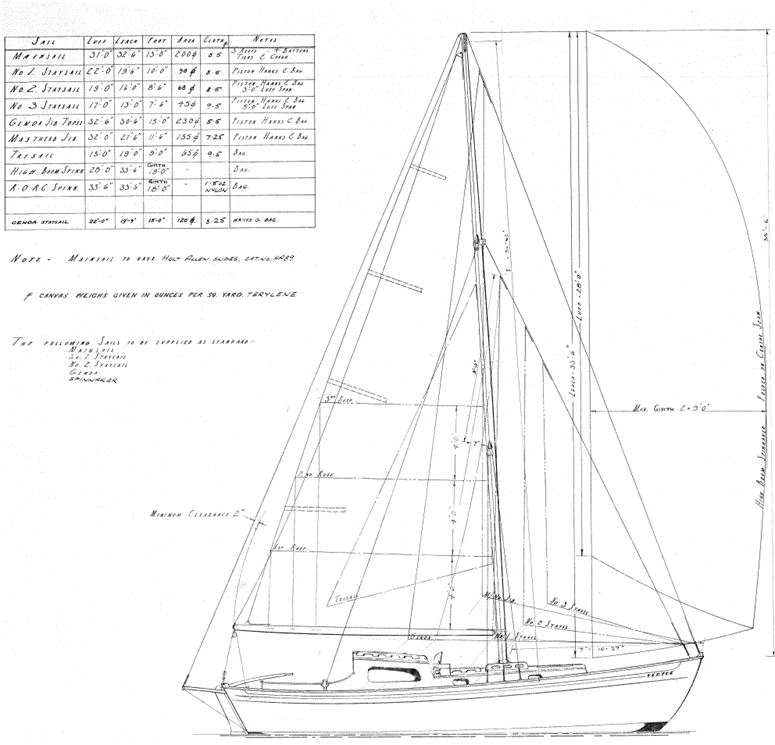
Not the Ocean variant, but the same rig
Rather than a single backstay on a boomkin as in the sailplan above, Mea has a split backstay, leaving room for the windvane.
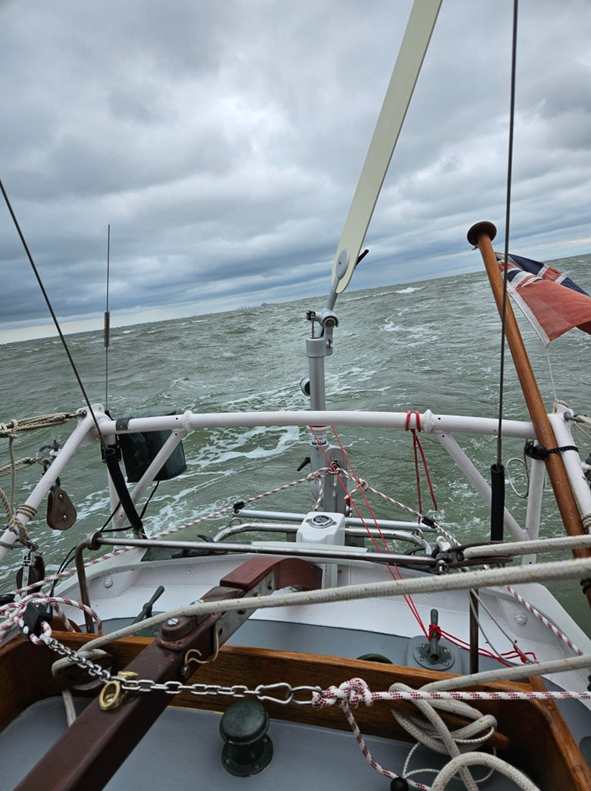
The block for the mainsail sheet was originally placed on the pushpit but I moved it to a dedicated horse more in line with the end of the boom, fearing that the backward pull could loosen the fittings at the end of the boom as happened to David Lewis during his 1960 Ostar. As in David Lewis’ Cardinal Vertue, Mea’s boom is a shortened version of the original sail plan. I have seldom regretted this as Mea has, if anything, a bit of weather helm, at least with her current slightly sagging sailcloth (2000 vintage).
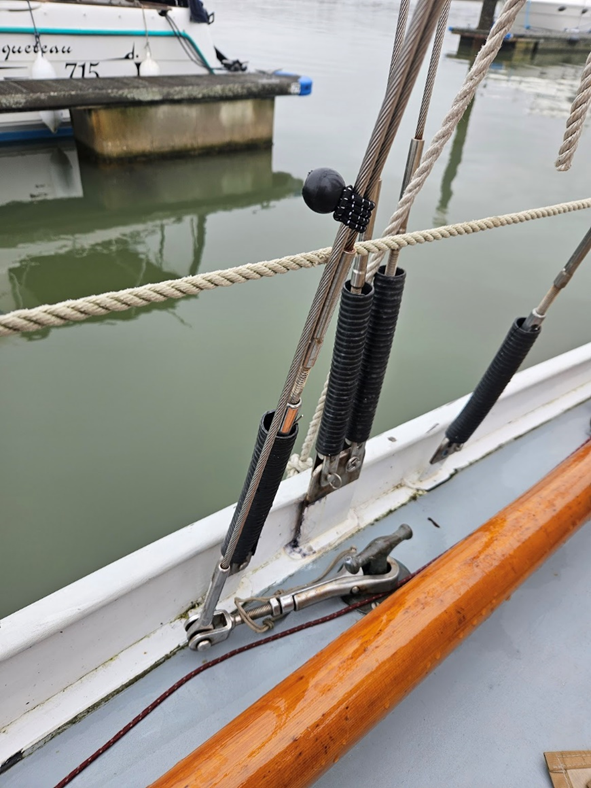
To counter the tension of the inner forestay, Mea has a set of running back- stays, tensioned by bronze deck levers. I have struggled with storing the running stays when not in use, as even with all the slack allowed by the lever they interfere with the boom, when sailing downwind. The best solution I came up with is to detach the upper runner and attach it to the guard rail, while the runner tail lies on deck, kept in place by a short elastic shockcord to the nearest stanchion.

To connect the runner and the tail I use a screw lock carabiner. An adjustable elastic chord prevents the runner from moving forward too much and banging into the spreaders when not in use, and recovers the slack on the leeward runner when in use. Because the lever only provides an approximate tensioning, I have added a turnbuckle for fine-tuning, which I operate by hand once the lever is down. This completely satisfies me.
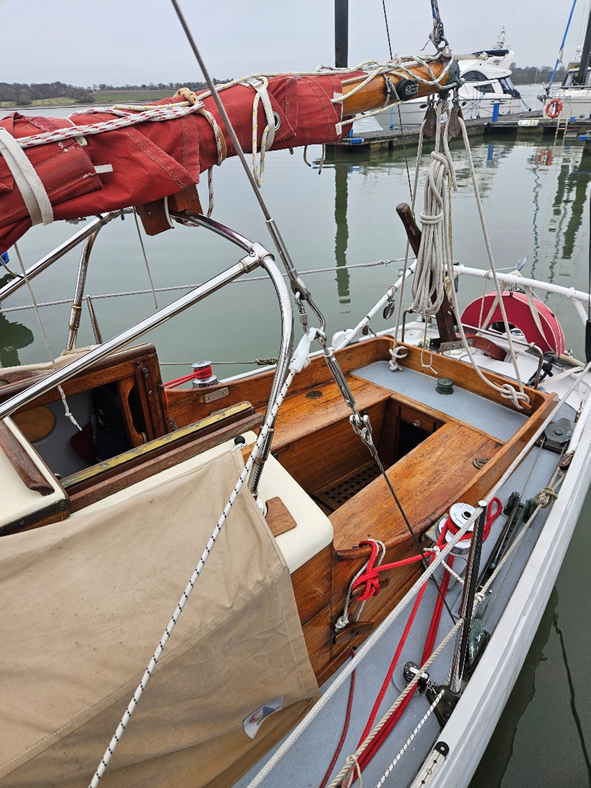
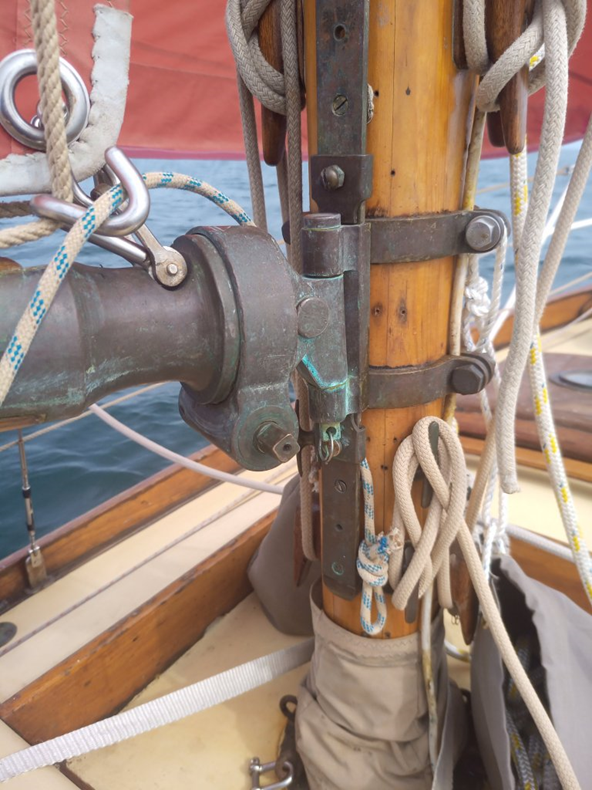
For historical reasons, I would have been very keen on testing the original system. However, this would have entailed removing the boom cleats, which I wasn’t very keen to do. I later added two more cleats (4 in total now, three for the reef lines and one for the foot), so reverting to boom rolling has become even more unlikely at least under my ownership (but still possible).
I have always wondered why roller booms have disappeared, in favour of the totally stupid in-mast furling system: unsafe, inefficient, and expensive – but it is a matter of fact that the boom roller never graduated from the 1960s. My understanding is that it is particularly unsuited for solo sailing, without an additional person at the sheet working out wrinkles.
One argument in favour of slab reefing is the possibility of having a vang. This however is absent on Mea, and given the weight of the boom I don’t think it is really needed.
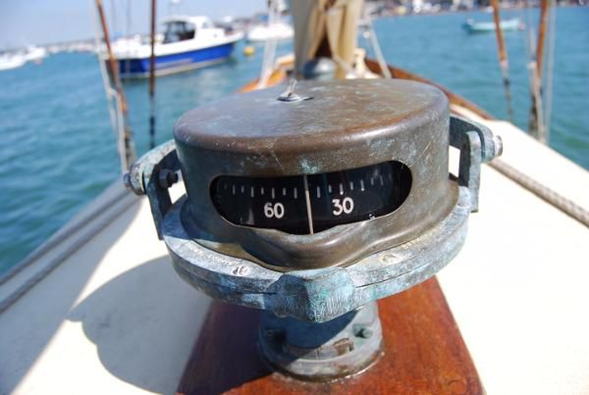
A disadvantage of the slab system, on the other hand, is the need for long reefing lines. On Mea, the reefing lines also risked jamming around the Sestrel compass mounted on the garage, an issue that Mea’s past owners did not address. After some hesitation I have therefore moved the compass to the cockpit (see Take it or leave it – part II – Sailing Mea), and replaced it with a handrail.
I made two more modifications to the mainsail. First, I removed the boom rail, as it looked like an open invite for rot. I unscrewed it, plugged the holes and glued an oak strip on the track (see Take it or leave it – part III – Sailing Mea). Instead of slides, I now use laces. This has one advantage, in addition to simplicity. When I need to change the mainsail, I simply lay it on deck alongside the boom, then start unlacing (or lacing) it. No need to bring the sail forward to the mast to get the slides into the track, which is often inconvenient especially in rough conditions.

Notwithstanding this advantage, I try to avoid changing my mainsail if I can, and I do not have a trysail. Anders Lindgren, who sailed Mea on an Atlantic tour back in the 1980s, speaks very well of using a trysail:
“During my worst storm, homeward bound from Venezuela, Northwest of the British Isles, I hove to first, but then ran with bare poles. 12m waves like big trains just flushed past underneath us, mostly. Mea lifted her aft beautifully in those waves as she always did. Going against the wind was a bit more tedious, especially in short waves, partly because of old sails. And I swore about the missing Storm main many a time. I never needed a sea anchor or ropes”.
However, I would be a bit worried having to make the sail change in (very) bad weather. I rely instead on my generously reduced mainsail under three reefs or – when the worst comes – on taking the main down altogether.
The second modification is more structural and entailed a further slight reduction in sail area. I have added a (fixed) frame that supports a (removable) mini-sprayhood:

This required shortening the leach of the mainsail by about 30-40cm, so Mea’s mainsail is no longer a right triangle. Not right, but not wrong either, as it gives precious extra headroom in the cockpit. The sprayhood frame also supports the boom, when the mainsail is stored – see Take it or leave it – part IV – Sailing Mea.
As for the foresails, I made little modifications. Mea has a furling jib. This was a big upgrade with respect to what I was used to, and I have to say that I find it practical, although I would probably spend no money to replace it, when the time will come. However, I have learned the usual hard way that it is unsafe to use the furling jib above Force 5, as the risk of jamming it increases exponentially, as well as the difficulty of un-jamming it. I should add that a tiny little sail with a large sausage luff is also probably not very efficient. So, above Force 5 I furl the jib completely, and use a staysail instead. I have three of them of various sizes – all bought on ebay, plus the original 1960 storm jib. I normally take only one or two with me.
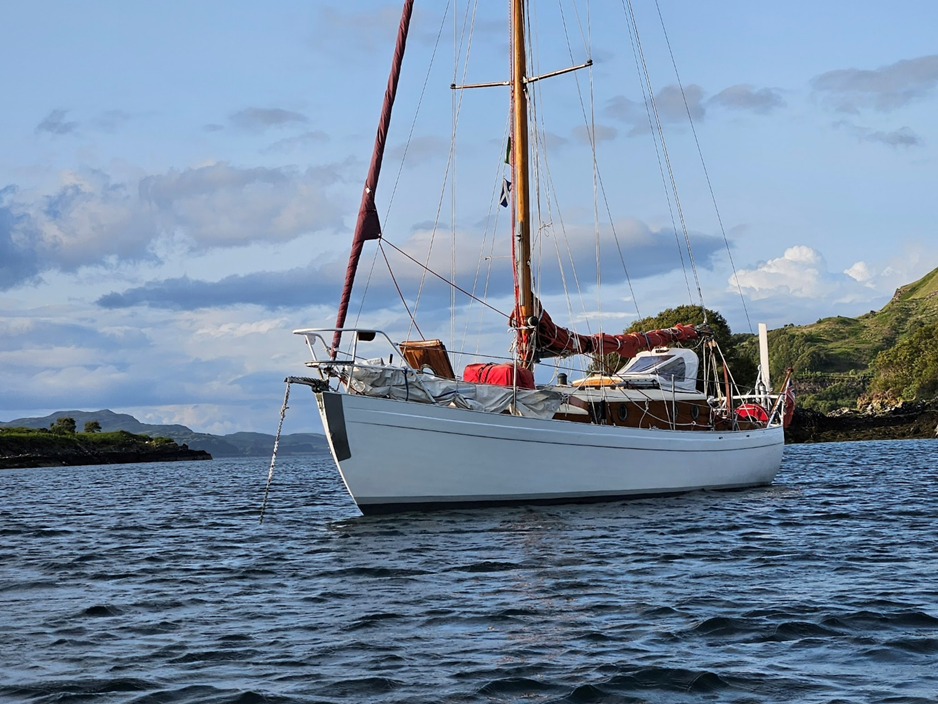
Mea in Puilladobhrain
When I bought Mea, in 2018, she had the jib sheets going to two cars on the toerails. She also had, on each side of the deck, two apparently unutilised eyes, which I suppose were originally used respectively for the masthead foresails (back eye) and the inner foresails (front eye).
Out of concern that the toerails might be too weak to withstand the full force of the wind on the jib, I decided to go back to the origins. However, I disliked the idea of not being able to adjust the position of the tack. So I put the jib sheet through a block on the back eye, and through two nylon rings (to be safe) on a pulley going through the front eye and back to a cleat on the cockpit coaming. When the trim is slack, the jib sheet goes directly to the back eye; by sheeting in the trim, I can increase the angle of the jib sheet, until the sheet goes to the front eye when the trim is completely sheeted in. I am quite satisfied with this system, the only drawback being that there are more ropes running on deck. I have left the tracks on the toerail as a backup and found that the adjustable car comes in very handy when it comes to tying down a cover, while the track protects the toerail from chafe from the mooring lines.

As for storing away the removable forestay when not in use, on Mea the stay is shortened and attached to an adjustable pelican hook. I therefore simply attach the pelican hook onto a deck cleat, and tie the stay to the front D-shroud with two small elastic chords, one low on deck, and the other one higher up. I must admit that I made quite a few experimentations before recovering this solution that some previous owner must have come up with, I suspect with great satisfaction …
I also sail with a symmetric spinnaker on a wooden spinnaker pole (both bought on ebay) – indeed, I have two wooden spinnaker poles, but I normally leave the second, very heavy one at home (I took it with me when I sailed the Round Britain and Ireland race). I experimented with an asymmetric spi, but I found the real thing so much better and more flexible – I’ve come to believe that asymmetric spinnakers are good only on very light and fast boats, where the apparent wind never really comes from behind. Not Mea’s case.

___________________________
SHEERSTRAKES
Roger Robinson
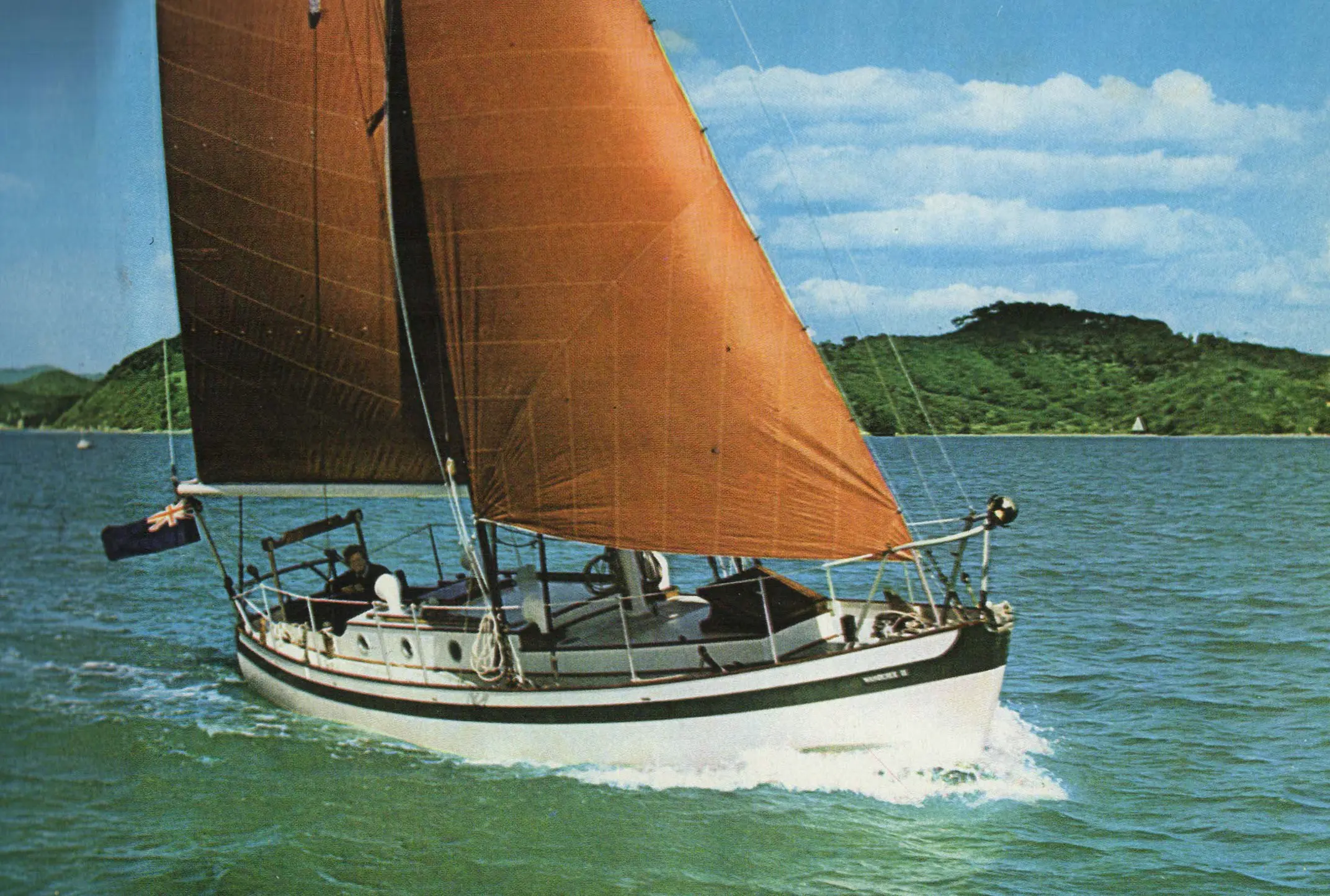
The Hiscocks’ Wanderer III during her second circumnavigation.
The design characteristics of the old sailing pilot cutters were acknowledged by Jack Laurent Giles to have influenced his thinking during the creation of what eventually became the Vertue class. One of the most visually striking features of the pilot cutters that ranged the Bristol and English Channels, was the thickening of their massive oak-planked topsides for up to three or even five strakes below the covering boards. These were working boats and had to withstand the rough and tumble of their hard lives, boarding pilots both by dinghy and actually alongside much larger ships at sea in all weathers, and even being towed alongside at speeds of up to twelve knots.

The pilot cutters Marguerite, Hope and Kitty moored in Barry showing their licenced pilot numbers displayed on their bulwarks for’d, and painted name-boards on their quarters.
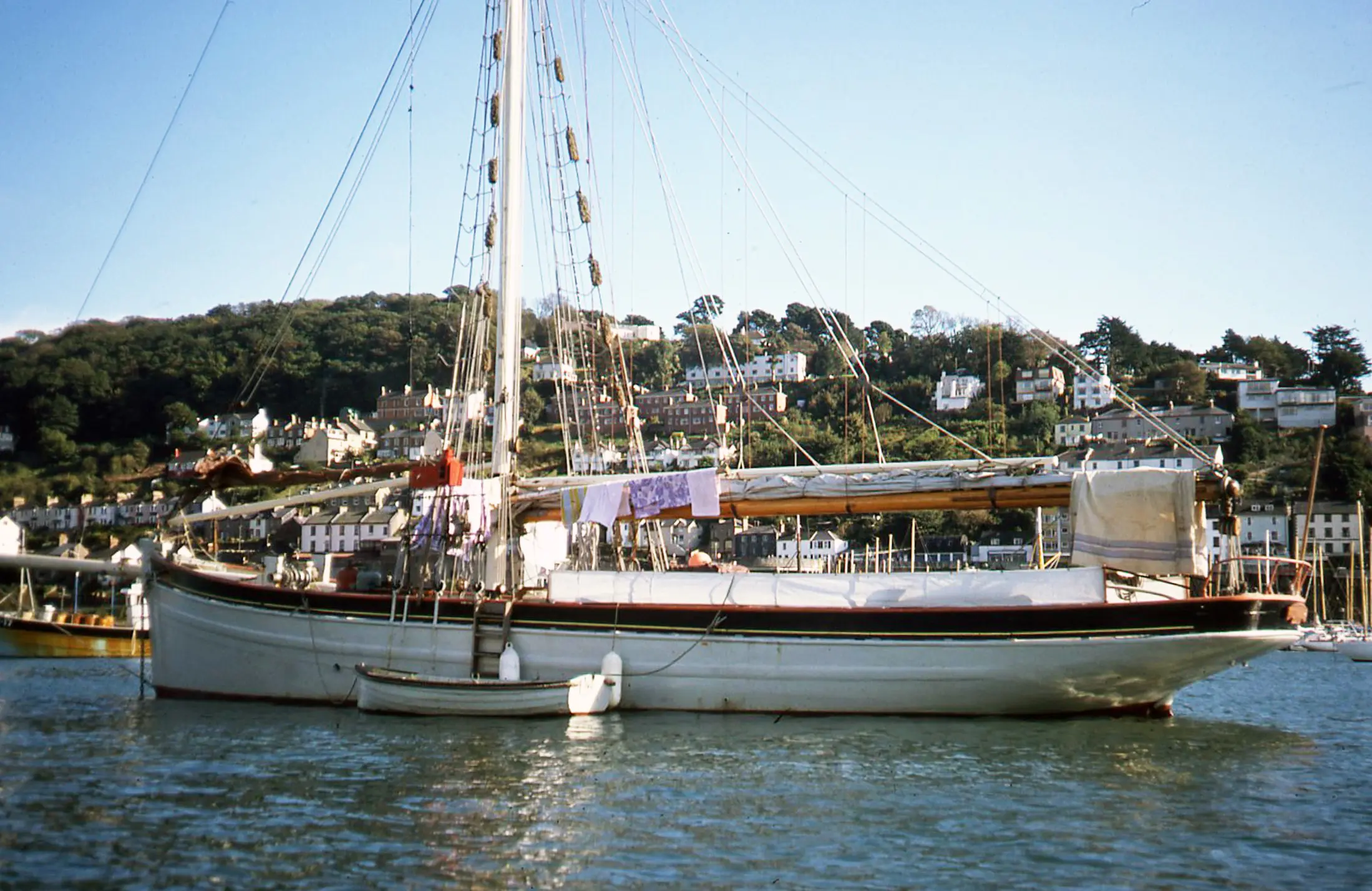
Quite often the lowest of these thicker strakes were thickened even further, perhaps to as much as 2.5 inches, as shown on this photo of Marguerite that I took in the early 1960’s. In addition to the sweeping black bulwark planking this thicker band further accentuated the bold sheer of the pilot cutters. I first sailed aboard her to Brittany as a teenager with the Island Cruising Club out of Salcombe. I was smitten.

A few years later I was living aboard the pilot cutter Mischief for several weeks in Lymington as we fitted her out to go South. I had remembered the photographs of how the working pilot cutters in Barry usually displayed their names on their quarters and gained the Skipper’s agreement to replicate the idea aboard his beloved cutter. In his usual taciturn way, whilst he seemed to approve of the finished article he never actually said so, but I think he might have liked it as the names of both of Mischief’s successors, Sea Breeze and Baroque, were subsequently displayed in the same manner!
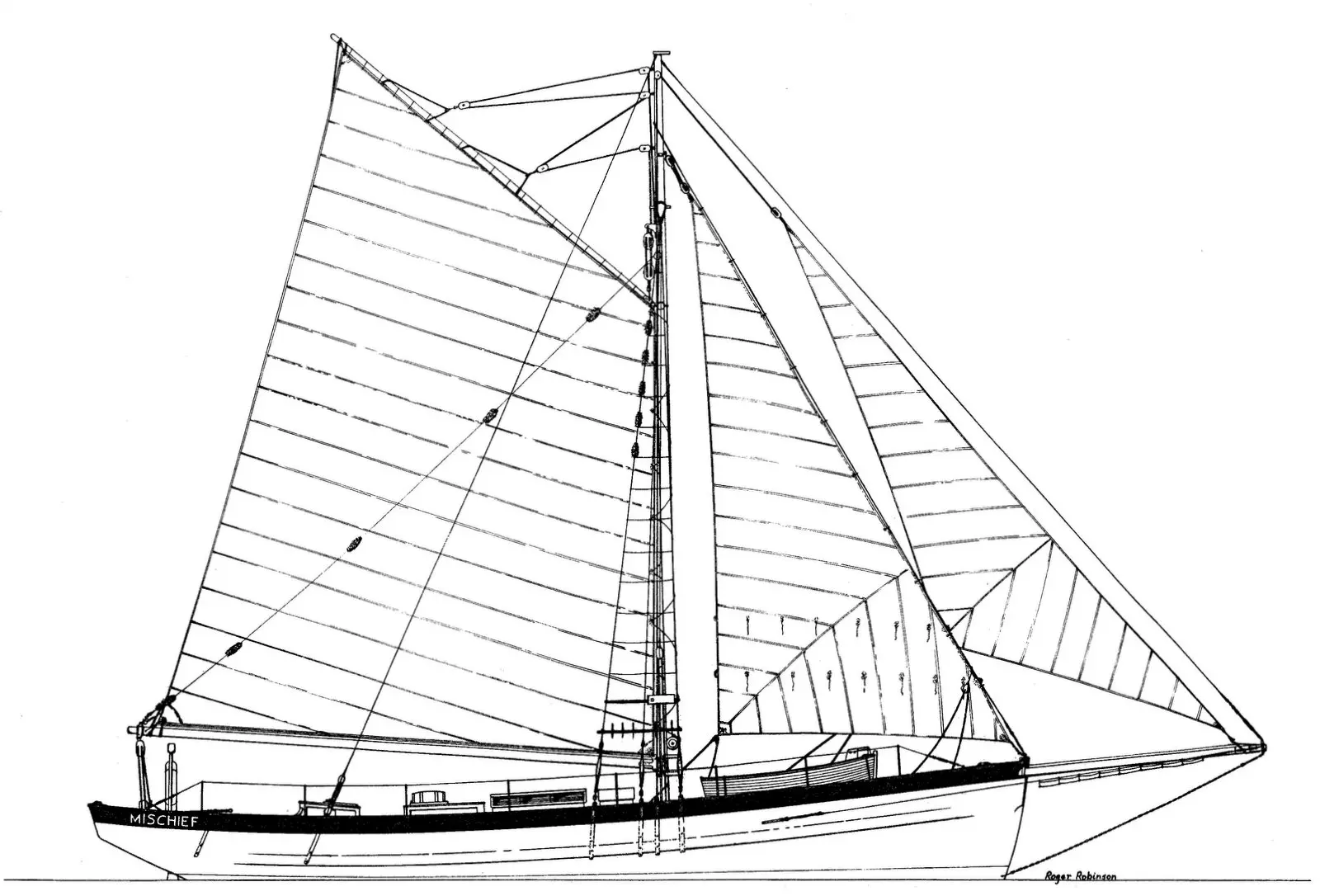
The Mischief had the most exquisite sheer.
Our own pilot cutter Olga was built in Porthleven like the Sea Breeze and had the thickened strake well down her topsides. Here she is in Cornwall being refitted for the passage up to Essex where we spent eight years gradually restoring her.
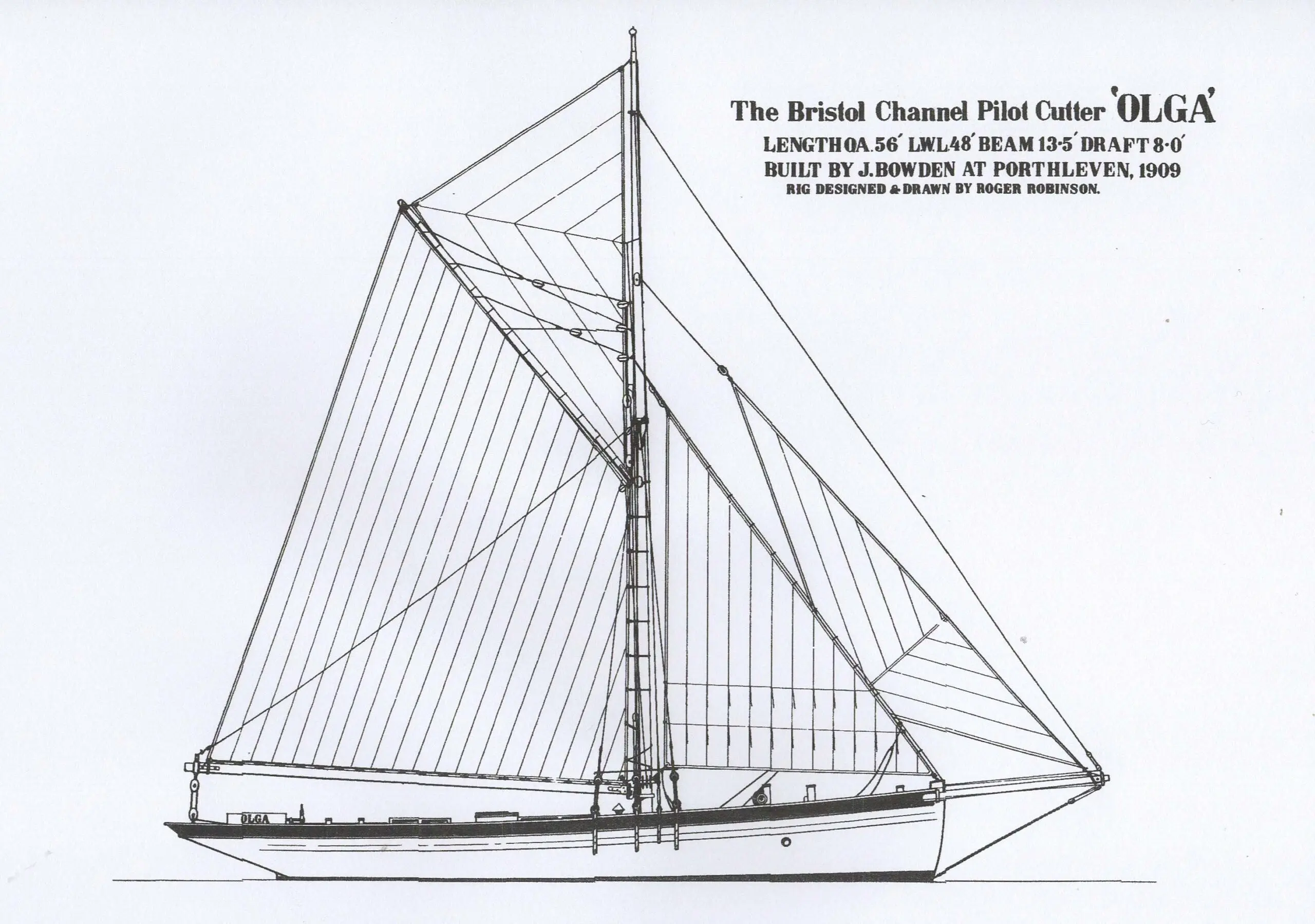
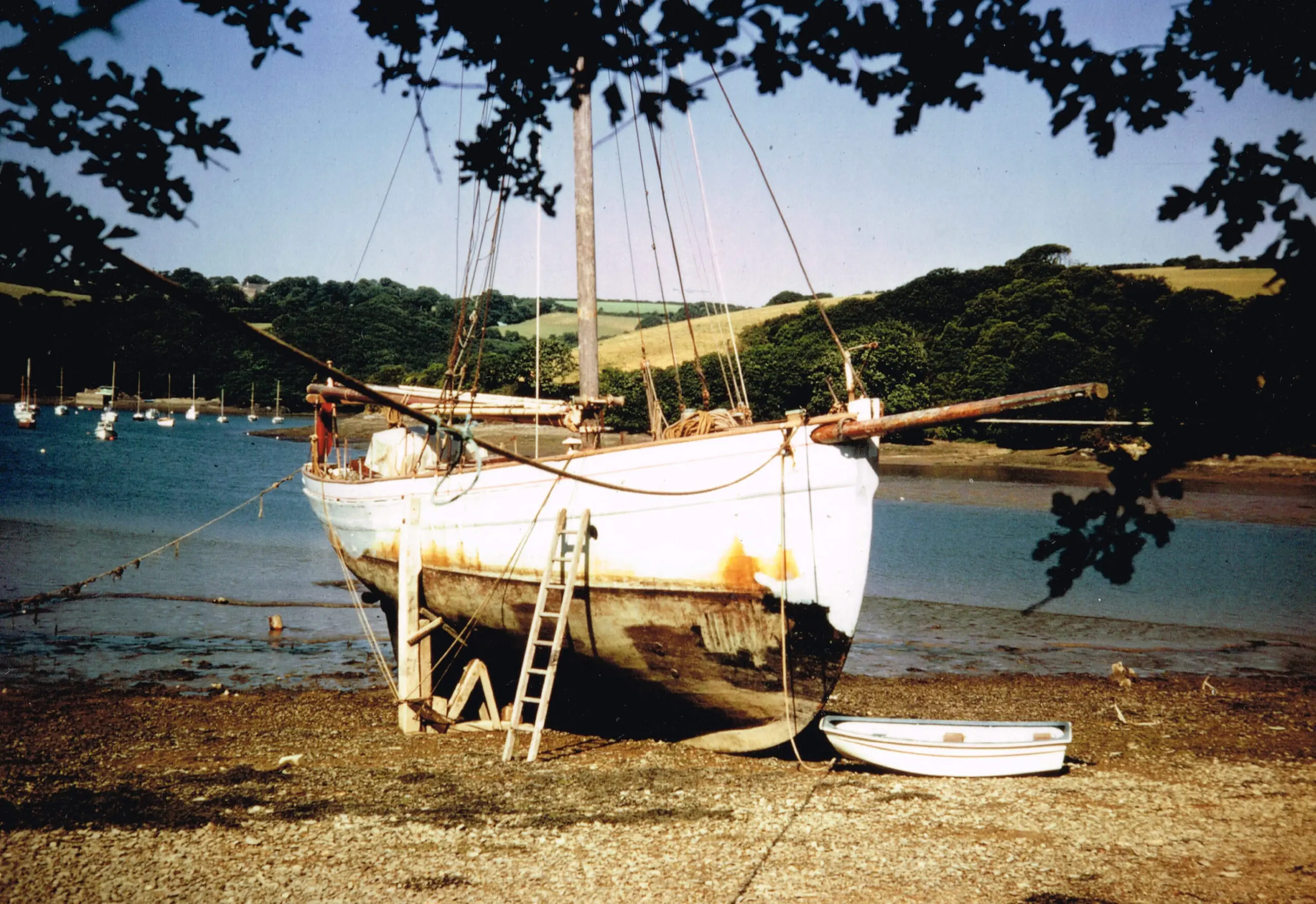
Olga
Like Andrillot the first Vertue, Monie was built with the thickened sheerstrake that became one of the signature details of the class, as well as more than 15 of Giles’ other cruising boat classes over several decades to come.
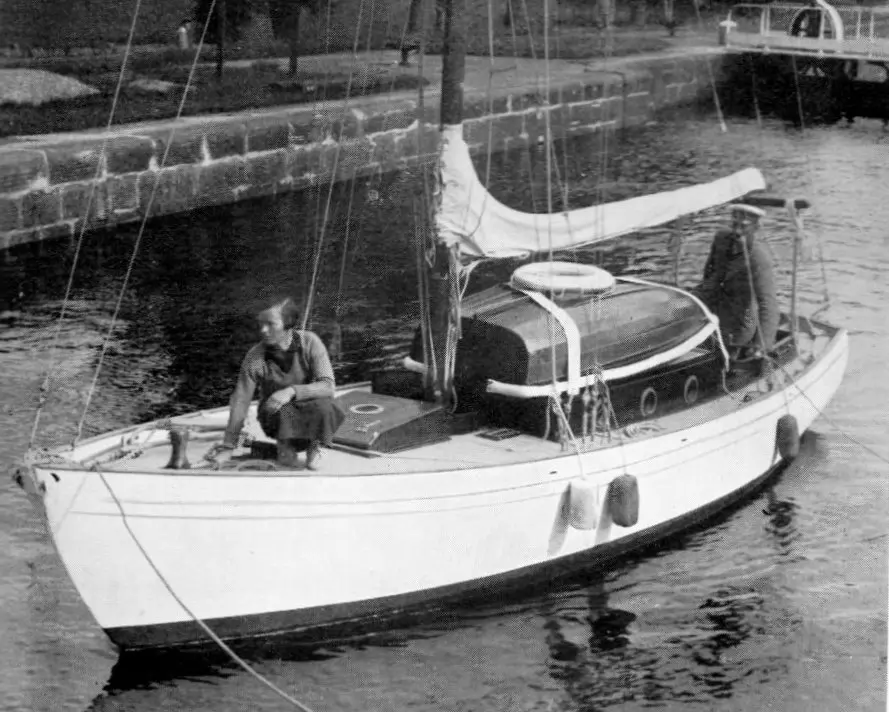
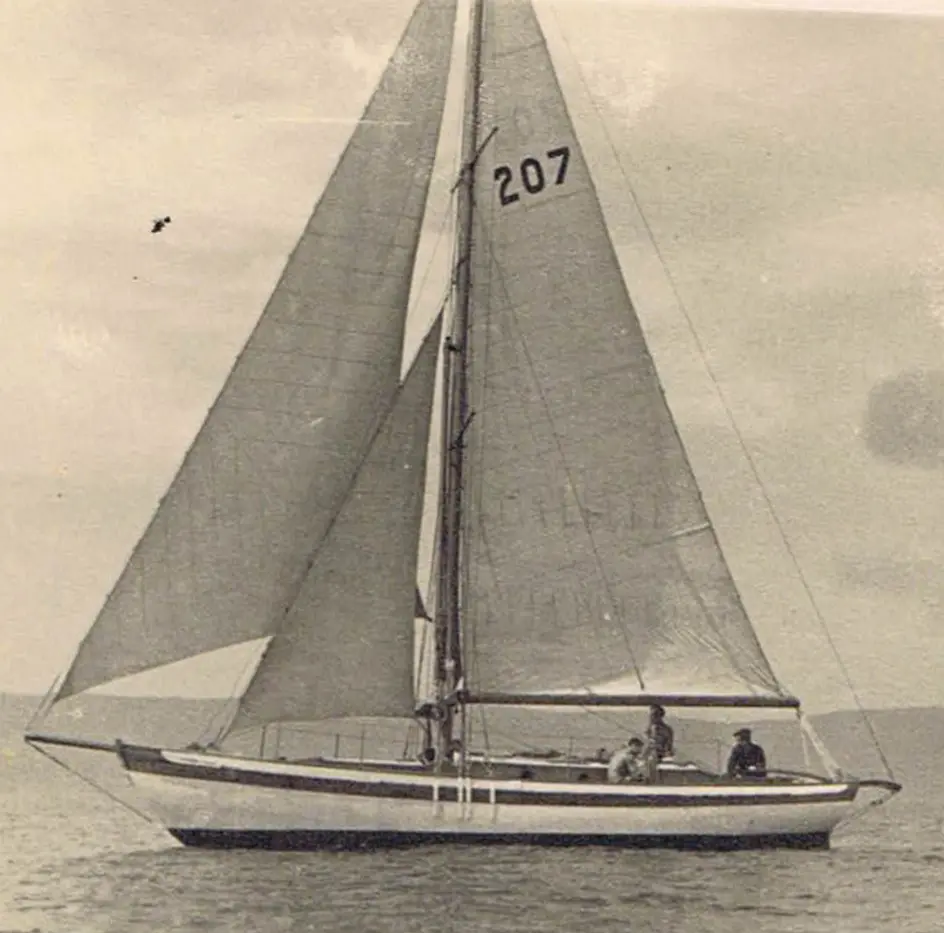
The Vertue Monie soon after her launch, and Valfreya
Between the building of these two boats however, the ‘stretched Vertue’ Kalliste appeared, and the elegant twelve ton Valfreya was launched by Trudessons’ in Sweden for a keen cruising man in this country. She appears to be the first boat to actually make a feature of her sheerstrake by leaving it varnished against the dark colouring of the rest of her topsides. The next boat to do this was of course the formidable Dyarchy which was also built by Trudessons in 1938-9, but her sheerstrake did not contrast so strongly with her topsides.
____________

I had been wondering exactly where the idea of accentuating the sheerstrake came from until I discovered that the old pilot cutter Dyarchy, who had her second strake thickened, was actually measured and drawn up in 1934, just when the drawings for Andrillot and Wanderer II were about to be conceived. The imaginative leap that Giles clearly took, was to raise the thickened strake up to the edge of the deck. This then formed the visual and structural band that was to become probably the most recognizable single feature of more than fifteen of his more celebrated designs: but it all started with the first Vertue, Andrillot, and Wanderer II.
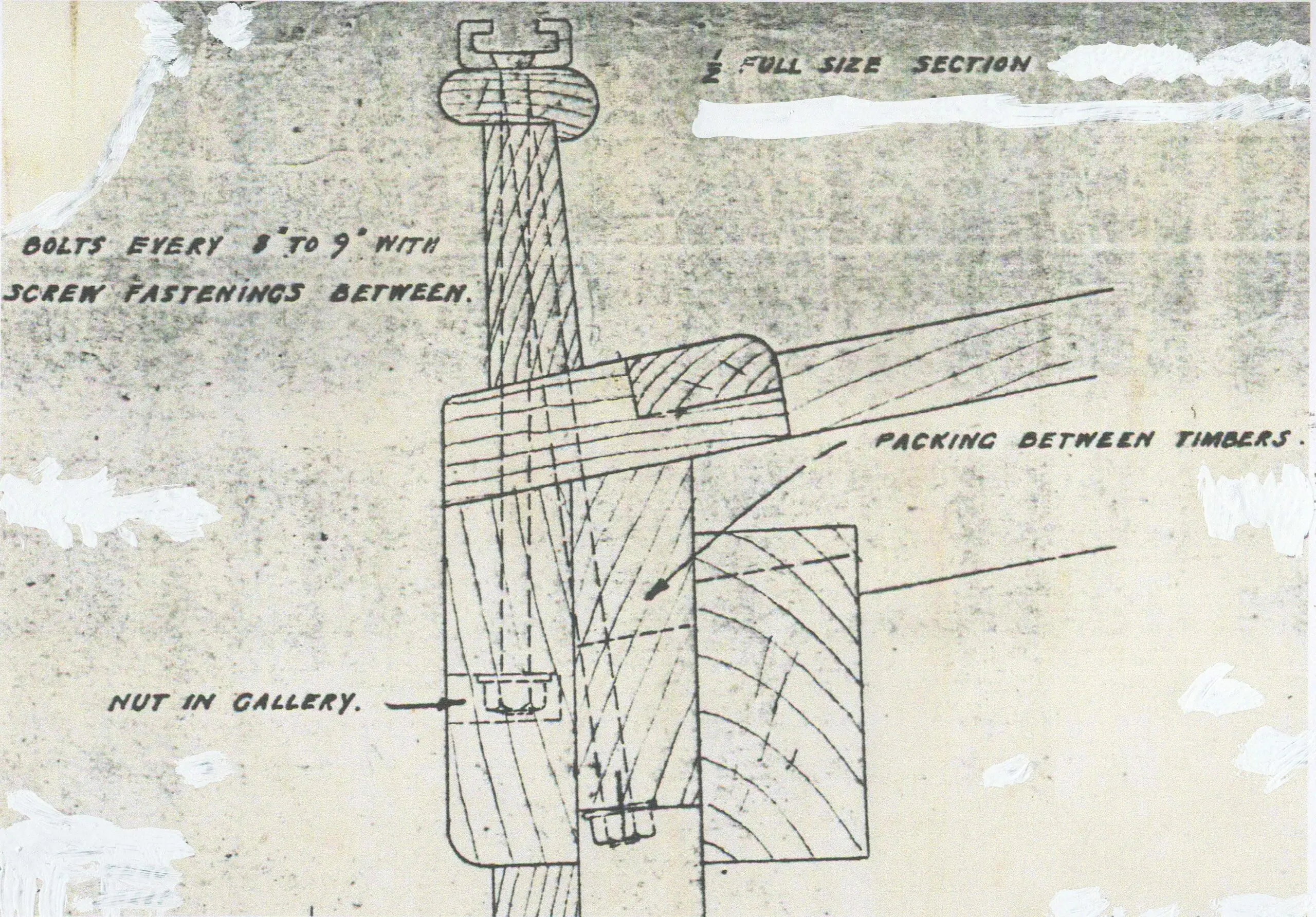
A detail of the Vertue’s massive deck edge construction.
On climbing aboard a wooden Vertue one is immediately struck by how substantial she is, an impression which is partly created by the heavy scantlings of the bulwark-like toe-rail. Compare this with, say, a Folkboat, Stella, or a Scod and the working-boat origins of the Vertue become evident.
After the war was fought and won, the Vertues were given a doghouse, and a name, but their sheerstrakes remained unadorned. Eric and Susan Hiscock had taken Wanderer II to the Azores and back and realised two things. Firstly, they had enjoyed the experience enormously, and secondly, they considered that their boat was too small to carry all they needed, if they were to continue further west in pursuit of a lifetime of cruising. So they returned to the design office at No. 4, Quay Hill in Lymington to talk to Jack Giles about a new boat. As ever, they pleaded poverty and, as usual, Jack responded with an elegant solution. The Partnership had recently prepared the design for a modified Kalliste but the enquiry had fizzled out, so why not tweak it again to accommodate the Hiscocks’ requirements? And so Wanderer III was conceived and almost a year later, in early 1951 she was launched, looking very like an enlarged Vertue but without a doghouse, so that a 7’ praam dinghy could be stowed on the coachroof abaft the mast. She was also rigged just like a Vertue but one outstanding feature was that her sheerstrake was strongly accentuated by being painted a bright green colour, perhaps making a striking statement about her pilot-cutter origins.
When Wanderer III’s first circumnavigation was completed Eric’s book ‘Around the World in Wanderer III’ was published in January 1956, just when she appeared at the National Boat Show, Olympia. She was admired by thousands of people, including some Vertue owners. Her sheerstrake did not go un-noticed but before long Eric and Susan were planning a second circumnavigation. By now they had trained themselves to record their activities on cine-film and when they completed this second trip, they had a colour film to illustrate it. Eric’s book, ‘Beyond the West Horizon’ was now illustrated in full colour, and the prominent green sheerstrake stood out even more clearly than ever, as she floated in The Pool at the 1963 Boat Show in Earls Court. By now the couple had become national celebrities and even their taste in seagoing paintwork was afforded the greatest complement possible…. by being imitated. Vertues in particular started to have their sheerstrakes picked out in colour, and later in the year I took this photograph of Monie in Salcombe, complete with her bright blue sheerstrake pleasingly accentuating her springy sheer.

Monie in Salcombe in the early 1960’s.
Fifteen years later the first of the grp VII’s began to appear and before long some of these had the coloured gelcoat of their prominent sheerstrakes indelibly moulded to accentuate what was left of the bold sheer of the earlier boats.
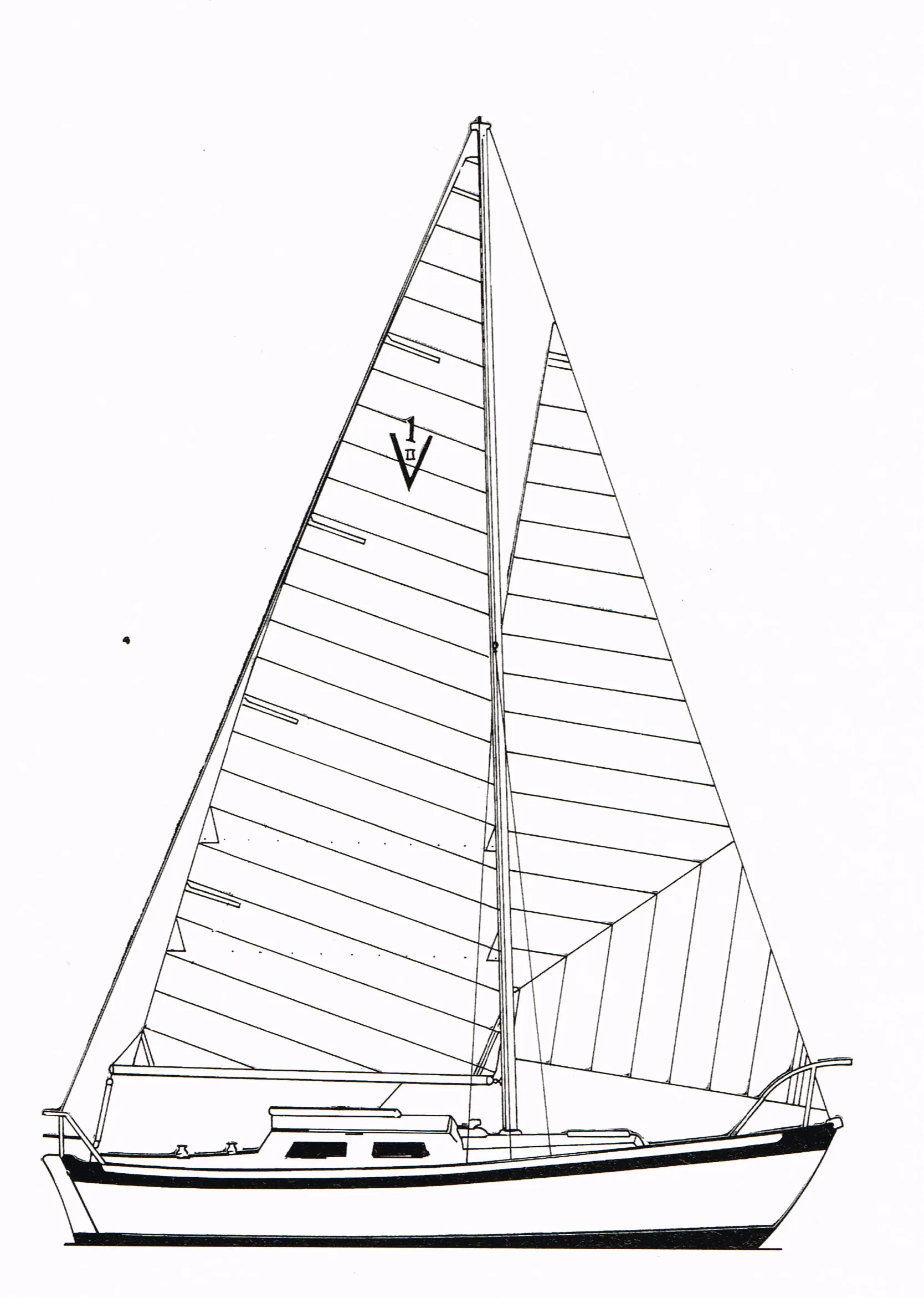
By the end of the 1970’s advertisements for the grp Vertue II’s included this image of the integrated sheerstrake already moulded to the colour of the customer’s choice. The sheerstrake was here to stay!
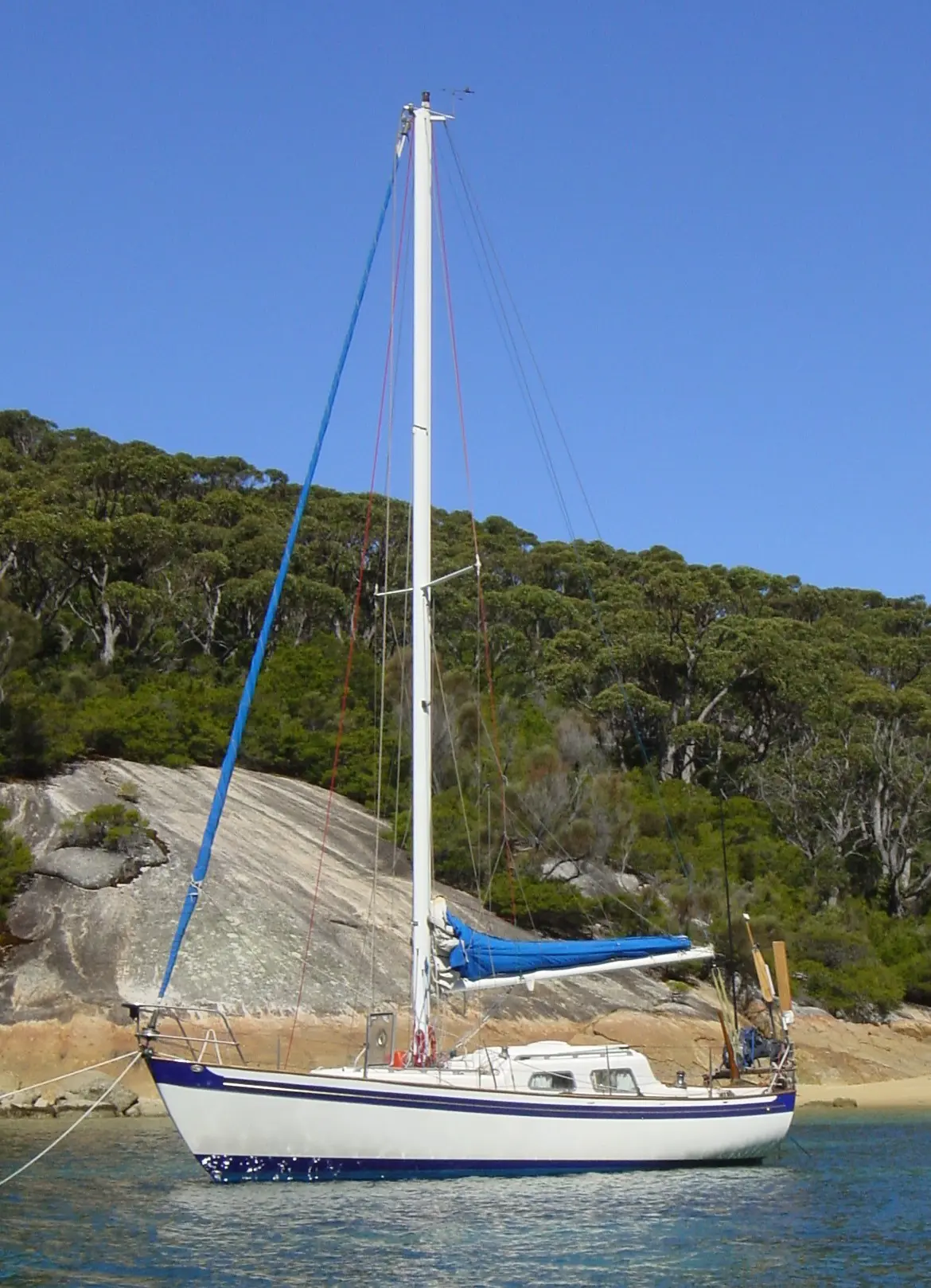
VII 3 Faire Vertue was shipped out to Melbourne for completion.
The original rationalisation of the pilot boats’ thickened rubbing strakes by Jack Giles permeated many of his cruising designs over forty years of practice during his lifetime. The Hiscocks’ legendary Wanderer III popularised the idea of boldly colouring this design feature during the middle part of the century. Now this device is used right across the spectrum of modern yacht design in an effort to reduce the apparent height of a yacht’s topsides and to try and infer some degree of spring into their sadly flattened sheerlines.
__________________________
Stelda
Massimo Zanco
“My first experiences with a Vertue date back to when I was just over twenty years old. She belonged to a friend — a sailing instructor and a true mentor — who taught me many things, but above all instilled in me a deep passion for traditional boats.
Now, having passed the age of fifty, I have decided to become the custodian of one of these remarkable yachts. This decision is not only for my own fulfilment, but also to pass on the traditions of sailing, maritime history, and restoration to my children, who share a strong enthusiasm for the sea.
In October, when I discovered Stelda, I made contact with Roger — who has since become a friend — and shortly afterwards travelled to the United Kingdom to see her in person.
Poor Stelda had been laid up ashore under cover for many years — abandoned, and poignantly still filled with the belongings her late owner had left on board, as though he might return at any moment. The encounter was deeply moving: a blend of emotion, responsibility, passion, and love. I decided to proceed with the purchase.
I must admit that the process was far from simple. The family did not possess the documentation required to manage the customs formalities necessary to transfer her by road to Italy. I therefore began extensive research, gathering as much historical and technical material as possible. I contacted the MCA, Beta Marine, and the historic Lloyd’s registries. In the end, thanks especially to Roger’s invaluable assistance, we were able to assemble everything required to proceed.
Further complications arose when the initially appointed transport company discovered that their driver did not hold a passport — now essential for entry into the UK. I therefore had to identify an alternative haulier. I was fortunate to find Alessio — professional, precise, and reliable — who accepted the challenge. (I would be pleased to share his contact details with anyone interested.)
In the final days of December 2025, accompanied by my trusted partner in every adventure — always by my side on land and at sea, my wife — I travelled to Hull to prepare Stelda for transport.
On 3 February, she finally departed the United Kingdom and began her journey — albeit on wheels — towards Italy, arriving safely on 6 February.
She is now located at a boatyard in the Northern Adriatic, in Trieste, where she awaits the beginning of her restoration.
The restoration programme is intended to return Stelda to her original configuration — the very condition that enabled Peter to complete his Atlantic crossing. Accordingly, “George” (Peter’s famous wind vane) will also be brought back into service.
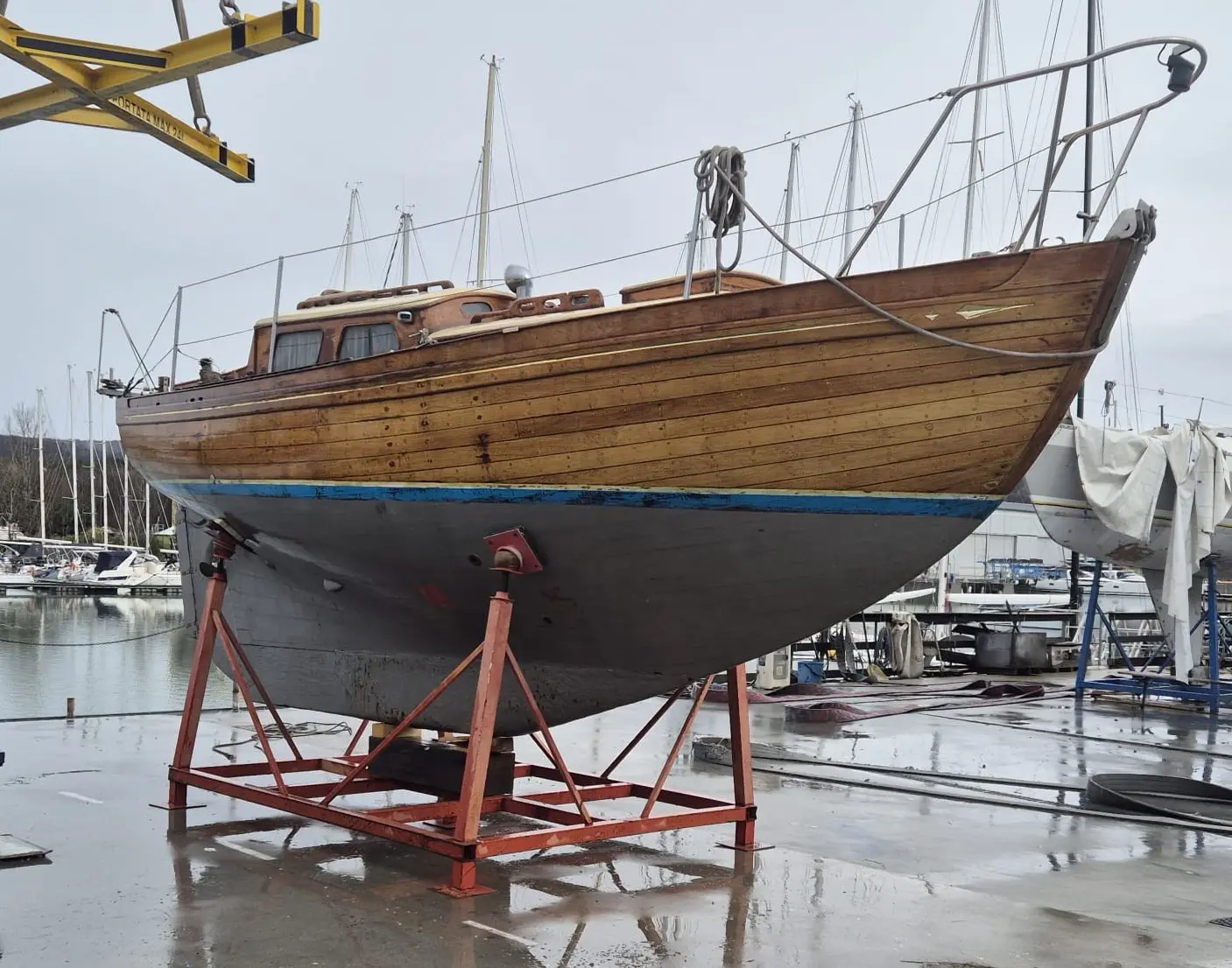
Fittingly, her arrival in Italy took place beneath rain in perfect English fashion — perhaps easing her transition into a new homeland. She will, however, need to grow accustomed to the warmer waters of the Mediterranean, as several of her sister Vertues have already done (I understand there are now five based in the Adriatic).
My hope is that a small yet great yacht such as Stelda may serve as a living instrument through which to transmit the art of sailing, the culture of the sea, and maritime tradition — not only to my children, but also to the children of friends and to all those who wish to approach sailing as it once was: grounded in authenticity, seamanship, and simple, tangible values.
Perhaps one day I may also have the opportunity to meet Peter’s family and show them that Stelda continues to sail the seas. I believe that would be a meaningful and fitting tribute.
My sincere thanks once again to Roger and to all the friends who have supported this project thus far.”
(It’s wonderful that such an enthusiast should arrive just in time to take on this wonderful project. I had been working for over a year to try and find someone to take on Peter Woolass’ old boat and now it looks as if she will be treasured into the forseeable future. I feel that Massimo has given me much more credit than is really due but I’m so glad that Stelda will now return to her natural element and am looking forward to bringing the story of her rejuvination back to some future Newsletters in due course. Roger.)
_______________________
The Stern Locker
Stop the press! In addition to the above story about Stelda, I received an email yesterday from the new owner of the John Perry-built Vertue Tanera. She still remains part of the growing Italian ‘fleet’ and I am hoping that Emanuele Tamburini will write and tell us more about sailing out of his Tuscan home port of Livorno in due course.
Please dear Reader, remember that this light-hearted attempt to continue to entertain and amuse Vertually all who find us, rely on YOU to keep coming up with the goods. Please don’t leave it until your will…….send us your stories NOW, (or soon, anyway, please.) as you have so kindly been doing for thirty-something issues so far! As you can see, we are happy to publish almost anything.
FAIR WINDS!
Roger
“Out, gone me”
____________________________