

SPRING NEWSLETTER – 30 – MARCH 2025

Welcome to your regular quarterly Newsletter for an update on Vertuelly anything. This time I’m delighted to have been able to start proceedings with another delightful account in our ongoing series about ‘My Vertue and Me’. Bill Rogers has transported us to the wonderful coastline of Massachusetts, where he completed a masterly ‘deep refit’ on his exquisite boat Stronghold, since when he has also taken her north across the Bay of Fundy and on up to Nova Scotia. Another, completely different, major project is being meticulously undertaken by Joop van Son in the Netherlands and it is fascinating to have some of the intricacies of modern Vertue construction illustrated in his latest update. This is serious stuff and Joop’s explanation of the process of constructing the very latest Vertue, No 239, is amazing. I’m also especially grateful to celebrated Classic Boat columnist Adrian Morgan for his lyrical account of the challenges of moving his boat’s base from the soft, southern Solent, to the rugged north west coast of the Scottish Highlands. It seems there are pros, cons, and enormous contrasts involved in such an exercise. As our little website is maturing I am delighted to see that more owners, past and present, are getting in touch. Gill and Geoff Fuller, the past owners of the grp VII Flame have sent some colour photos and details of her conception and early history, as well as some pictures of the outstanding joinery work with which they completed the interior fitting out. We are all hoping to be able to find out if the boat is still based in Italy and would very much like to hear from her current owners. We also have another tale about one of the more celebrated Lymington L’s from Joe Brummel, who is custodian of that class’s archives. Finally, I recently came across irrefutable proof of the Giles’ partnership’s views on the use of the ‘s’ word to avoid the ‘masthead sloop’ description of the typical Vertue rig. Please read on and enjoy our little quarterly newsletter, almost entirely put together by you, Vertue owners and enthusiasts. And don’t forget to look at the growing list of Vertues that are for Sale, and the expanding database about all the Vertues that have been discovered all over the world.
_________________________________
My Vertue and Me
Bill Rogers
When we settled in Woods Hole, Massachusetts in 1989 my Vertue had already been here for 20 years, but had not sailed for several seasons. I first saw her when her owner asked me to fit a graving piece in the stem. He then sailed her for two seasons, but she leaked badly and he hauled her and stored her in a barn built for the boat. By this time the boat was over 50 years old and badly needed a refit. I was not the only one in town who wanted to take over the boat so I was very pleased when Geoff passed her on to me for $1500.
At the time I still owned a 30 foot Tancook Whaler, designed by my friend George Stadel, that I built in the shed where I would work on Davalon. There was also another local boat, a Swede 55 coming on the market at a good price that I saw as my reentry into the charter game. Finally, the Swede was sold to South Africa, the Tancook Whaler was bought by a local boatbuilding couple, and I owned the boat I’d dreamed about since I was young.
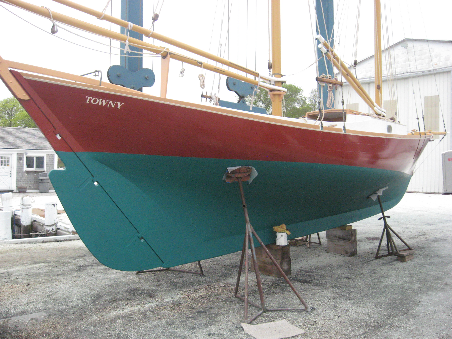
The Tancook Whaler Towny.
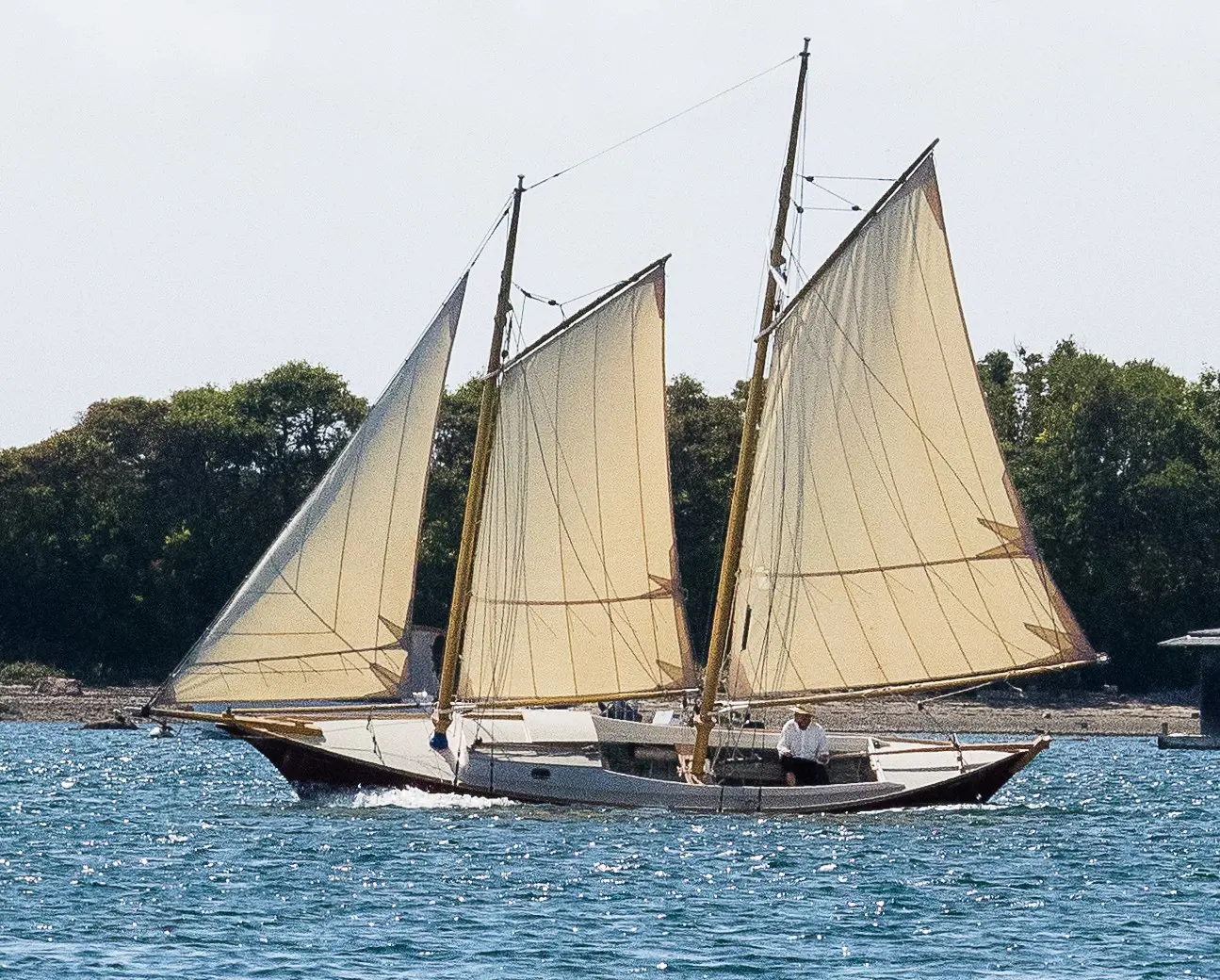
Towny under sail.
Davalon looked bad when I got her over to my shop. She was dirty from her years in storage, a lot of her paint had been burned off, the brightwork was crazed and flaking, the deck canvas on the foredeck was failing. But everyone knows how satisfying it is to start taking things apart. The engine, tanks, wiring, exhaust and shaft were removed to get at the frames. All the galvanized deck hardware, the bronze highfield levers, the cleats and the mast step had to come off to repair the deck and the toe rails. I built shelves to the ceiling of the shed to store all the gear and joinery that got removed. It was all tired looking and dirty and I wondered if it would ever go back in the boat.

I started by removing the garboards, and first and second broads. This opened up the boat for most of the major work I did: the stern timbers of the backbone to be replaced, the iron floors to be recast in bronze, 5 pairs of iron sick steam bent frames. Some jobs I recall as being very rewarding. The deck canvas seemed to be laid in something very much like Dolfinite which when warmed up by the heat gun looked like it could be put back in the can. Under the canvas the hard pine deck was beautiful and sound. The toe rails, which were loose with an open seam between them and the covering board were still sound and could be reused. Refastened, rebedded, and painted I stare at them with satisfaction whenever I’m sailing.
The broads were terribly iron sick. In some stations there were three screws and two iron rivets. I clamped doublers on them so they wouldn’t break in half. Then, for some reason (expense) I repaired them with long scarfs around each hole. It worked remarkably well. New garboards were got out of one long Wana board from Nat Benjamin’s stock on the Vineyard. Cost for one board, $900, but every inch of that board went into the boat.
Finally, after fours years work, launched again as Stronghold, Darryl and I took a first trial cruise to Narragansett Bay. The first leg was a beat down Buzzards Bay into a good summer south wester. With one reef in the main and the #1 jib we were over canvased and almost blinded by spray as we pushed through the swells of Block Island Sound,. Sorry, but we were sailing a Vertue. I’ve long known of the, perhaps apocryphal, story about the sign at the yacht club,”Too windy, except for Vertues.” The boat was in her element.
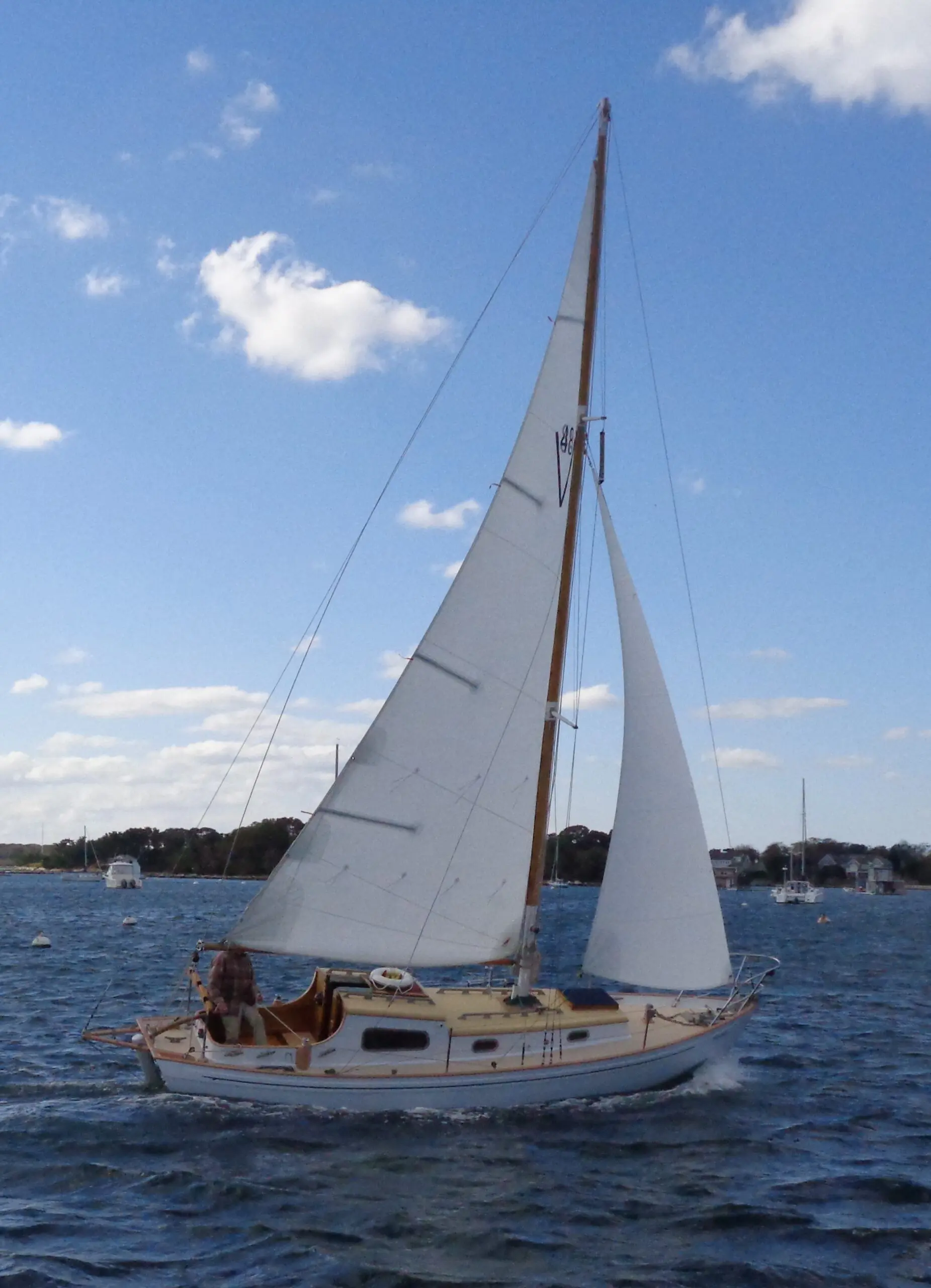
Stronghold ‘in her element’!
We also made a cruise to Maine that summer. In 2018 I made a solo trip to Nova Scotia with some memorably bad weather around Cape Sable and across the Bay of Fundy and a wild late night entrance into Port Moulin. The boat was always comfortable and able. My wife remembers when I returned, staggering into the kitchen at dawn, unshaved, my clothes in rags, teeth falling out and down to 175 lbs.
In 2019 There was another good trip to Nova Scotia. I sailed alone for most of the trip, but had a crew for the three day passage from Cape Cod. My wife joined me in Halifax and we sailed together for a week. On that cruise rounding Cape Sable was memorable for the good weather and the beauty of that coast.
My Vertue has been a good boat for me because I sail alone most of the time, it is capable and comfortable in strong wind and it is not expensive to maintain. I’m grateful to Roger for introducing me to other Vertue owners and so learning of their cruises, even if reading about them makes me suffer terribly from envy.
In the past I’ve always felt that being aboard the boat took 20 years off my age. If I can gain just a few years this summer I might get to Nova Scotia again. Or I could sail down the coast and gunk hole in some of the many little coves in the Gulf of Maine I haven’t visited. With a five day forecast one can pick the weather, and when it’s howling with wind and rain there are few places where I am more comfortable than down below on my Vertue.

Note: Bill’s very modest account above barely touches on the skill and fortitude of his major refit and restoration of Davalon, which became his very own Stronghold. I strongly recommend readers to look at some of the photographs and words that illustrate some of this endeavour, which can be found by looking at Stronghold’s own ‘page’. He has also recently decided to put her up for sale, but I suspect she won’t be available for a few months yet! I couldn’t resist adding in here the joyous photo of Towny under sail; doesn’t it lift the spirits? Roger.
______________________________
Vertue 239 progress last year (2024)
Here is a fascinating update written and illustrated for us by Joop van Son who is building the latest Vertue in his garage in the Netherlands. The meticulous care he is taking is illustrated by the laser levelling technique he has shown us. What a fantastic project!
Bulkheads/frames are ready. Setting up building rig (April).
Installing the first (bow) construction bulkhead. (May 2024)
The green lines are from a cross line laser, which is positioned at the other side of the building rig, a bit further aft than the stern (vertical = centre line, horizontal = water line)
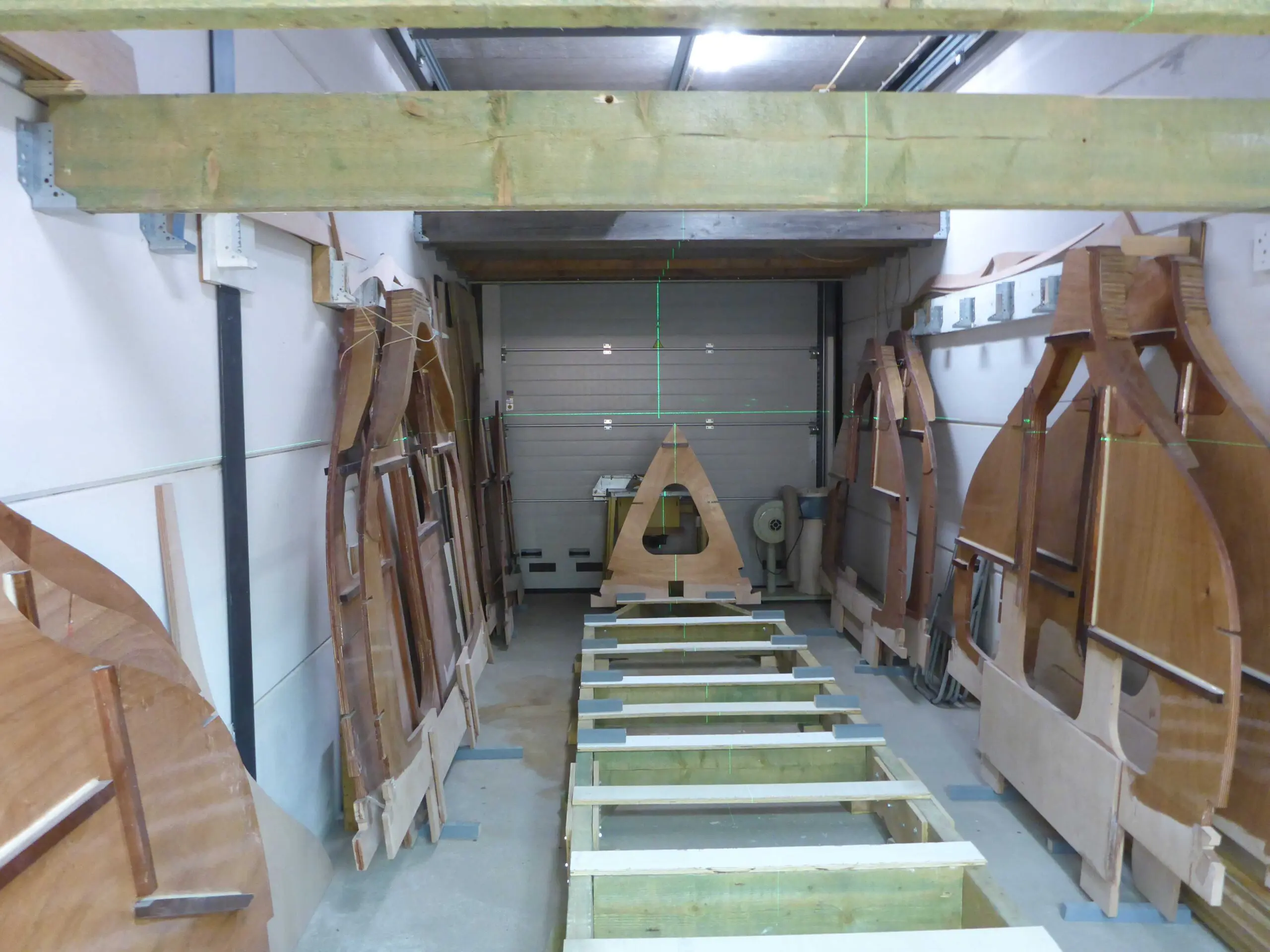
Then one by one all other bulkheads are placed on the building rig.

A horizontal stringer is temporary placed, to connect the bulkheads. A template for the bow is
placed in front of the first bulkhead. (Four bulkheads, May/June)
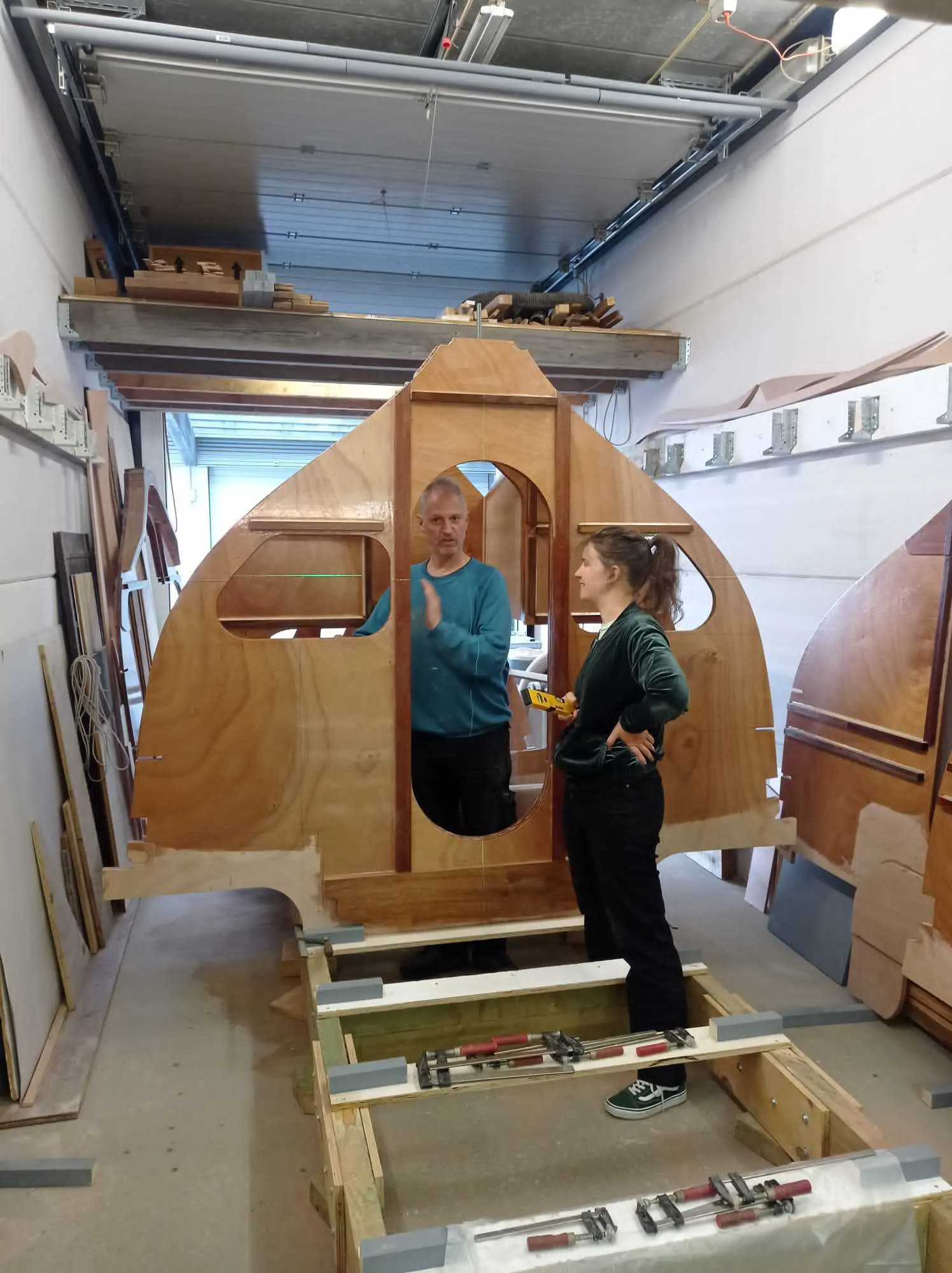
With a little help from my daughter the mastbulkhead is placed in position. This is the thickest and heaviest one. It weighs almost 50 kg.

If possible the bulkheads will be interconnected with each other with vertical plates. (June)

The last vertical bulkhead (August 2024) which is the aft part of the cockpit.

From above you already can see the shape of the boat. The last 3 bulkheads define the cockpit. Then the next 2 (including number 3. So 3, 4 and 5) define the galley (port) and the navigation table (starboard). In front of that there are 2 settee/berths.

September 2024 all bulkheads and the stern have been placed. On to the next phase.
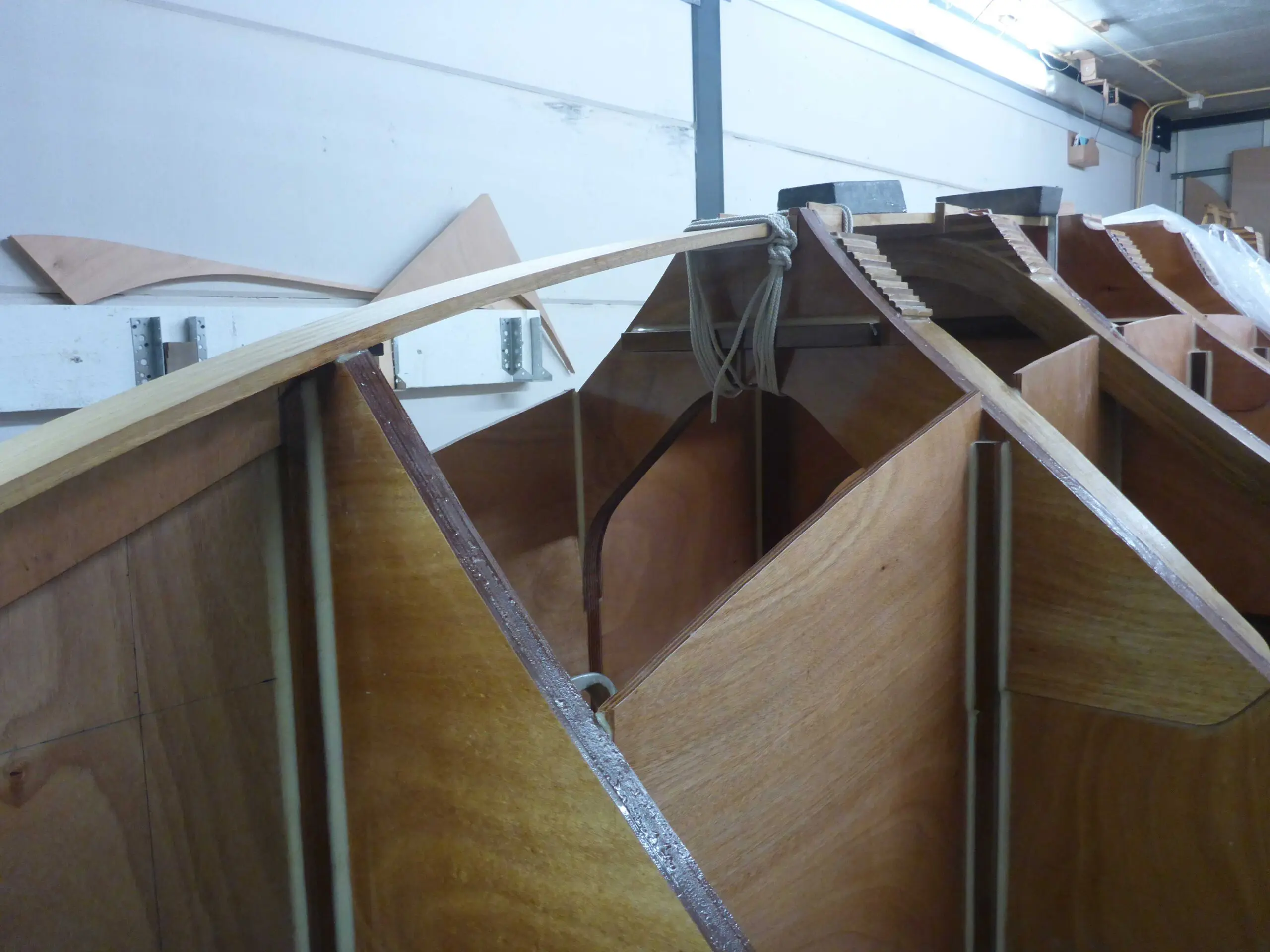
Construction of the bow/forefoot (December 2024). It was quite an effort to make it fit. Part of the topsides of a number of bulkheads had to be removed or adjusted. Above you see the first layer.
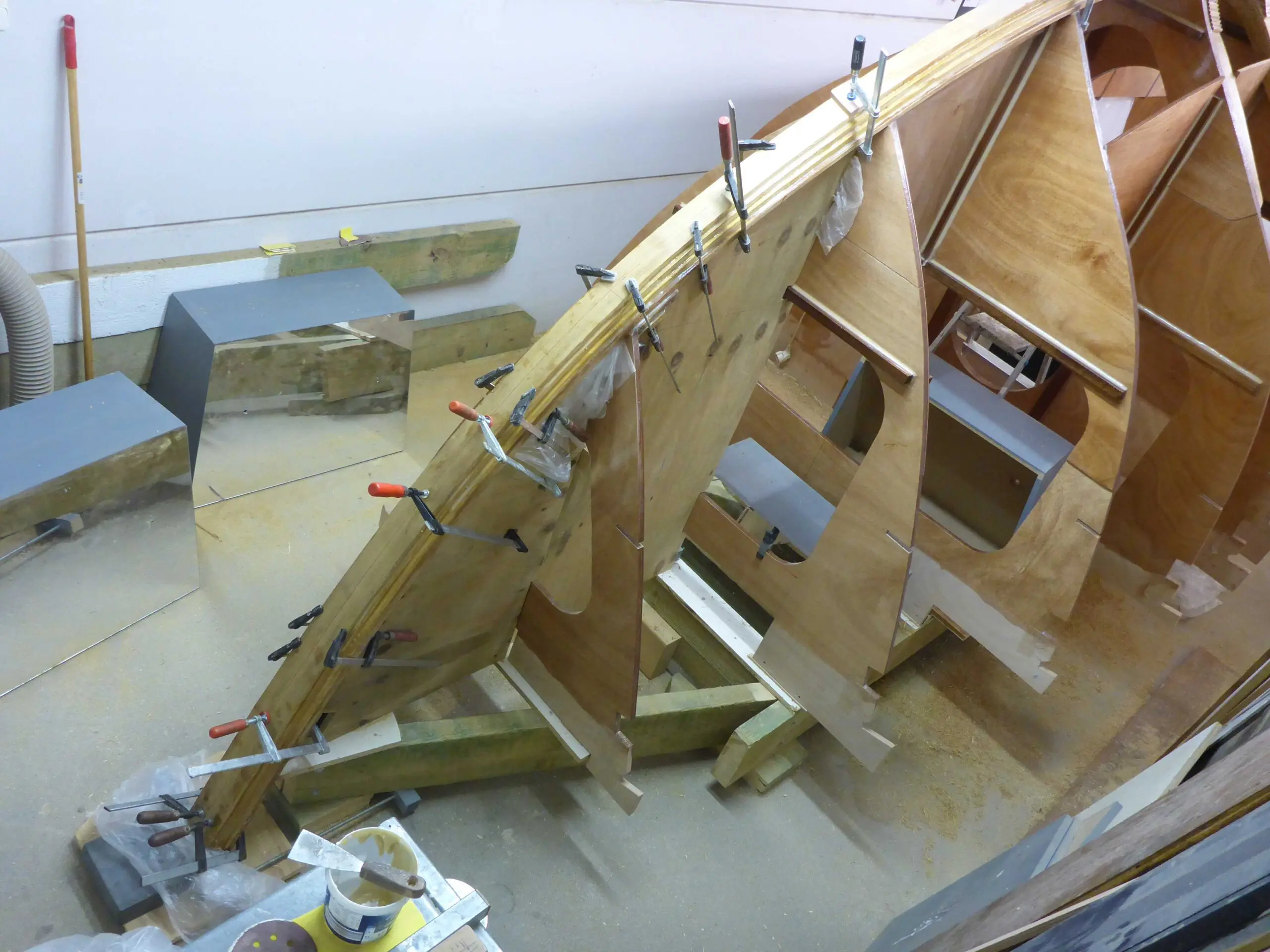
Below four layers (February 2025).
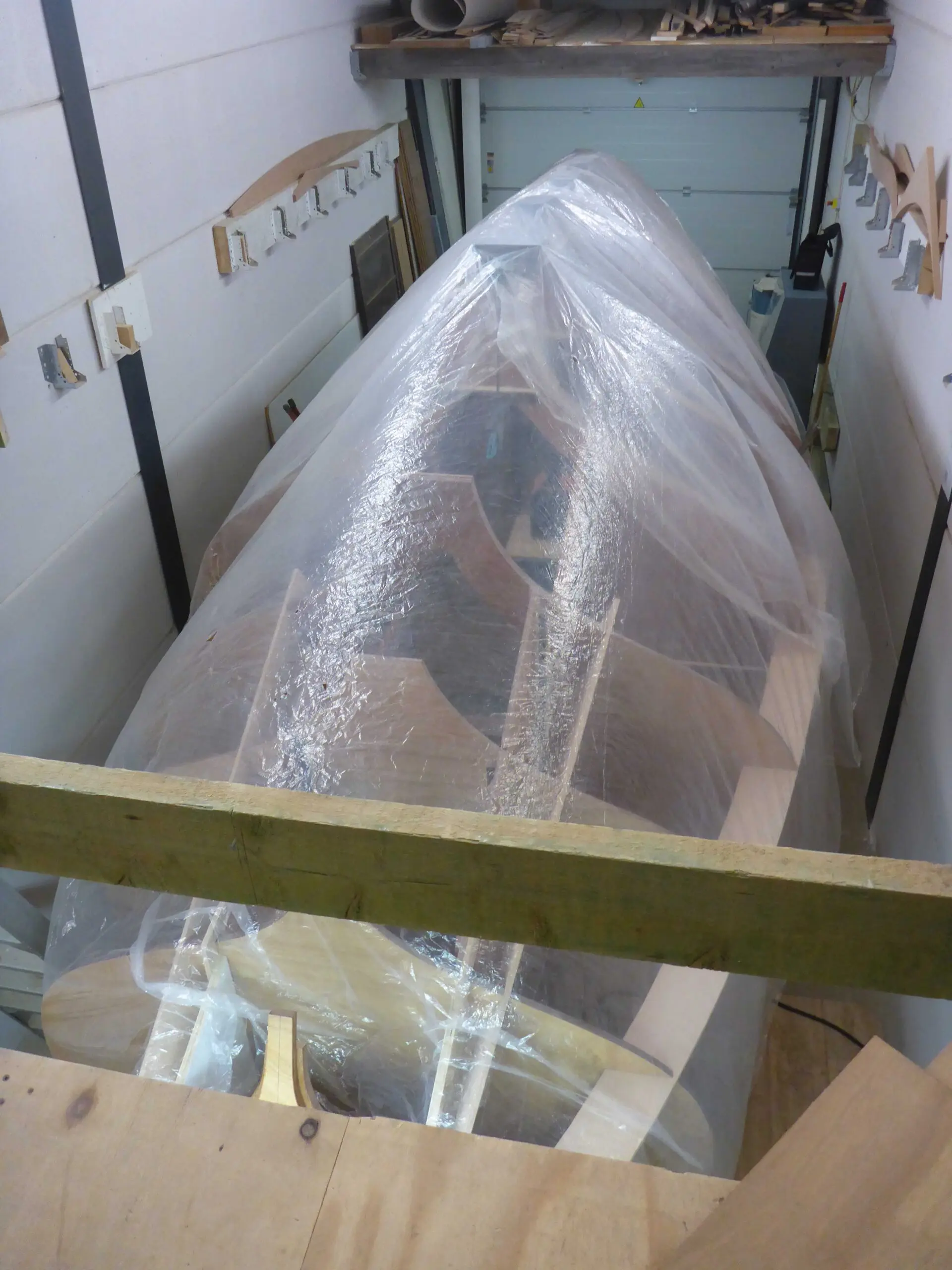
At that time it was already quite cold in my building place (6-9 degrees Celcius). So for curing the epoxy I had to build a tent and put a heater inside the tent. Inside it was nice and warm! (15-20 degrees)
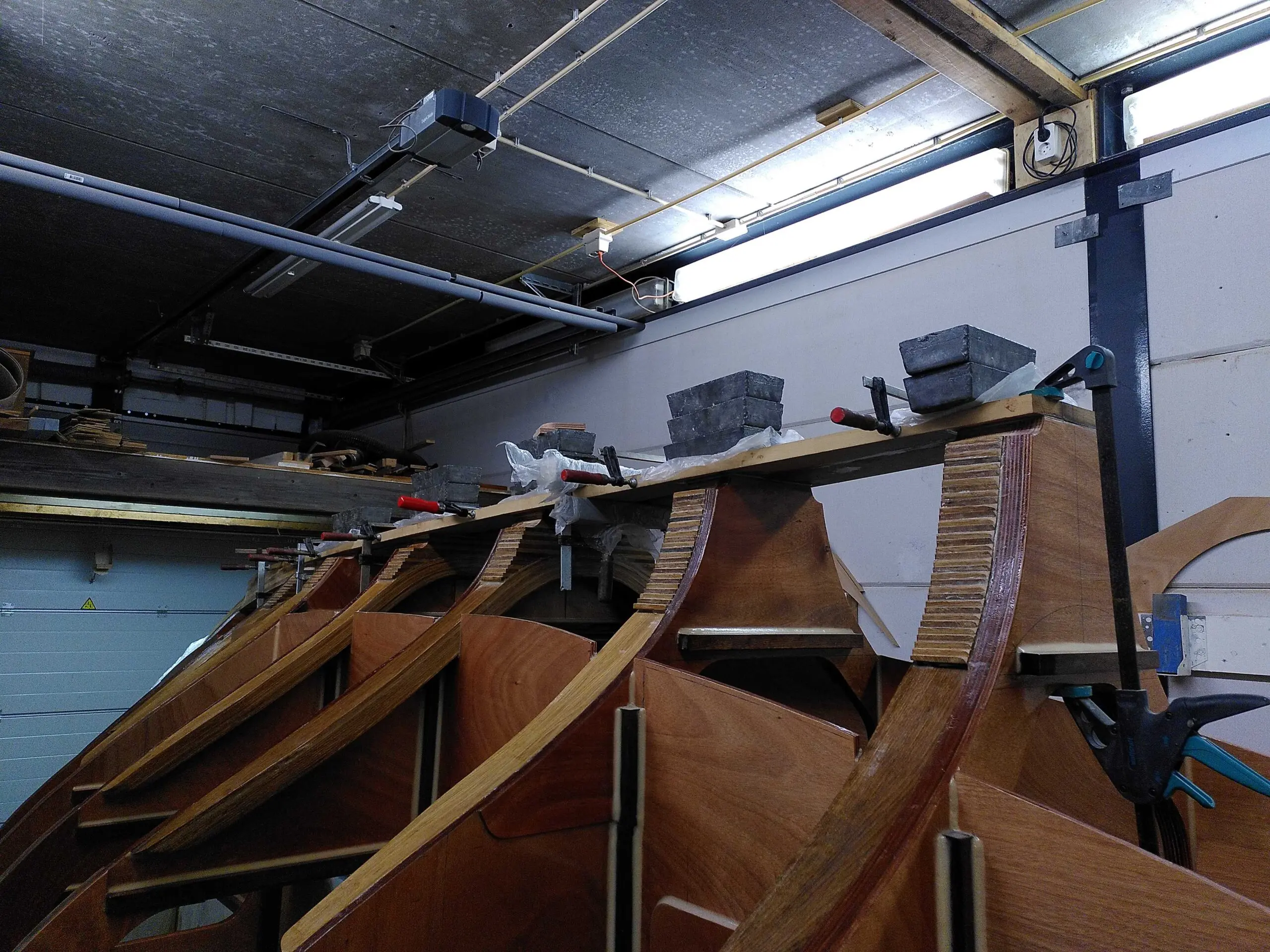
Next step the keelson. The lowest forward part. The lead keel will be connected to this.
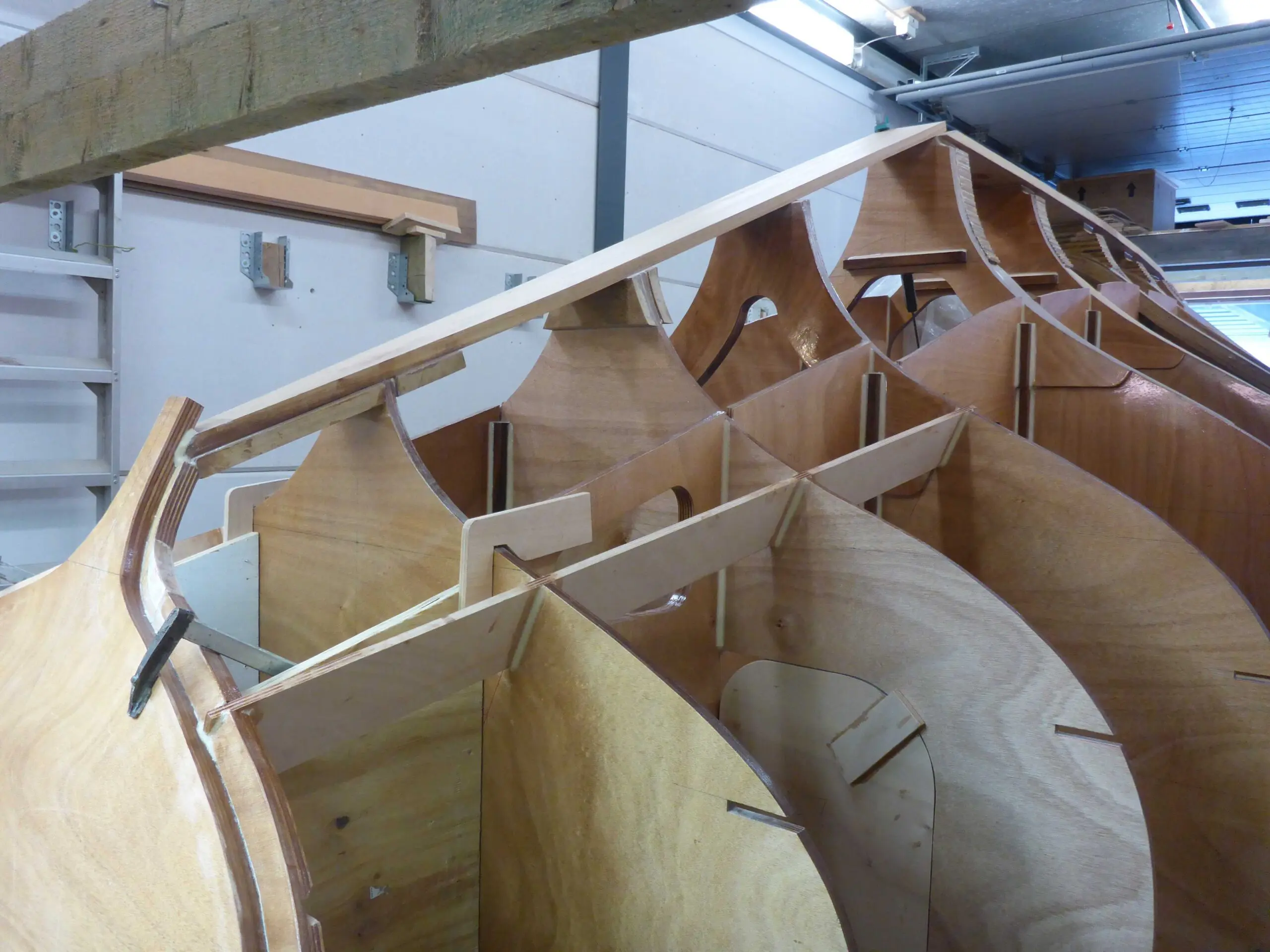
Keelson the aft part. The deadwood and false keel are connected to this part.
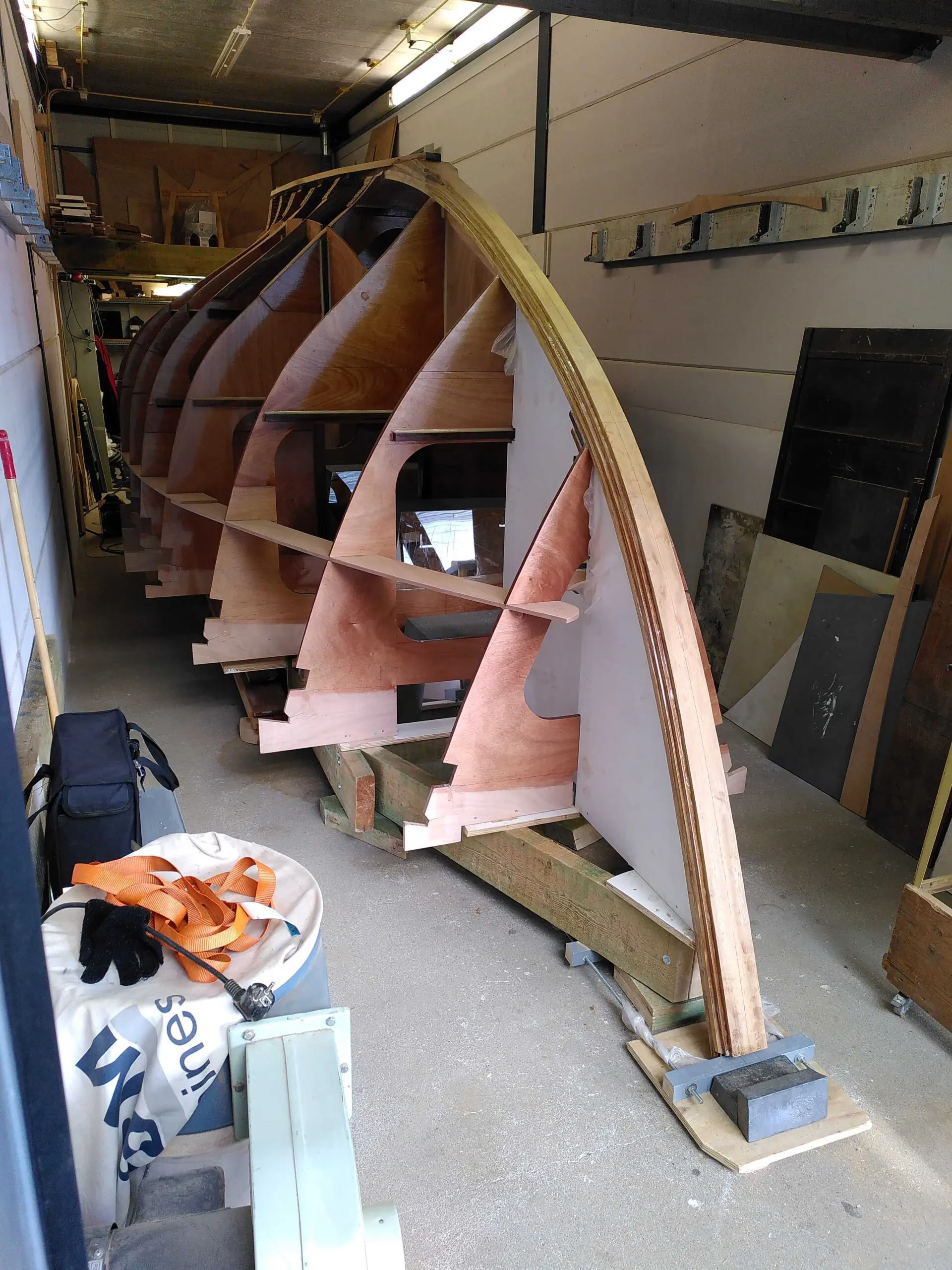
Stem, forefoot and keelson laminations. The shape of the hull is really emerging now.
Next steps this year:
One more layer for the keelson.
Fix all stringers
Create the beam shelf and then I can start with planking. I hope this summer!
____________________________
NORTH and SOUTH
By Adrian Morgan
On the desk to my right lies a copy of Anthony Heckstall-Smith’s Sacred Cowes, together with a copy of Douglas Phillips-Birt’s Waters of Wight. Hamish Haswell-Smith’s An Island Odyssey, open at the chapter on Mingulay, and his companion volume Scottish Islands, reminding me that there are around 150 islands we have yet to explore, is at my right hand. The Solent vs The Hebrides; surely there’s no contest?
Many years have slipped by since we shipped Sally on the back of a low-loader up to Port Edgar marina on the Firth of Forth from her river berth opposite Mercury on The Hamble. A year later, via the reopened 30-mile Forth-Clyde Canal (she was the 96th boat to cross) we sailed her down the Clyde, through the Kyles of Bute, Crinan Canal and up to Ullapool in the far north of Scotland. Thus in three seasons we swapped the creeks and harbours of the Solent, what Phillips-Birt calls ‘one of nature’s happier geographical accidents’ and the West Country via Scotland’s East Coast for its wild north west.
Haswell-Smith writes that ‘there are few parts of the world which possess such magic and mystery as the seas round Scotland.’ And yet I have to admit to feeling a twinge of nostalgia whenever I recall long days on blue green waters, skirting the Brambles, slipping into Fowey; anchored in the Helford; evenings in The Jolly Sailor and warm nights tucked up in Newtown Creek under the stars where the only sounds were those of the wading birds, the wind through the seagrasses, ripple of the tide and the raucous laughter of the crew of those Sunseekers, rafted up three abreast two mooring buoys away.
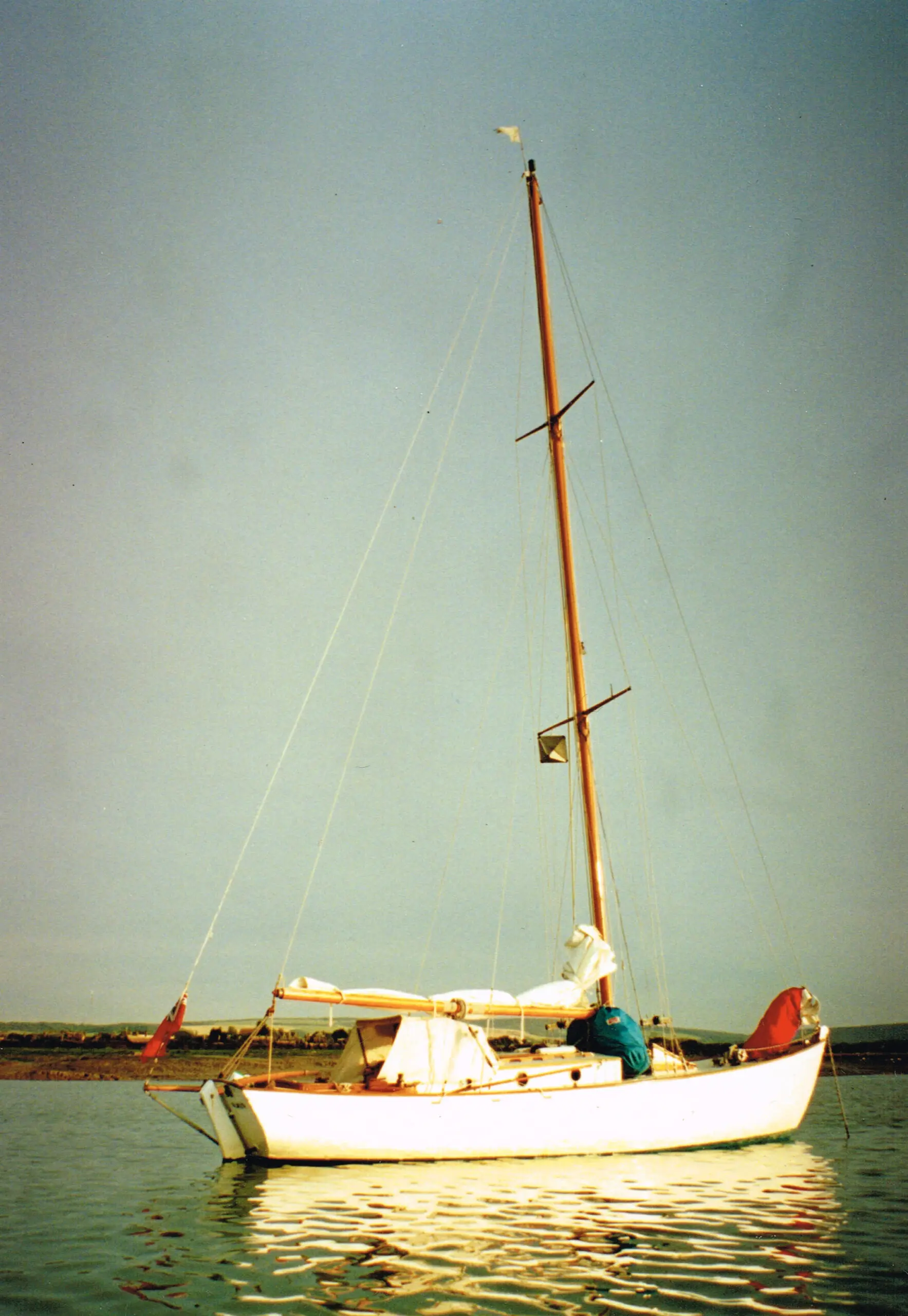
Solent Sailing
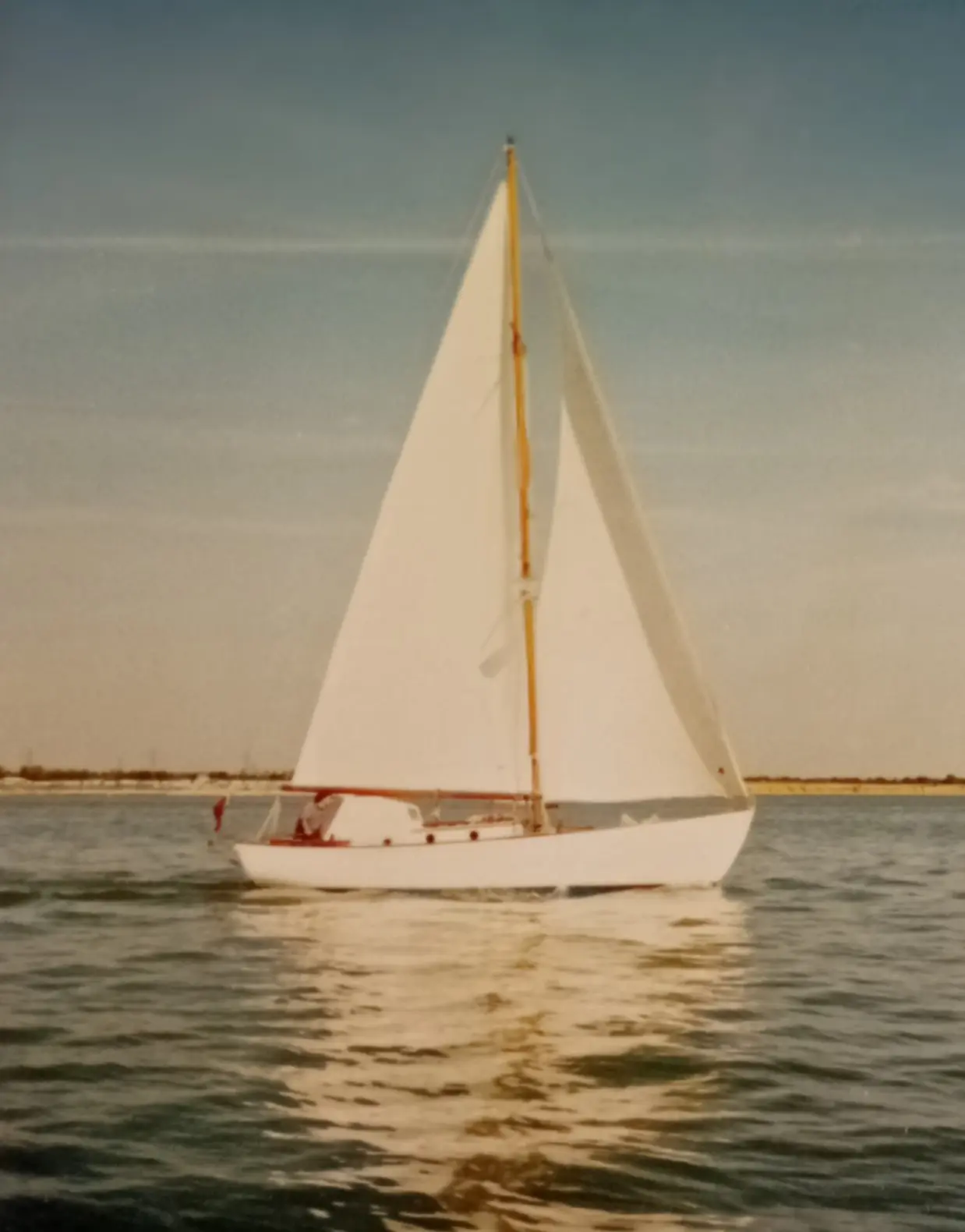
That’s the trouble with nostalgia; it plays tricks on the memory. And yet for all its detractors, overcrowding, expense the South Coast is still, arguably, the proper place for yachts. As the Alps are to skiing, so is the Solent to sailing. Its waters have seen so much: invasion fleets leaving for France; Nelson’s departure for death and victory at Trafalgar; J Boats tuning up for the America’s Cup; a cloud of X Boats gathering under the Squadron guns; Darings lying at anchor in Cowes Roads; great warships, wrecks and fragile yachts. The Solent is the test bed of ideas; to sail here is to see at first hand all that’s new and exciting in this sport we hold so dear. To sail here, in short, is to share yachting’s history and, what with the sights and sounds and constant risk of collision with in-bound container ships or a fleet of charter yachts crewed by chartered surveyors, there is never a dull moment. To paraphrase Dr Johnson’s remark about London: when you’re tired of the Solent you’re tired of sailing.

Social sailing
How does it compare with the Firth of Forth, where we spent our first season after leaving the South Coast. ‘It is strongly reminiscent of the Solent, with essence of Fawley refinery and soupcon of Southampton Water,’ I wrote back then. ‘Except when did you last see a dusting of snow on the hills beyond Niton? And roll on the day when that quintessentially English stretch of blue-ensigned yachtin’ water is spanned by anything so spectacular as the Forth rail bridge – a rusty red exercise in belt and braces…’
This was making the best of it for, in truth, the muddy, grey waters between Dunbar and Grangemouth are hardly inspiring. We explored every inch of their drying harbours and bleak islands, the best of them being Inchcolm with its old priory and colony of vociferous seabirds. For all that, it still wasn’t like home. ‘Why?’ I wrote. ‘Is it because, how shall one put it tactfully, the waters are not exactly classic cruising?’ I at least longed for the West Country with its lovely waters, wooded harbours and creekfuls of old boats. For me the Firth of Forth offered little apart from ‘shallow draught cruising yachts nestling behind crumbling stonework in unlikely places, exposed to every wild wind that blows up, down but seldom, helpfully, across the Forth’. And not a decent waterside pub anywhere.
Why? The Firth had huge appeal for anyone forced to live and work in a city. No more Friday afternoon dash to beat the London exodus; no more Sunday night scramble to get back. Port Edgar, an old destroyer base near the road bridge, may have lacked the facilities of Hamble – although it had a superb chandlery – but … ‘on a clear day,’ I wrote, ‘of which there have been many this year, from Inchkeith Island the affluent, classic city of Edinburgh is close enough to make out Nelson’s monument on Calton Hill. That’s like seeing Trafalgar Square from the Bramble Bank.’
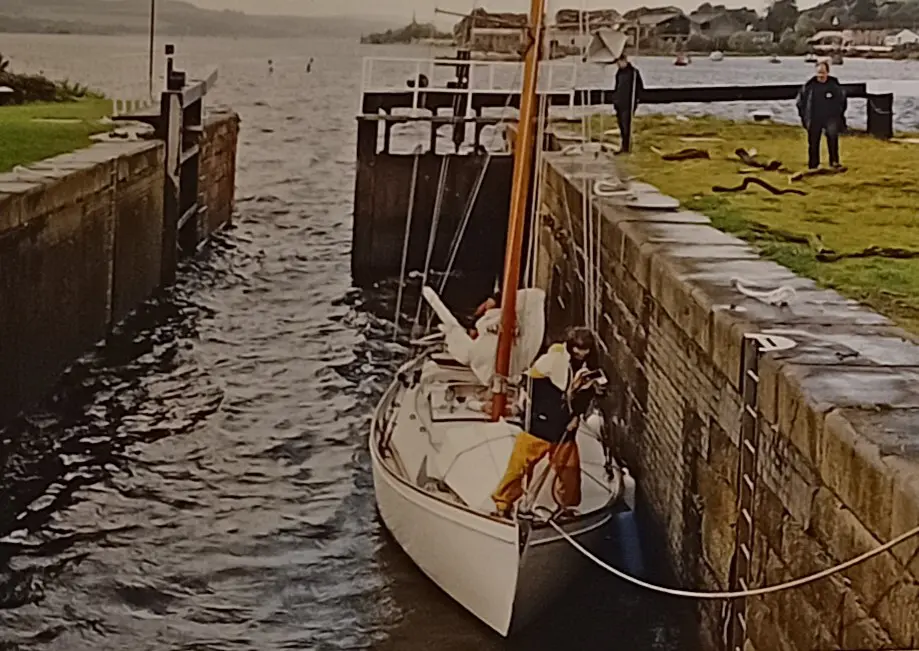
Sally locks into the Forth-Clyde Canal
In May 2000 we’d had enough of Edinburgh. We’d also exhausted the possibilities of cruising a long keeler in the shallow East Coast waters. We debated the options. Round the top of Scotland, through the Pentland Firth, or the shorter cut through the Caledonian Canal. In the end we unstepped the mast and took her through the newly opened Forth-Clyde Canal. Sally’s long keel parted the weed like an icebreaker and we had nothing but courtesy and curiosity. Even in the depths of Glasgow’s Maryhill, no one seemed the slightest bit inclined to lob concrete blocks or creosote at us, as we’d been warned. The sun shone, birds sang and we were escorted every mile of the way by British Waterways staff. They opened every lock and bridge, and the bill was £17.50.
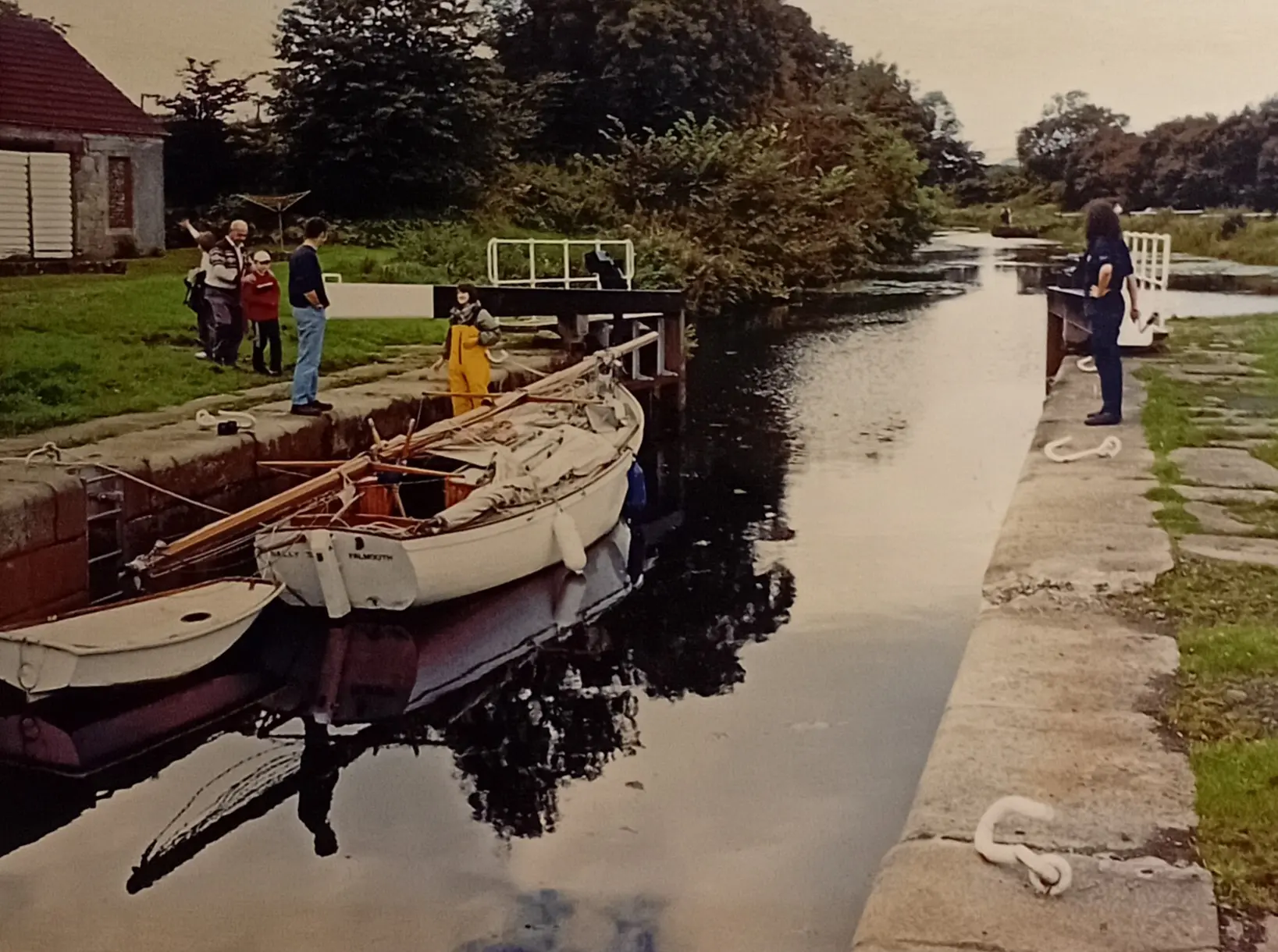
Decanting into the Clyde at Bowling Basin two days later we were met by the dazzling rays of a westering sun. The whole of the West Coast of Scotland lay before us and a coast that so many people had told us contained ‘the finest cruising waters on this planet’.
In September 2001 we took Sally on her first West Coast cruise. In 10 days we covered most of the Clyde, a magnificent natural sailing stadium, bounded by hills and mountains, cut by sea lochs. For the breadth of its scenery it eclipses the Solent entirely. Sally, a South Coast boat, felt very much in her element. This was a playground to rival anything the West Country or Brittany could offer. Moreover it had history: Britannia, the Big class. Fife, Mylne, and Watson. It was also warm that September. A typical log entry reads: ‘Sun 23: 1000 towards Loch Gair – sun, blue sky, no wind. 1100 sailing slowly into upper loch Fyne porpoises are playing around the boat, whistling to them for ages. Sailed into Loch Gair around lunchtime and anchored in gorgeous, horse shoe bay. Sun blazing, Adrian varnishing. Took off in dinghy keen for shower – pilot says showers for visitors at hotel. Friendly locals relieve me of rubbish…’
Although it was late in the season, we explored from Bowling to Ardrishaig, where the pretty little Crinan Canal begins its short traverse of the Kintyre peninsular: Loch Long, Gareloch, Loch Goil, the Holy Loch. One night found us anchored under the stars in An Caladh, a bay behind an island at the top of the Kyles of Bute, the only other boat being a varnished Fife motor launch belonging to the nearby estate, not a Sunseeker for miles. At Tarbert on Loch Fyne we holed up for a few days as a series of fronts passed over, walked, read and eat fish and chips. In late September we met few yachts. And, as a South Coaster, I missed them; missed watching their antics, the set of their sails; their mishaps. The only yachts worth noting were snugged up on moorings at the top of sea lochs: a couple of Vertues, a Brittany, a Harrison Butler at the head of Gareloch. Again I felt pangs of nostalgia.
For all its grandeur the Clyde lacks the Solent’s self confident – perhaps arrogant – knowledge that it lies at yachting’s epicentre. Gone were the great fleets of one designs; gone the classic yards such as McGruer’s, Robertsons and of course Fife. The Clyde was being slowly marina-ised, colonised by shapeless cruising yachts.
Had we lived in Glasgow, this would have been a superb weekend playground. The Clyde yachtsman has much about which to be smug: weekend sailing to spare, shelter, and for holidays he can slip through the Crinan Canal or round the Mull of Kintyre and head for one of over 160 islands that Haswell-Smith says lie in the path of the setting sun.
By then we were living not in Glasgow but 300 or so miles further north, in Wester Ross. It was time to move on. Sally wintered at Bowling – try £400 for six months storage ashore, including craning in and out and cradle – and in May we stepped the mast, paid our dues, waved goodbye to the lock keeper and motored down the great river that had once carried the Queens, Mary and Elizabeth, the QE2, and so many ships from the Clydebank yards to the open sea. It was an exhilarating moment, feeling the power of the stream, quickened by the ebb tide, carry us westwards. A week later, via Crinan, the Sounds of Mull and Sleat, past the headlands of Rubha Reidh and Greenstone Sally reached her new home in Loggie Bay near Ullapool.
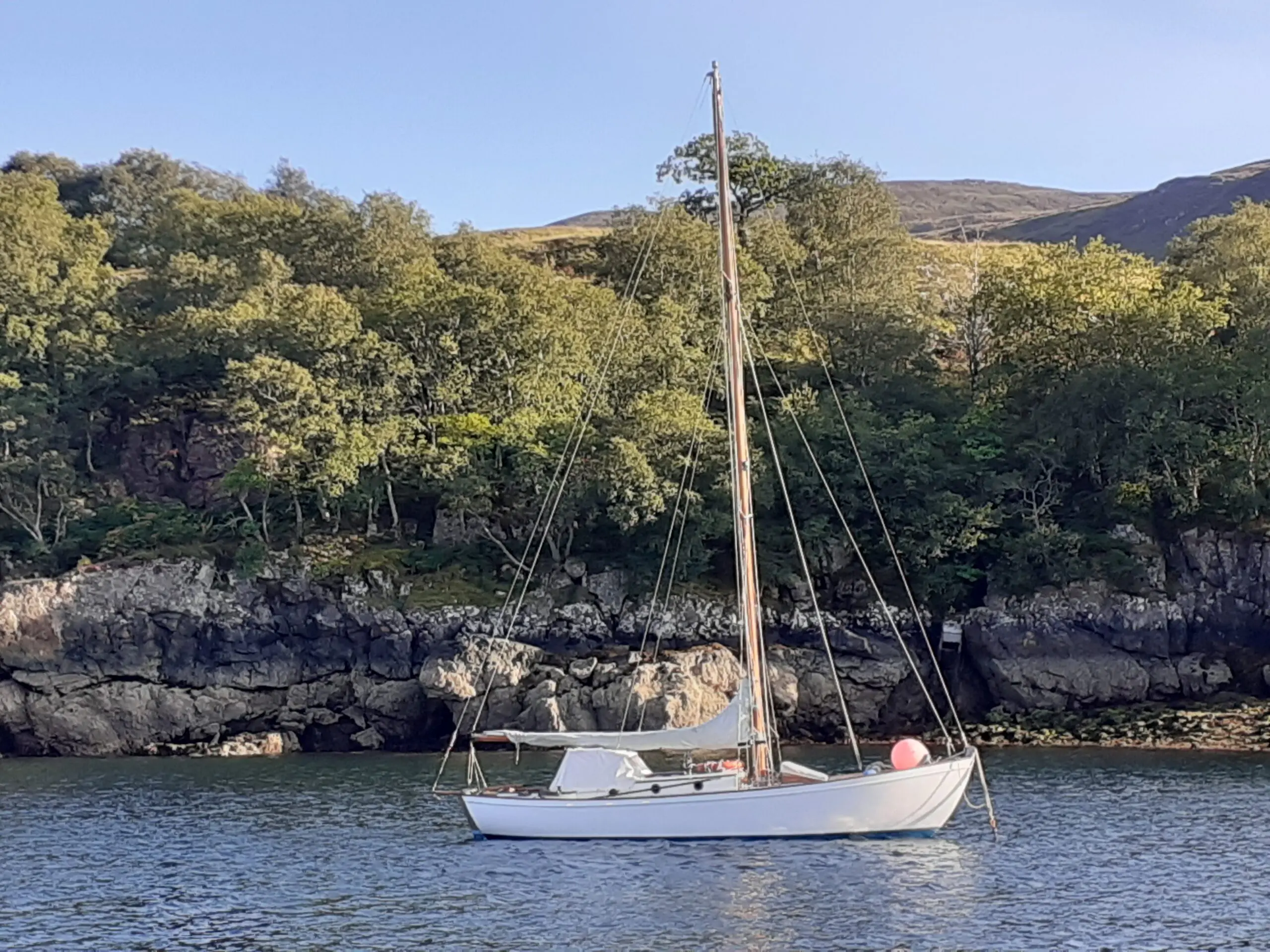
Sally‘s new home in the Highlands.
Since May Sally has lain to an orange mooring buoy in this sheltered bay on the south west side of Loch Broom. Birch trees and rowan line the low cliffs and the rocks at low water are covered in brown seaweed. The mussels that colonise the shore are big and make fine eating. The tender is pulled up in the shelter of an ancient dry stone wall made for just that purpose centuries, maybe millennia, ago. A boat-shaped enclosure, on which a double-ended fishing boat would have been laid, crumbles on top of a grassy mound. Sheep wander down to the water’s edge. From the shore a track leads up through the fields of wild flowers, over a burn, past a tumbled down croft and a farm yard where chickens wander freely. The anchorage is reputed to be one of the safest in the area, protected from the brutal south easterlies that hammer down the loch and the westerlies by the high hills above.
Sally shares the anchorage with two wooden Folkboats, an aluminium cruising yacht and a collection of fish farming launches. I have walked the ½ mile down from the road many times when the wind is tearing through the branches to find Sally lying in a slick of calm. The mooring cost £450 to buy and lay. That will be it until it’s time to haul and check the swivels. The nearest chandlery is 50 miles away in Inverness. It is, however, the biggest in Britain. Ullapool Boat Builders specialise in wooden boats. There’s a thriving sailing club.
In the first season since leaving the Clyde we have visited perhaps a dozen of the 162 islands described in Hamish Haswell-Smith’s definitive book Scottish Islands. From Tanera Mor to Scalpay, Sally has sailed perhaps 600 miles, and we are just beginning to feel qualified to make some generalisations about swapping the Western Approaches for the Isles of the West. So, aside from knowing the Solent intimately, sailing the West Country and Brittany she has now sailed the length, and nearly the breadth, of the West Coast of Scotland. In June we took her via the Summer Isles – Ullapool’s weekend archipelago – as far as Kylesku, a few miles shy of Cape Wrath. We saw three yachts. And in September we slipped across the Minch to the isle of Lewis, down the coast of Harris, via the Shiant Islands and several sea lochs, through the Sound of Harris to Taransay. We saw one yacht in 10 days. We were seldom out of oilskins.
The first generalisation is this: it is rarely T-shirt weather, even in mid-summer. Secondly, the further north you go, the fewer boats you see. Past Ardnamurchan Point and yachts thin out, marinas cease and there’s a sense of being on your own. Some harbours have a few pontoons – Lochinver, Stornoway – but mostly it’s a case of anchoring or trusting to a mooring buoy, some of which are laid by nearby hotels. We know of one man who spent 10 years living on a Rival 34 in these waters. ‘And what did you use as a main anchor?’ I asked. ‘A 50lb Bruce,’ was the answer. Ours is a 25lb CQR. ‘Get a bigger one,’ he advised.
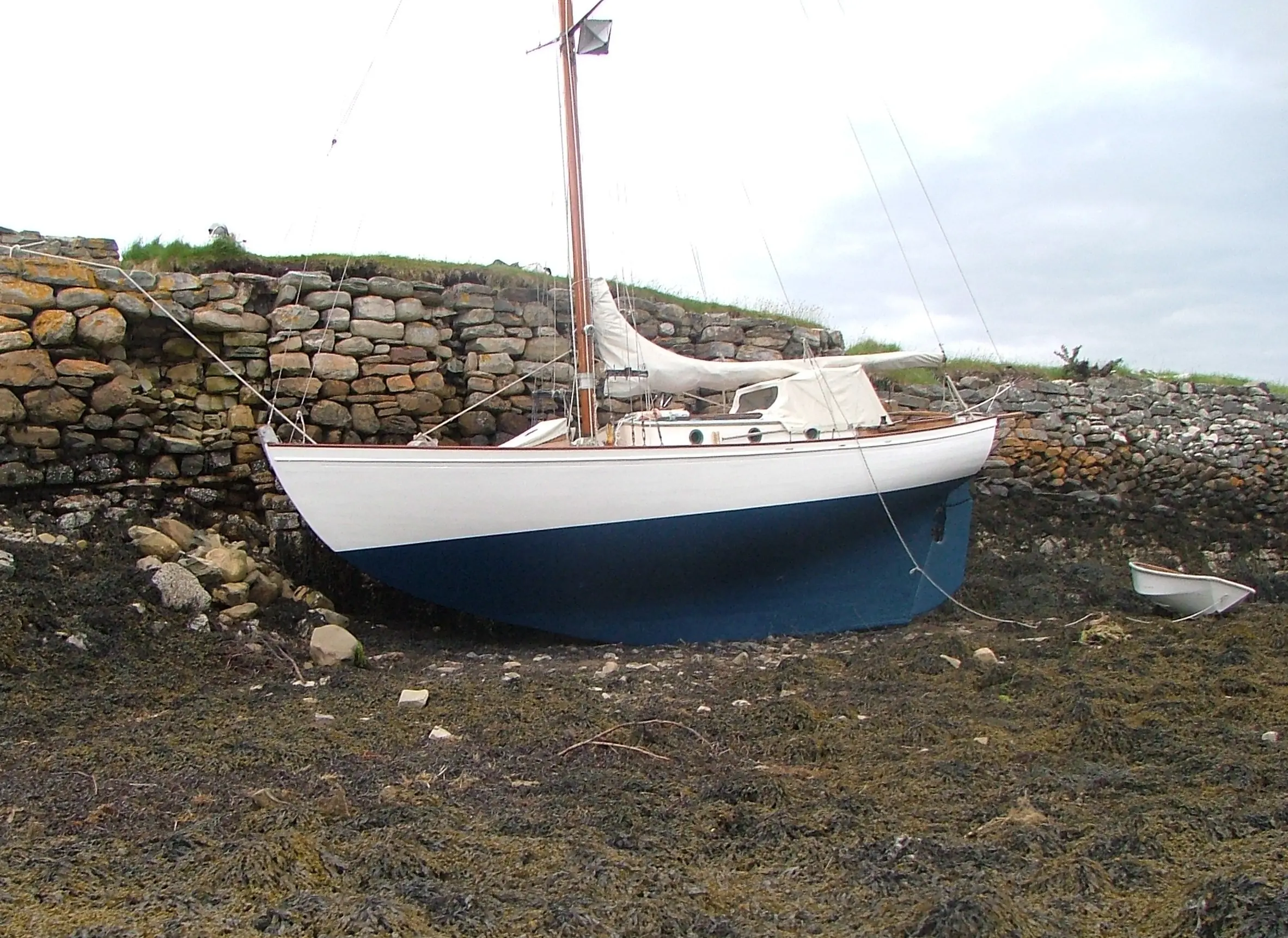
Highland ‘slipway’
The waters make for a self-sufficient breed of sailors who care little for the appearance of their topsides, cleanliness of their fender socks or depth of their gel coat scratches. They’d laugh at the notion of hosing down their boats with fresh water at the end of a day’s sailing or buffing up their stainless steel stanchions. In a short season – May to September, the best month’s being the former and latter – they pack it in as best they can, then haul them up the beach on makeshift trollies. Four local boats from Ullapool made it to St Kilda this year, four more to the Faeroes. A handful slipped through the Sound of Harris in July bound for the Monachs. The Western Approaches may feel the full force of the Atlantic, but once through the Sound of Harris, and with nothing but the lee shores of Lewis for shelter, it can feel very lonely out there in the big swells beyond the Outer Hebrides.
Our achievements have been modest in comparison. My attitude was best summed up by the owner of one of the Folkboats that share Sally’s Loggie Bay anchorage. ‘The trouble with you,’ he said ‘is that you miss all that South Coast yachtiness. All that socialising in crowded anchorages, with everyone pretending they’re on their own. All that “isn’t she a nice boat. What is she?” business.’
In a way he’s right. In all the anchorages we’ve so far dropped a hook, we’ve seen just one other cruising boat. We’ve had glorious sunsets, downed many whiskies, seen a party of stalkers bring a beast down to the shore at dusk, picked our way into wild places using cairns and cottages as transits, watched the seabed rise up to within inches of our keel through clear water and tasted silence. We have lain uneasily under the basalt cliffs of The Shiants, home to puffins and Britain’s only colony of black (plague) rats. We have sounded our way into lovely land-locked Rodel, with its ancient chapel and newly refurbished hotel.
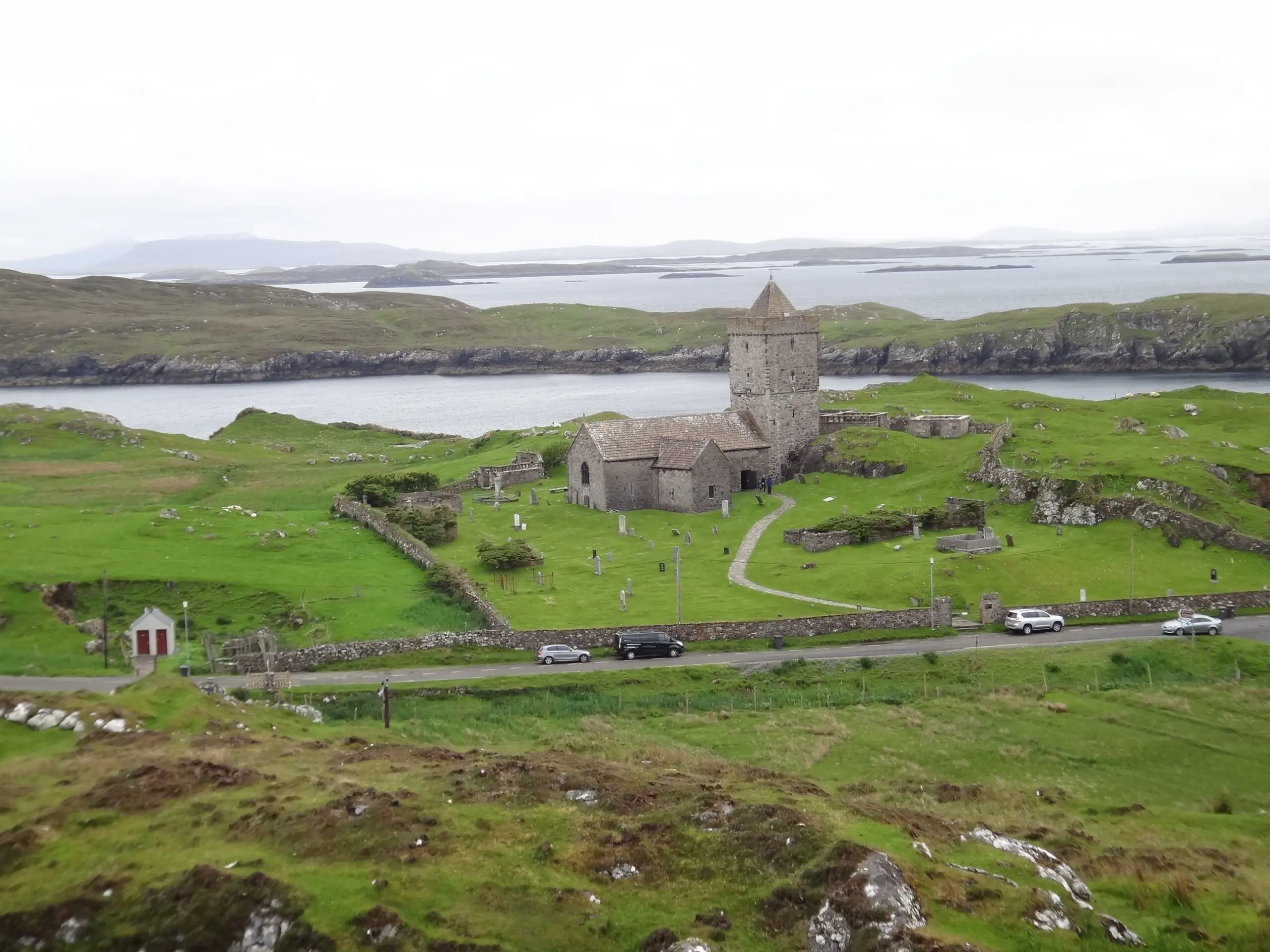
The ancient chapel of Rodel with the isles of the Sound of Harris beyond fading into the drizzle.
I have fished Loch an Duin on Taransay, Sally riding at anchor in the island’s perfect crescent-shaped sandy bay. A thousand more deserted anchorages lie unexplored, not all of them blighted by fish farms and infuriating electronic seal scarers; a thousand hillsides remain to climb; a thousand lochs in which to cast a fly. Then I can’t help feeling that once again we should turn Sally’s head south and find out what’s left of her old stamping ground.
______________________________
FLAME OF AVON
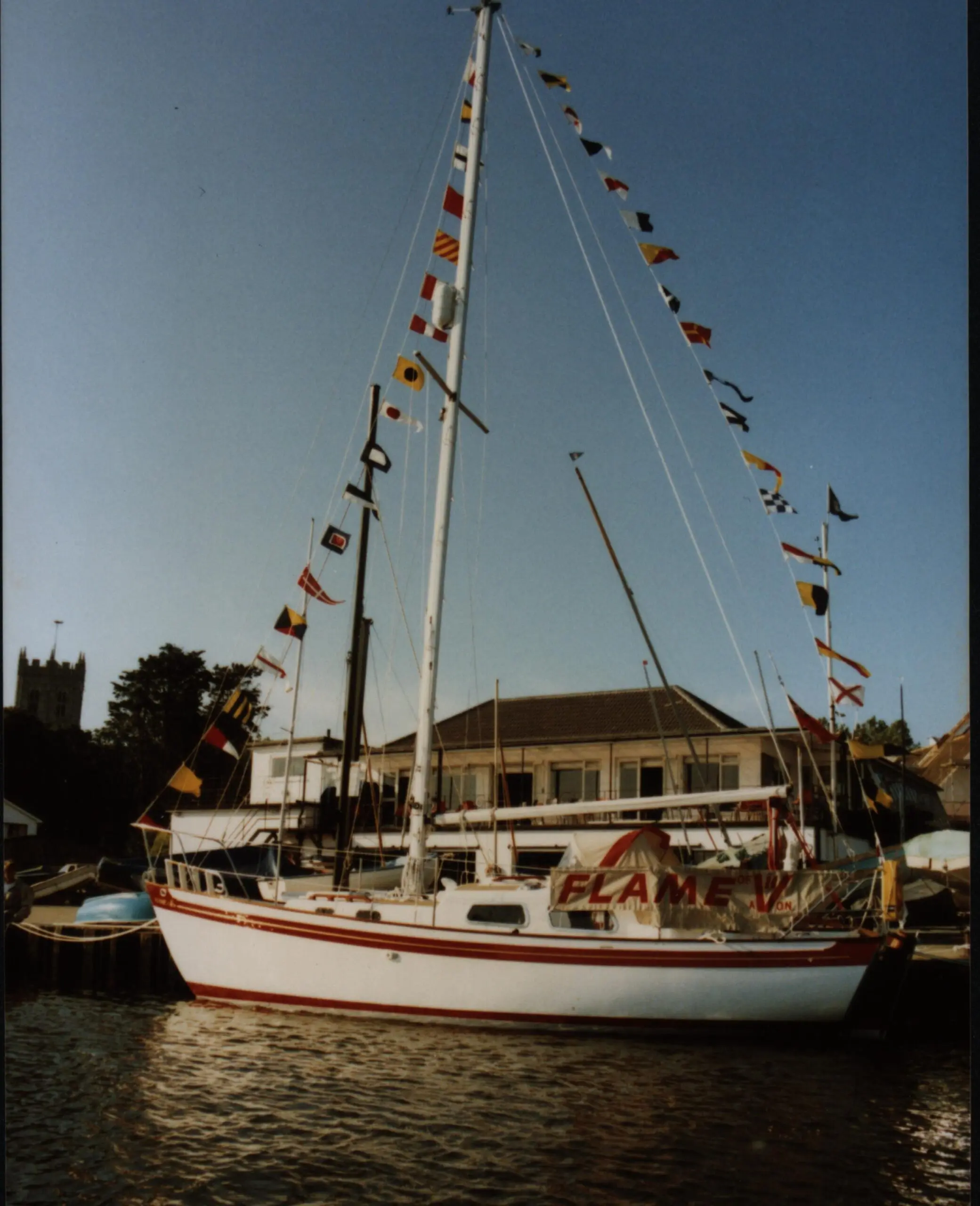
Flame of Avon VII 22 is launched. 22nd. June 1989
Gill and Geoff Fuller kindly sent some delightful photographs recently, and reminiscences of their time with Flame in the 1980’s and ’90’s. Gill wrote:
“My husband, Geoff and I purchased the full hull and deck mouldings from Bossoms in the late 1980’s and fitted her out at the premises of Robert Ives Mouldings in New Milton, Hampshire where Geoff was Development Foreman. He had served his boatbuilding apprenticeship at Elkins in Christchurch in the late 1950’s.”
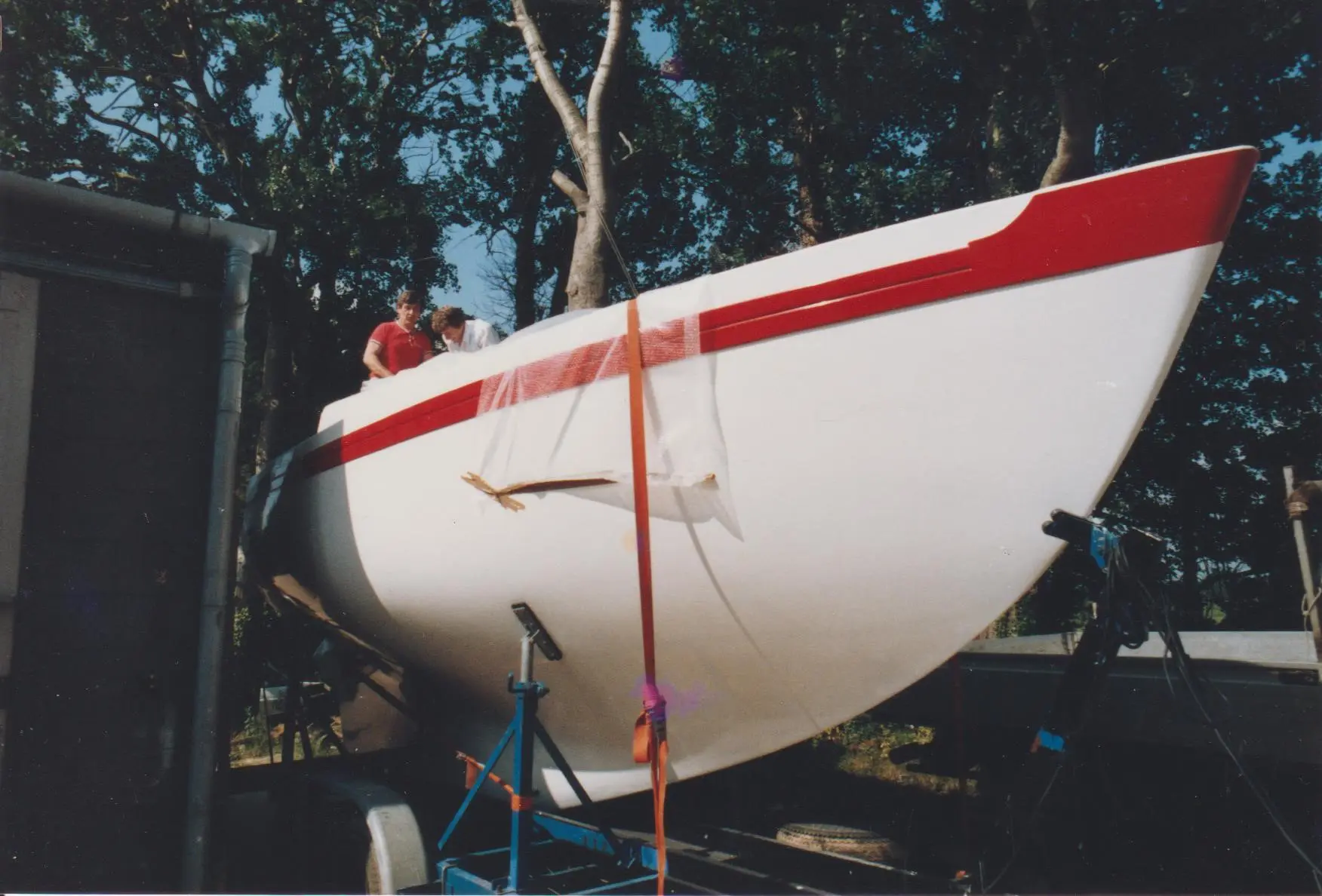
Flame being fitted out.
“In 1997 we left the UK aboard Flame and travelled through Belgium, Holland, France and Spain. Arriving in Menorca in 2000 we decided to settle there. In 2006 we sold Flame but lost track of her. We had heard that she went to Italy and would really like to find out where she is now.”
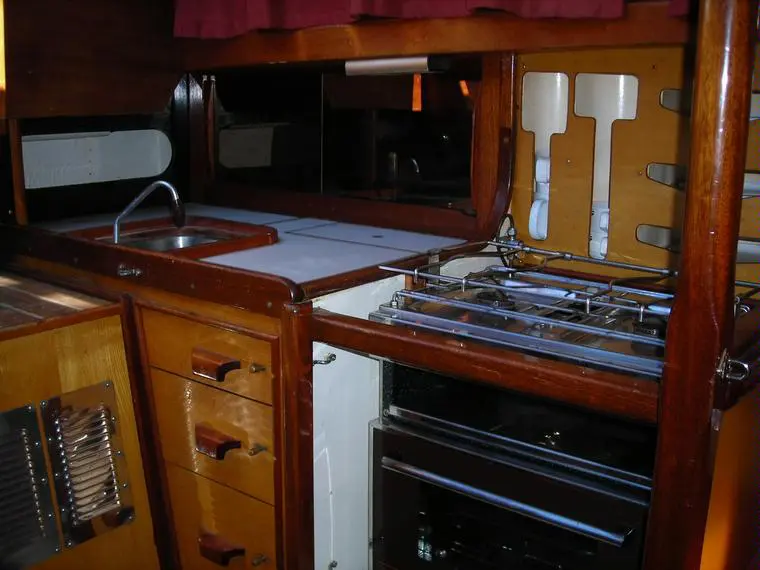
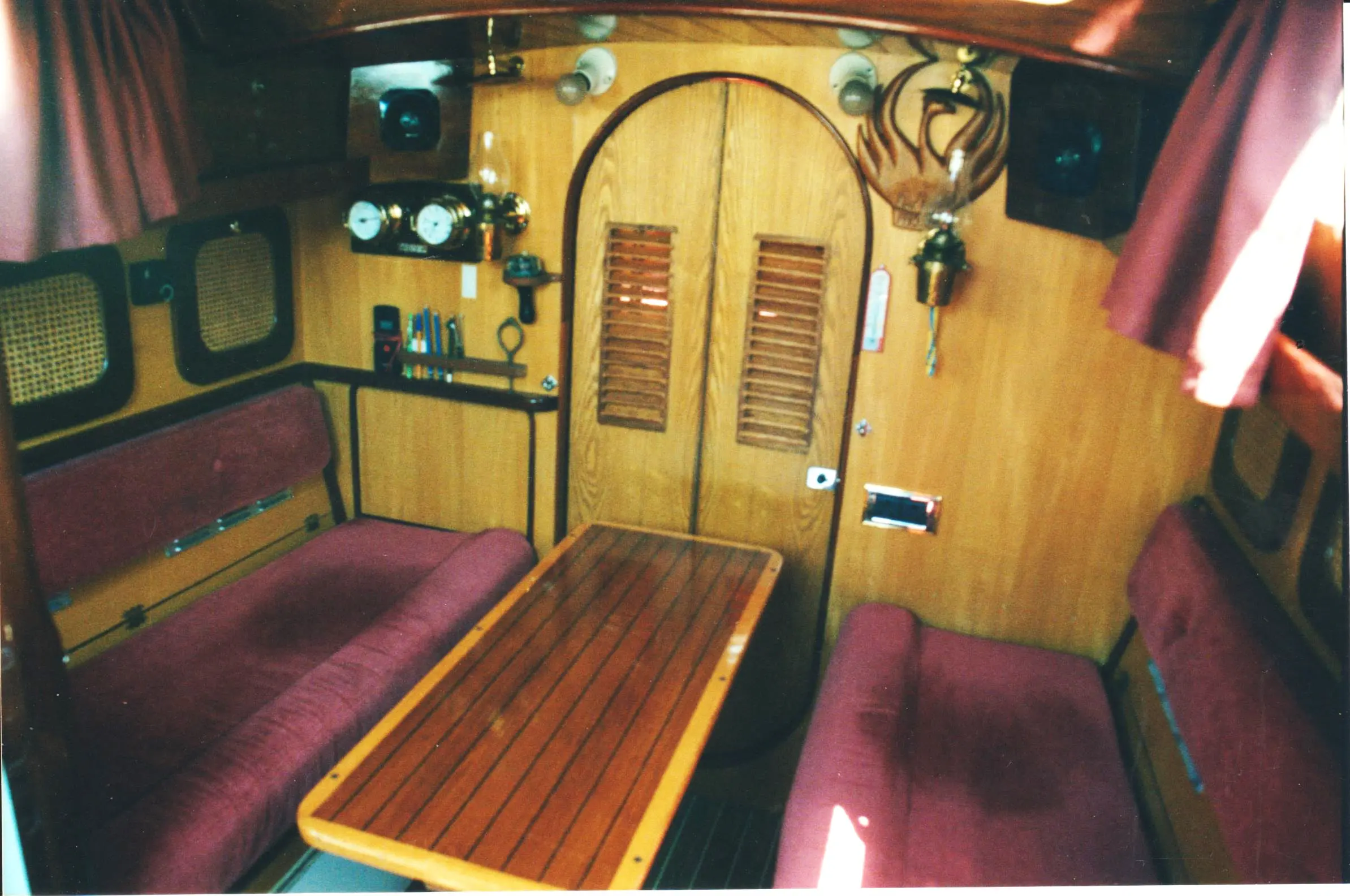
As can be seen from these photographs Flame‘s interior fit out was superb.
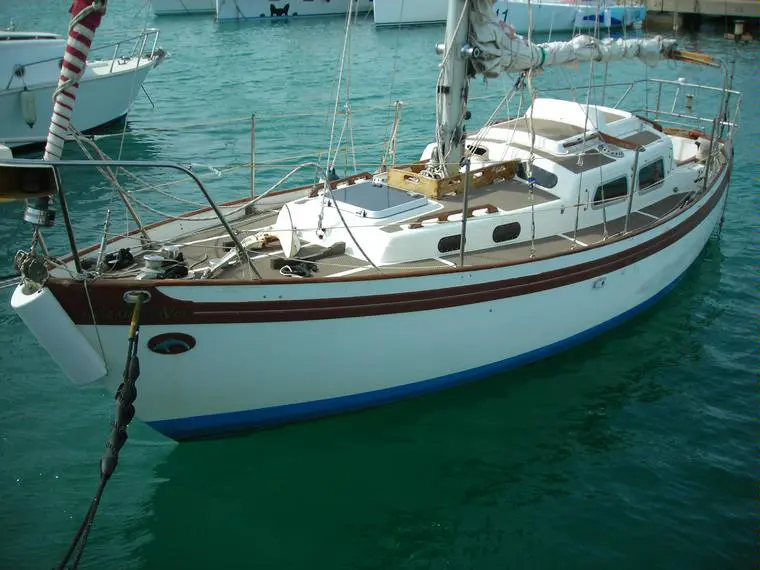
Flame looking very workmanlike moored in Italy a few years ago.
______________________________
Some more Lymington L News
from Joe Brummel
Comparison of the Ls and the Vertues shows a distinct change in length, beam and the ability to perform well in heavy seas – this is vindicated by the many voyages made by the latter, several having been published in books and magazines.
I shall start by writing about the boat that was the most difficult to trace and which subsequently became the one that I knew best.
I had arranged a meeting with Barry van Geffen, proprietor of Laurent Giles Ltd. During our discussion of Giles and his designs it struck me that Barry might rather talk about his own work and might resent the fame of his predecessor.
However, he was clear that there is a need for a book on Giles, adding that the family is not interested in the Master: I see that as a major handicap for anyone who took it on.
At a later meeting with Richard Gatehouse’s (Wavecrest 2) widow Penelope, I was given Richard’s notes. Well, I had been searching for Bonita L6 for a long while, she was the only gap in my survey, and I was about to learn what an Eureka moment is (I had to pause while consulting Lloyds Register of Yachts to see if any vessel had borne the name Eureka: in 1955 there is a Sprts’l Barge of 112 TM, Maldon built in 1981.)
So what Archimedian truth had I found?
Well, on page one of the notes was Bonita, neatly crossed through, and above that, elegantly written, Wavecrest ll – ah! Richard’s previous boat was . . . that’s right. (At which point I felt obliged to find out whether there had ever been a Bonita registered at Lloyds.) Surprise, surprise: Aux Ywl bt 1888, Similar 1890, BmSlp 1921,Bonita ll BmCut 1919, AuxKch 1932 – Bonita L6 was built in 1935 in Christchurch, three years before the ketch in Tiverton, Devon.
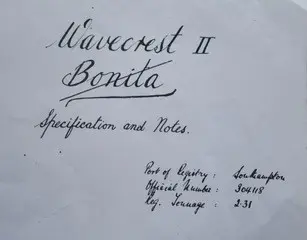
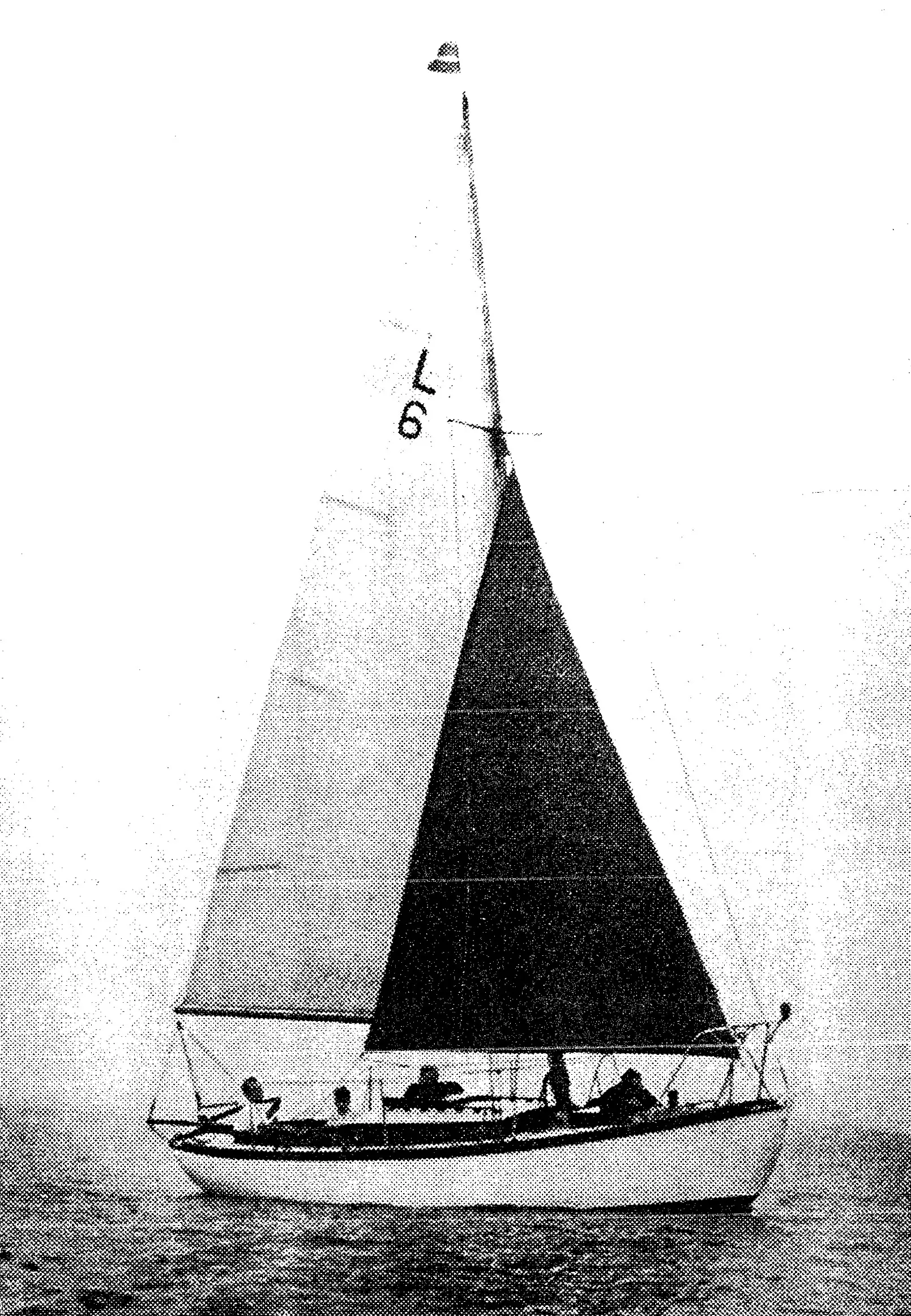
BONITA
A word to anyone planning a name change for anything: boat, house – even one’s surname: you may be about to change history or at least bewilder and antagonise the researcher.
So what did I discover on my only incursion into website chat? In July 2015 an email from Russell Thomas on Google said “I own Wavecrest although I have re-registered her back to her original name Bonita.”
OMG! I am sure you are right Russell, um, well, let’s just get on with the story.
Just before we do, there is an email below Russell’s from Keir MacNally – “I am the current owner of Skipjack L11 (built as Lympet) and I was given a list of owners by the previous owner.”
Well, there does seem to be a trend for original boat names.
A propos, in the intervening years Skipjack has been broken up, few details known but in a note to Martin Taylor (Saving Grace L15) Diggony Rose, Boatkeeper (not in this case) Portsmouth Naval Property Trust relates: “The keel has been scrapped and the fittings distributed already I am afraid . . .”
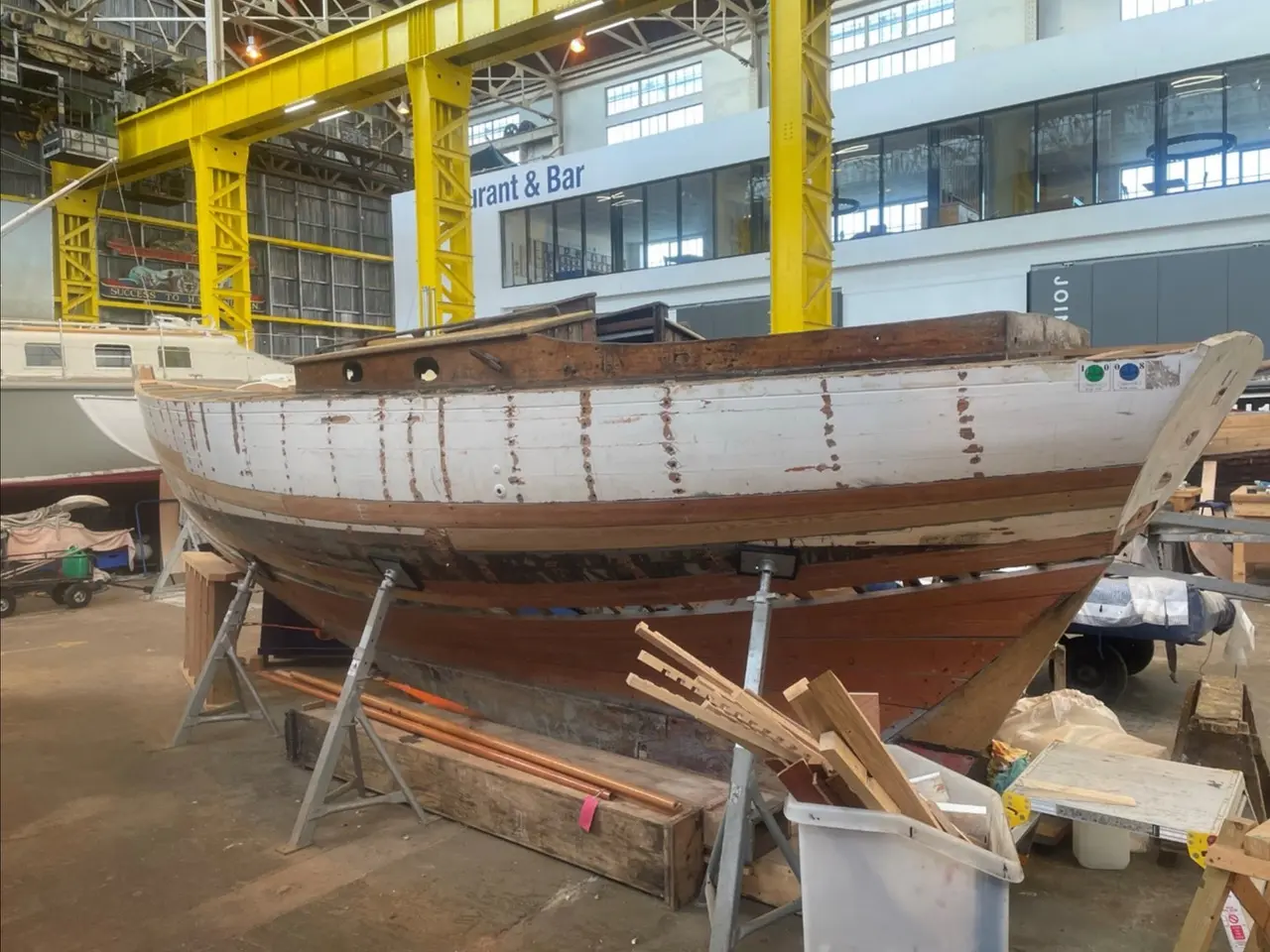
Skipjack being replanked.
Richard had bought Bonita in 1954 specifically to develop navigation equipment; she was more suited to the task than his 3-ton barge boat Wave Crest.
Electronic Engineering, June 1960, had printed “A Miniature Transistorized Echo Sounder” by RNB Gatehouse AMIEE, promoting “a very small and robust instrument …. for use in depths from 2.35ft to 32 fathoms.”

As to the suitability of L6 for the task, a bridgedeck was seen as important, providing an almost level surface to work on: it was noted that it was also a convenient table for wine bottle and glasses. And improved access to the engine.
However, sailing on the boat some 40 years later I found the companionway, difficult originally, even more so with that addition. The L-Class has a generous 6ft long cockpit, but Richard knew what he wanted and later owners could revert if they wished. It is not known what L6 had by way of an engine, but by 1998 a Dolphin had been fitted, a motor known by many if only on account of the need to switch off when changing gear – with no gearbox one had to switch batteries and re-start the engine – vision of boat closing rapidly with large iron buoy?
Richard begins his article “The principle of echo-sounding is well established, but equipment has been for larger boats and deeper seas;”
He developed Hecta “with a view to producing a ‘pocket-sized’ echo-sounder with a range of 30 fathoms that might be used in the smallest fishing boats, surveyors’ dories and sailing yachts.” Requirements included limiting power consumption to 0.1W which was achieved; knock and water proof casing. Optimism for success lay much in the capabilities of transistor circuits replacing the valves and barium titanate transducer.
There were many factors to consider: sea, noise, bottom echo, wave echoes; parameters had to be fixed for transmitted power, receiver gain &c. After considerable experiment the final specification included Maximum Range 32 fathoms over mud, power intake 0.1W at maximum range, accuracy +/- 3% or 6 ins in ambient temperature -20C and +60C. Hecta, and later Harrier, Homer and Heron, became very popular aboard yachts of all sizes.

Giles Bowen helming Wavecrest II
____________________________
MASTHEAD SLOOPS (and the ‘s……’ word)
Most Vertues are bermudan rigged as masthead sloops, although several have followed Andrillot’s original rig as a gaff cutter. There was also a drawing produced for a three-quarter sloop rig with jumper struts restraining the after pull of the standing backstay. However, I can’t recall ever having seen a photograph of this having been carried out, and I wonder if the idea was ever taken up.
As the design drawings of Andrillot and Eric Hiscock’s Wanderer II were being developed over the winter of 1935-36, both clients were still heavily influenced by their ‘working boats for cruising’ acquaintances. These fellow cruising men still distrusted the abilities of slender ‘bermudan’ masts, and the available mast track systems, to remain in place in heavy weather. They also had reservations about the performance of the bermudan mainsail on long ocean passages. However the writing was on the wall and ocean racers such as Dorade, Robert Clark’s Mystery and Giles’ larger ‘Vertue’ Kalliste were all demonstrating the seaworthiness of the rig. Giles’ astonishing Waipipi even had her mast stepped on the coachroof when launched in 1937. After Sally II that year, and the revised ‘class’ drawings for Monie the following winter, the ‘bermudan rigged’, masthead sloop configuration became the standard class option for nearly all future Vertues.
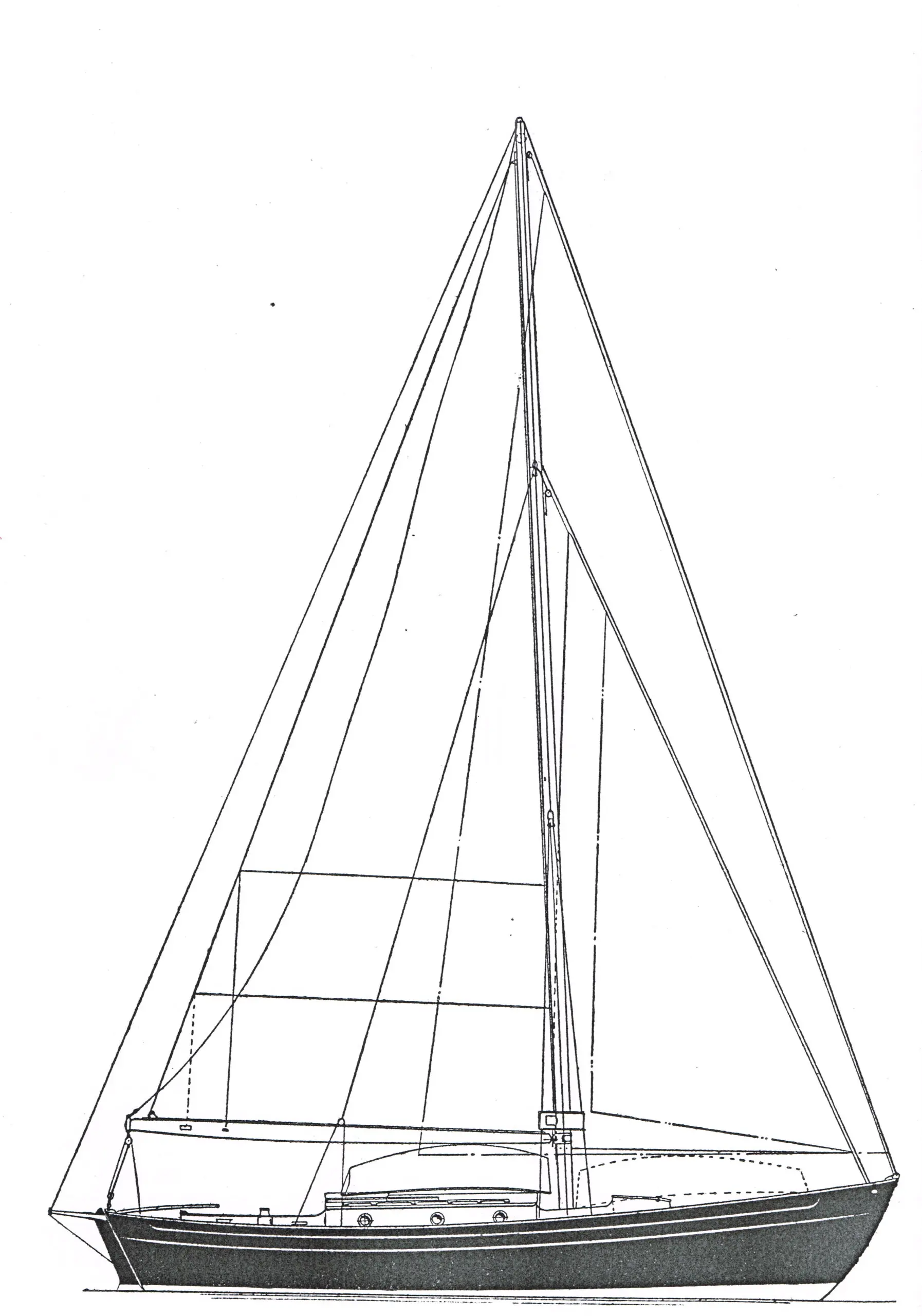
Monie V3 with her masthead sloop rig.
The beauty of this version of the masthead sloop as drawn, is that the masthead genoa jib can easily be replaced by a working stays’l when the wind pipes up and it’s just like changing gear. The heads’l is then not only smaller but also lower and its centre of effort is further aft, ready to balance the next gear change which might be to roll a reef into the mains’l.
So successful was this form of the masthead sloop that other classes such as the Brittanys, used it and even the diehard gaff-rigged adherent, Eric Hiscock had Wanderer III so rigged when she was launched in 1951. Whilst he rigged his new boat in the modern manner, I think he did so with some misgivings. Even after their first circumnavigation Eric wrote, in 1957, that if he and Susan were able to replace her with a larger vessel, they would rig her as a gaff cutter. (In actual fact they then completed a second circumnavigation and an Atlantic circuit before succumbing to the temptations of a much larger bermudan ketch, in Wanderer IV, complete with the romantic and practical ‘clipper’ bow that they admired so much).
Meanwhile the Giles practice were being driven to distraction by the ignorant use of the ‘slutter’ word to describe the rig by those who thought it somehow also enabled a pair of heads’ls to be set at once. Douglas Phillips-Birt was emphatically not one of these and his books and long-established column in the Yachting Monthly enabled him to gently impart a degree of wisdom into some of the seagoing debates of the time. In one of these ‘Reflections in the Sea’, he discussed the correct use of some seagoing terms then in use in 1954. The exercise ended in a state of exasperation, however. He wrote:
(‘As I finished writing the above, a letter arrived from Humphrey Barton:’
“Jack (Laurent Giles) and I beg you not to use the dreadful word slutter. Masthead sloop describes the rig exactly. Slutter should not be allowed to survive. Do help us to kill it”)
Today the nasty habit is still not completely dead, and I urge anyone reading this to respect the views of those who created the rig and to finally help us kill off once and for all the ghastly, lazy, use of that unacceptable, ugly word.
_______________________________
Now that I’ve got that off my chest it only remains for me to wish all readers of this latest Quarterly Newsletter “Fair winds and following seas!”
Roger
________________________________